With this update, ACI customers can increase their business agility through network automation capabilities, simplified management, and enhanced security. These features can be applied to any combination of workloads in containers, virtual machines, or bare-metal environments, both in on-premises data centers and private clouds.
Data centers are undergoing significant transitions. Despite the increasing complexity of data centers and multi-cloud environments, businesses must improve their speed, flexibility, security, and scalability. ACI 3.0 addresses these demands with innovative features, including:
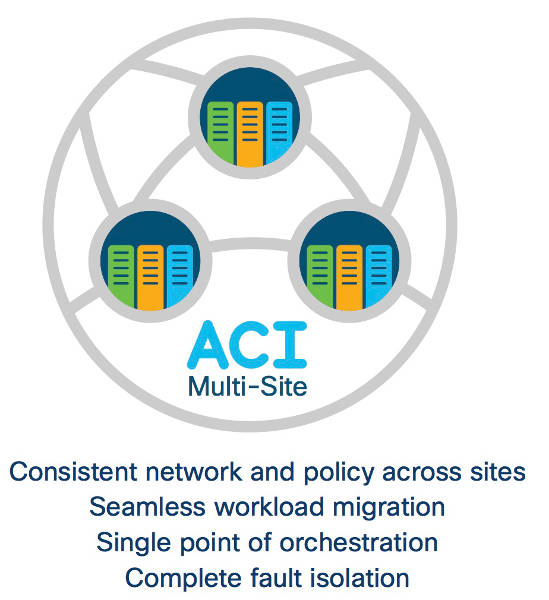
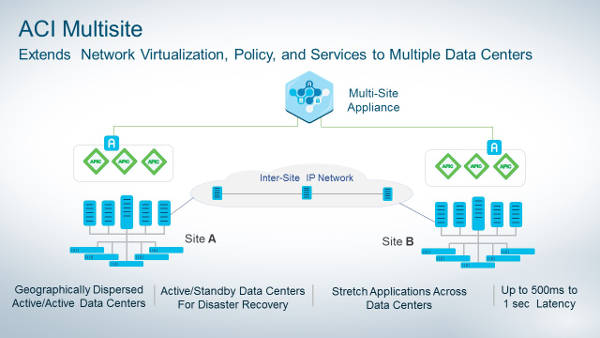 • Multi-site management: Enables easy connection and management of multiple geographically distributed ACI fabrics, improving availability by isolating failing domains and providing a global view of network policies through a single management portal. This greatly simplifies disaster recovery and the ability to scale applications horizontally.
• Kubernetes integration: Customers can deploy their workloads as containerized microservices, define network policies using this open-source system, and obtain unified network models for containers, virtual machines, and bare-metal environments. This capability brings to containers the deep level of integration that ACI has maintained with numerous hypervisors.
• Improved operational flexibility and visibility: The next-generation user interface simplifies the use of ACI with new, consistent templates, topology views, and troubleshooting wizards. In addition, ACI now includes enhanced insert and delete capabilities, support for mixed operating systems and quota management, as well as latency measurement across fabric terminals for troubleshooting.
• Security: ACI 3.0 strengthens network protection by mitigating IP/MAC spoofing attacks with the integration of First Hop Security, automatically authenticating in-band workloads and placing them in verified security groups, as well as facilitating granular policy enforcement for terminals integrated into the same security group.