Along with the increasing need for higher transmission speeds, the demands for advanced data centers are limited by rising energy costs, the need for efficient equipment temperature control, available space, and environmental concerns.
Eventually, the growing bandwidth demands will require migration beyond 10G to 40G and ultimately to 100G.
In its latest report, “Market Size for 10G/40G/100G and Its Forecast,” Infonetics, a market research firm, notes that the 10G market is booming and will continue to grow in the medium term, “40G is advancing rapidly, and 100G should start soon and take off before 2013.” Infonetics
’ research forecasts a compound annual growth rate (CAGR) of 59% between 2007 and 2011 for all businesses related to 40G and its service delivery equipment.
IEEE Proposals for 40G and 100G Standards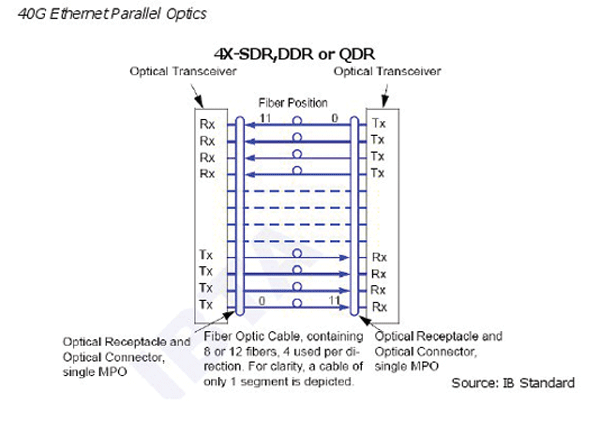 In an effort to address these needs, the Institute of Electrical and Electronics Engineers (IEEE) established a dedicated working group (802.3ba) in January 2008 to develop a standard for Ethernet solutions using next-generation 40G and 100G data rates. The 40G component is expected to support an immediate need in the data center market, while 100G is anticipated to meet the needs of high-performance computing, network aggregation, core switching, and routing applications.
The Project Target Authorization Request (PAR) currently includes a target for multi-mode fiber over distances of at least 100 meters over OM3 fiber. At a second meeting in May 2008, the IEEE 802.3ba working group adopted several recommendations to lay the groundwork for the initial draft of the 40G and 100G standards. The working group chose parallel optics as the basis for the new standard, which it expects to finalize by mid-2010. Standards generally tend to lead sales for three years, so sales to early adopters can be expected in the second half of 2013. Considering that a typical structured cabling system can be fully utilized for fifteen to twenty years, it makes strategic and financial sense to consider deploying 40/100G networks now.
The latest structured cabling standard for data centers, EN 50173-5, requires that all cabling follow a centralized architecture, with cabling originating from the local distribution point (equipment closet) and returning to a central main distributor (potentially via a zone distributor). 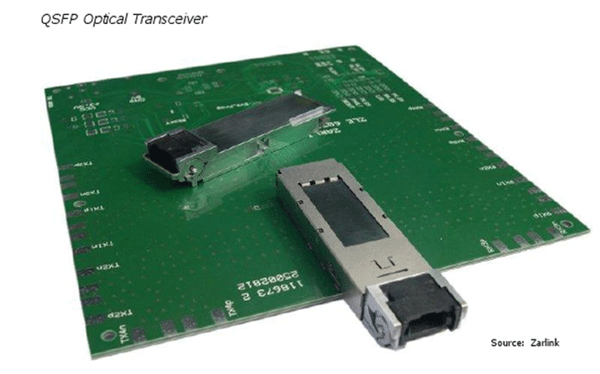 The fiber cabling deployed must be at least OM3 grade, and connectivity must be established using LC duplex connectors or high-density MTP or MPO connectors. Combining the requirements of EN 50173-5 with the IEEE 802.3ab proposal to ensure a smooth transition from 10G to 40G and eventually 100G can only be achieved by deploying a structured cabling system that utilizes high-density MTP connectivity between the main distributor and the local distribution point. This would allow the deployment of a 10G system today using MTP (Micro-Polymer Cable) LC duplex modules and a subsequent transition to 40G and 100G using 12-fiber MTP connectivity without the need to reinstall new cabling. Migration from 10G to 40G and 100G Ethernet data transmission speeds can only be achieved with the development and implementation of structured cabling systems based on: (1) high-bandwidth, 50µm laser-optimized multimode optical fiber; (2) high-density modular connectivity; and (3) parallel optical transmission. Only such a system can provide the reliability, manageability, flexibility, and scalability necessary to ensure a smooth migration path to increased transmission speeds.
OM3 optical fiber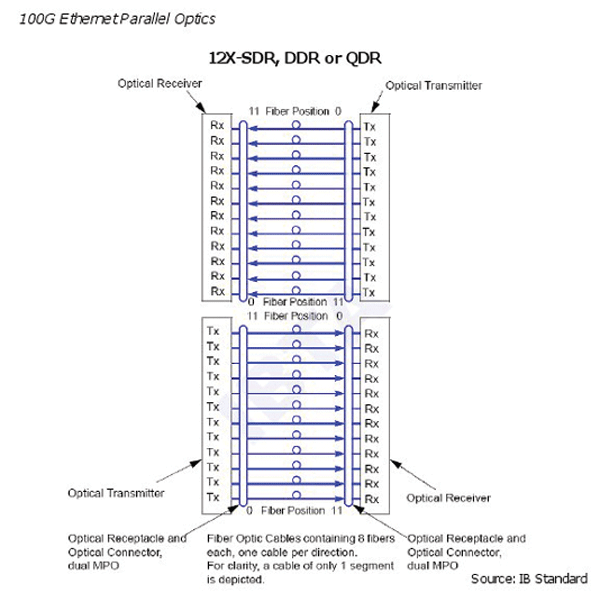 is the minimum fiber grade currently being discussed by the IEEE 802.3ab working group for 40G or 100G transmissions. With a 50mm core and a refractive index profile optimized for use with 850nm VCSEL lasers, OM3 fibers can achieve distances of up to 300m for 10G transmissions and a target of 100m for 40G and 100G. Initial tests have shown that distances of approximately 150m can be achieved with OM3 fibers at bandwidths of 2000MHz.km. If high-performance OM3 fibers with bandwidths exceeding 4700MHz.km are used, it is thought that achievable lengths will exceed 250m at 100G transmission speeds.
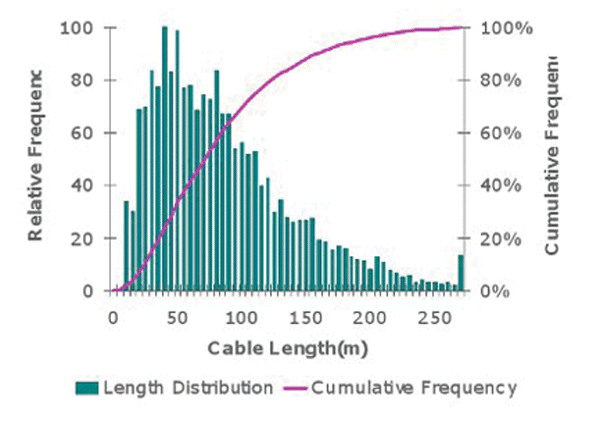
A recent study on cable coupling lengths in data centers found that a 100m distance covers almost 70% of all data center cable lengths, and 250m would cover approximately 99% of all couplings. There are currently no discussions or proposals within the IEEE 802.3ae working group for the use of lower-quality OM1 or OM2 fibers, as their structure and bandwidth would be prohibitively long. Therefore, if a cabling system is to be able to cope with the next generation of technology, deploying at least high-quality OM3 fiber is essential.
 40G and 100G Transmission Proposals
The IEEE 802.3ae working group is currently looking at three transmission protocols to achieve 100G transmission:
• MMF OM3 Parallel Space Division Multiplexing (SDM).
• MMF OM3 2 Wavelength Course Wavelength Division Multiplexing (CWDM).
• SMF OS2 10 Wavelength Course Wavelength Division Multiplexing (CWDM).
The first method will use low-cost VCSEL lasers to transmit ten discrete 10G signals in parallel over ten separate fibers and then recombine them at the coupling end. This approach has many advantages, starting with the fact that it is the cheapest device and the least expensive to drive and cool the lasers. The second method will transmit two 10G wavelengths from five fibers, giving a total transmission of 100G. This method will use more expensive wavelength division multiplexing (WDM) technology and requires more discrete lasers to achieve the same 100G transmission. The third method will transmit ten 10G wavelengths from a single fiber, giving a total transmission of 100G. This method will use single-mode laser technology and the much more expensive wavelength division multiplexing. It is estimated that Method 2 at 100m offers approximately 50% gain over Method 1, and Method 3 offers approximately 100% gain. Therefore, the winning technology is expected to utilize parallel transmissions over multimode fiber. Transmitting parallel signals over multiple fibers is not a new technology; Infiniband transmissions, which used 4, 8, and 12 fibers, have been in existence since 1999, primarily deployed in high-performance computing and server clusters. These transmission devices all utilize the MTP/MPO connector interface and have VCSEL transmitters in the same space as the fibers within the MTP/MPO connector.
High-Density, Modular Connectivity: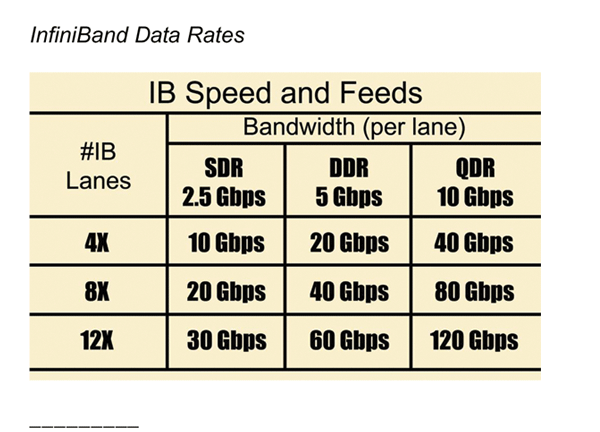 In addition to operational requirements, the selection of physical connectivity also plays a dominant role in providing a migration path for structured cabling deployments to support parallel optical architectures. Within this framework, the preferred option is high-density, factory-terminated MTP/MPO optical networks—OM3-based optical networks including trunk assemblies, unlocking modules, and unlocking harnesses. MTP/MPO trunk assemblies can not only save up to 80% of installation time compared to traditional optical solutions, but more importantly, they offer the flexibility to transmit serial and parallel signals. MTP-based connectivity is also a critical factor. MTP/MPO connectors represent a robust and mature technology capable of supporting 40/100G transmissions. The same applies to the recently developed Quad Pluggable Transmitter (QSFP), a high-density parallel optical module with a 12-fiber interface connector, the result of a joint effort by several telecommunications companies to define a highly integrated, 4-channel optical transmitter standard.
QSFP Optical Transmitter:
Despite the proven reliability and robustness of the connector for handling next-generation data transmission speeds, issues such as the total connector loss budget allocated for 40/100G and the maximum allowable angle index need to be efficiently managed for optimal parallel optical systems. To minimize the effect of total connector loss, manufacturers strive to develop sophisticated factory polishing systems to ensure the highest accuracy and tightest alignment necessary for optimal performance under given mechanical and environmental conditions. However, without industry standards, each cable assembler's polishing system varies, resulting in different finish geometries.
Although the IEEE 802.3ba working group has not yet established a standard for optical skew positioning for 40/100G applications (it is currently under discussion but a final decision has not yet been made), the optical skew index is a factor of paramount importance for parallel optical transmissions. Skewness can be defined as the difference in time of flight between light signals traveling in different fibers. Transmission failures in the form of latency and bit error rates are likely to occur if the skewness index is too high—that is, if there is a considerable delay between the fastest and slowest optical pulses. In the absence of standards, the skewness criteria of the 12X-QDR InfiniBand cable have emerged as the benchmark metric for skew performance at 40/100G speeds. 12X-QDR InfiniBand is a protocol using parallel optical transmission where 12 fibers transmit 10G and 12 fibers receive 10G, for a total data transmission rate of 120G – it is precisely this design that makes it comparable to the next-generation 40G.
The 12X-QDR InfiniBand specification requires a maximum 0.75ns angularity in the cabling system, including optical fiber and MTP/MPO connectors. Optical cable architectures that meet the 12X-QDR InfiniBand cable angularity requirements are considered future-proof, as they are capable of providing a smooth migration to 40/100G parallel optical transmissions.
OM4 Proposal:
The International Organization for Standardization (ISO) and the International Technical Commission on Electricity (IEC), through one of their joint working groups (ISO/IEC JTC1 SC25 WG3), proposed the standardization of high-bandwidth multimode fiber in early 2008. The new provisional fiber category was named OM4 and is intended to support 40/100G Ethernet solutions. The performance level specifications are significantly higher than those of standard OM3: more than double the bandwidth, greater operating distance, and lower system implementation costs (fewer parallel optical fibers required).
OM4 was expected to be standardized in late 2009 or early 2010.