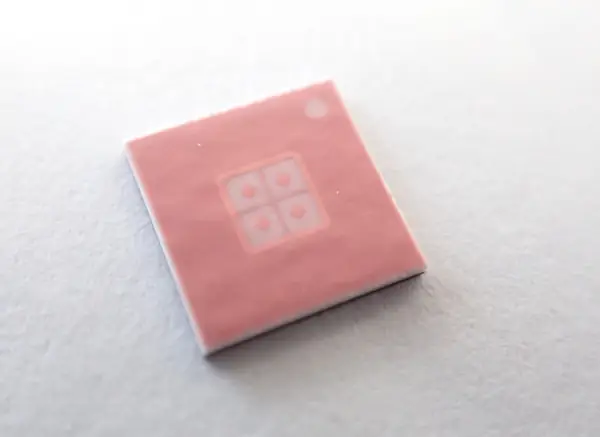
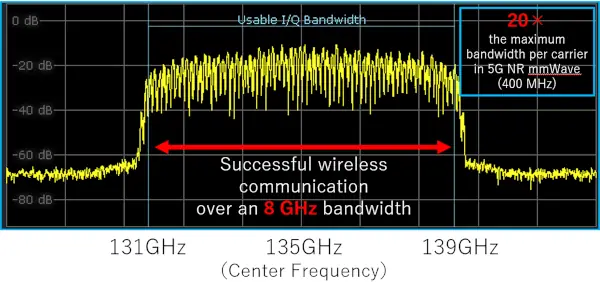
The module has demonstrated its ability to establish wireless communications at 135 GHz, transmit signals with bandwidths of up to 8 GHz, and control the orientation of the beams in two dimensions, both during transmission and reception.
According to Murata, this is the first antenna module based on LTCC technology that combines D-band operation and two-dimensional beam control in both directions of communication.
Communications above 100 GHz for future 6G systems:
The increasing volume of data generated by applications such as physical artificial intelligence (Physical AI) and digital twins is driving demand for faster, higher-capacity wireless communications. To meet these needs, frequencies above 100 GHz are being investigated as part of the development of future 6G systems. These bands offer the possibility of using bandwidths of several gigahertz, compared to the limitations of obtaining additional spectrum in mobile bands that already share space with other wireless services. However, operating at such high frequencies presents design challenges. The short wavelengths mean that small variations in connections or component placement can affect communication performance. Therefore, it is necessary to integrate antennas and radio frequency circuitry with high precision and maintain dimensions suitable for installation in equipment.
LTCC Technology and Imec Beamforming Circuit:
To develop the module, Murata used its Low Temperature Co-fired Ceramics (LTCC) technology and a D-band compatible beamforming integrated circuit developed by imec. The solution integrates the antennas, high-frequency circuitry, and connections necessary to transmit, receive, and control wireless signals. The integrated circuit manages signals from multiple antennas to orient the radio beam toward the target device. Two-dimensional control allows for horizontal and vertical beam direction adjustment, a capability designed to help maintain communication quality.
Ceramic Materials to Reduce Signal Loss:
Murata has developed ceramic materials specifically for this application, optimized for low dielectric constant and reduced dielectric losses. These characteristics limit signal loss at frequencies above 100 GHz. The company has also applied its high-frequency design and packaging technologies to precisely and compactly integrate the integrated circuit, antennas, and RF connections. This combination addresses the assembly requirements of the D-band and results in a high-density integration module suitable for mounting on equipment.
Applications in 6G communications and sub-terahertz sensing:
The results obtained demonstrate the feasibility of combining multi-gigahertz bandwidths and two-dimensional beamforming in antenna modules intended for future wireless systems. In addition to 6G communications, Murata envisions potential applications in sub-terahertz radars and Integrated Sensing and Communication (ISAC) systems. This latter technology would allow the use of a single wireless system to provide connectivity and detect environmental features, such as the position and movement of objects.
Murata plans to begin commercialization by 2030.
After demonstrating the module's capabilities, Murata will continue developing the technology with a view to its practical application and subsequent large-scale production. The company will leverage its experience in the mass production of LTCC components to advance this process. The stated goal is to begin commercialization by 2030, although development is still in the research and preparation phase for practical implementation.