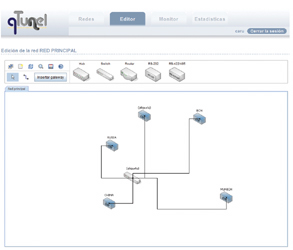
qTunel stands out because it proposes a solution that seems utopian or technologically distant to many professionals who have an idea of what M2M is or can become. qTunel offers a much simpler definition of M2M than the one initially considered standard, and this definition is accepted once its functionality is verified. It's very simple: just imagine that everything you want to interconnect is within the same space, and you have as many cables, switches, and routers as you want
to design your interconnections.
m2m
(Machine to Machine) - Quoted from Wikipedia: “M2M (Machine to Machine) is a generic concept that indicates the exchange of information in data format between two remote machines.”
Do we really know what it is?
We'll likely find many different definitions for M2M, which coincide in some aspects and differ in others, often depending on the target market segment or application.
It's precisely in this disparity of meanings that we find evidence that it's a still-expanding technology, whose definition is sometimes built on "what it's capable of doing" rather than "what or how it does it." There's no doubt that definitions of "mobile telephony" or "the Internet" are much more established.
M2M isn't exactly new; since the mid-20th century, there's been a need to connect machines. However, emerging technologies now allow us to tackle new solutions that, just a few years ago, seemed unfeasible due to cost or complexity.
Thanks to this, the M2M communications market is in a favorable environment, giving rise to a large number of very different solutions that attempt to meet specific needs in specific ways. That is, through vertical applications tailored to a particular need.
 Key Points of an M2M Project
: Security: First and foremost. When establishing communication between remote points belonging to any organization, production process, or administrative process, the first requirement to consider is security. This involves transmitting high-value data, so many existing M2M products must include software for their specific encryption and security systems.
Adaptability: Since the applications of M2M systems are countless, there must be systems specifically designed to meet the communication needs of vehicle fleets, vending machines, or extensive irrigation system deployments. All of these solutions are tailored to specific sectors and basically consist of two interdependent parts: a communications component and specific management software.
Availability: Depending on what is to be interconnected, signal range and coverage (if using mobile phone technologies) must be checked. Based on the technical requirements, the next step is to choose a communication channel and the operator that offers the best guarantees.
Infrastructure: Equally important is the quantity and diversity of elements that need to be connected. Accurate forecasting of the number and nature of the devices, as well as the quantity and type of data to be sent, will be vital. And of course, forecasting the speed and extent to which this infrastructure can grow is also crucial. This aspect must be carefully planned so that the communications system doesn't become inadequate too soon, nor is it oversized from the outset relative to the specific requirements.
Interoperability: The transmitted data is often used by different systems and must be accessible from various departments, companies, and services. Access protocols must be adapted to the different management and operational models, and the necessary applications must be developed to serve all participants.
qTunel's unique vision
: These key points must be considered when designing any machine-to-machine communication infrastructure, but it's easy to see that each key point we choose to focus on impacts the system's reliability and cost. Developing vertical or specialized applications narrows the target market, affecting the return on investment or leading to solutions that, for
their viability, don't consider
every aspect in sufficient depth.
The original idea behind qTunel's development is to offer a horizontal solution or platform that can address the widest range of applications, providing a high-performance, high-quality technological solution at a much lower cost and on a "pay-per-use" basis. This reduces both operating and maintenance costs, as well as initial infrastructure costs.
qTunel customers simply contract for connectivity. qTunel doesn't provide networks, cabling, installations, or even applications or software.
qTunel emulates virtual cables. In this way, the customer can provide connectivity to all their devices, locations, etc. as if it could have all its remote elements on a table.
qTunel relies on the internet as both its medium and a means of reaching any point to connect.
Key Points of qTunnel
Security: qTunnel emulates a cable. Any interconnected devices will interpret the connections as physical links to communication cables. It is physically impossible to attack the cable itself. Any intrusion threatens the devices, not the cable. Since qTunnel operates as a local network, any antivirus, firewall, or encryption system the client would use on a LAN will continue to function through qTunnel.
Adaptability: qTunnel isn't adaptable… qTunnel is compatible. Any network design that can be created with cables is ready to work with qTunnel. Because qTunnel is neither software nor a protocol, it hasn't been custom-designed for anything. On the contrary, its absolute transparency allows data from any software or protocol that the devices have been using, whether independently or physically connected, to be communicated. In other words, any custom application or security system the client has will continue to function through qTunnel. qTunel is a communications service, nothing more.
Availability: Absolute. qTunel exists and reaches anywhere thanks to the internet. The client only contracts connectivity. They don't contract for equipment, antennas, ADSL, or mobile lines from a particular network. qTunel is a service that allows you to integrate any device into your network, wherever it is, without worrying about how to reach it. Again, the device (or headquarters, or production plant, etc.) will be seen by the other elements as just another component of your installation or LAN. By using the internet, qTunel can utilize the connection available at the remote location, or if none exists, it can provide one wherever needed. To achieve this, it has agreements with the main operators to combine the infrastructures of ADSL, GPRS, UMTS, and satellite technologies, and even complements resources from several communications operators simultaneously to achieve redundant connections. This is why qTunel can guarantee connectivity from any point, anywhere.
Infrastructure: qTunel doesn't rely on any fixed or custom infrastructure. qTunel is scalable. qTunel users have powerful connection management tools at their disposal, such as web configuration. Using simple web utilities within the qTunel system, users can monitor all aspects of their connections and create any network design they can imagine between their devices, virtually incorporating switches, routers, and other elements. This makes doubling the number of connections or eliminating connection points as simple as qTunel providing the user with those connection points, which they then link as needed by simply drawing lines to them in the web configuration interface. Again, just as if you had all the elements you want to interconnect on your desk, along with all the cables and resources you need, qTunel allows you to easily and transparently reach any remote device.
Interoperability: qTunel does not affect the nature of the data being transmitted. Therefore, information transferred by users can continue to be used by different departments or services without needing to adapt any procedures or transactions. qTunel is inherently interoperable.
In short, qTunel is a system that enables M2M communications. Simply put, and thanks to its simplicity and, above all, its transparency and security, qTunel transports end-to-end connections using the internet as a medium. For this reason, qTunel functions as a vast network of virtual cables capable of extending a connection point to any location.
 From the user's perspective, what is qTunel?
 qTunel consists of Plug & Play gateways, a user password for the configuration/monitoring system, and a monthly fee.
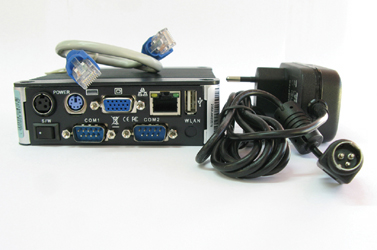
Each Plug & Play gateway provides a connection point. These are hand-sized hardware devices with internet connectivity provided by qTunel through a combination of technologies, depending on the operating environment. The gateways must be connected to the device they will provide the connection to, whether it's a computer, a PLC, an I/O device, or a switch (router) if interconnecting an entire office network, etc. Gateways included in the same contract, upon activation, authenticate to the system and establish completely transparent connections according to the predefined virtual connection configuration.
From a PC connected to the internet, the user can design their desired network among all the devices connected to the Plug & Play gateways.
From a systems perspective, what is qTunel?
The qTunel platform, along with gateway devices that connect to the physical layers, offers a set of services and links that securely and transparently manage the connection for point-to-point and virtual network connections. This is achieved using ADSL, GPRS, UMTS, and other technologies (to be added in the future) based on existing fixed/mobile operator infrastructure. qTunel
is essentially a comprehensive communications layer platform capable of automatically associating links between devices connected via the global Internet and/or GSM network. This association is performed independently of the logical protocol layers and operators involved, moving these associations to a virtual connectivity layer that enables point-to-point or network communication, with the ability to create topologies according to the needs of each application.
The system is transparent to the physical channels used by the devices, so that through system gateways, users will see their equipment connected in a manner analogous to a hardware connection via the gateways incorporated into the platform.
qTunel manages and controls communications so that links are maintained or restored automatically without any intervention from the users' end applications. The use of redundant servers with a very high degree of availability, along with the possibility of using redundant gateways with dual operators, allows for a level of availability comparable to, and even exceeding, that of wired or fiber optic links, with much more elastic and secure performance than applications using proprietary radio links.
The gateways are small devices configured to provide connected machines with access to the virtual interconnection system, performing encapsulation operations, automatic connection to the gateway servers, and adaptation between the different physical channels used.
The platform/gateway assembly is perceived by connected devices as a physical cable interconnection network or link. To achieve this functionality, the software platform includes a virtual link controller, "qTunel."
qTunel provides the system with all the necessary network and connection implementation devices, as well as application maintenance tools (GUI), enabling the configuration of topologies for each application.
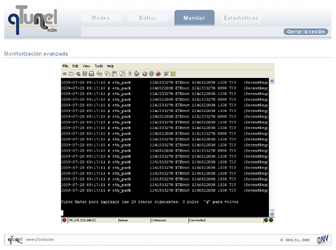
qTunel also incorporates monitoring and alarm detection mechanisms for the entire system, automatically executing backup protocols between servers and/or telephone operators. Any system failure allows for the generation of alerts that can be sent to or viewed by users via SMS, email, or a web server.
Furthermore, it features a service layer overlaid on the link layer, enabling the system to offer value-added utilities at the ISP level. These utilities can include services such as web access, databases, data hosting, or proprietary applications developed to meet specific needs.
For remote endpoints, a set of gateways is available that facilitate the connection between the customer's physical links and the transport layer used (gsm/gprs, umts, adsl, wireless, ethernet or satellite).
The gateways automatically negotiate a connection to the system with the qTunnel servers.
The connection is established using a proprietary IP address resolution/translation protocol, PDHCP/NAT, allowing links to be established over third-party ISP services with dynamic IP internet connections and, where applicable, encapsulation over other transport mechanisms such as GPRS, SMS, MMS, etc., all while remaining completely transparent to the user's applications. The transport mechanism is configured according to the bandwidth requirements, power consumption of the remote points, and other specific characteristics of each application. These devices are perceived by the user's machines as connectors between their systems, just as a physical connection would exist, and are entirely transparent to their applications and equipment. The QTUNEL/GATEWAY platform as a whole results in a true machine-to-machine (TM2M) connection or a virtual pseudo-wire (VPW) connection.
Gateways enable the virtual transport of RS-232/422/485, Ethernet, digital I/O, and analog I/O connections, allowing for LAN applications, data capture, monitoring, and automation using machines completely independent of the qTunel interconnection service.
Logically, gateways are divided into two parts. The first module performs automatic linking and connection negotiation via a GPRS/UMTS or Ethernet service. The second module has an output that allows client equipment to connect and establish remote connections for:
- RS-232/422/485.
- Digital inputs/outputs.
- Analog inputs/outputs.
- Ethernet.
The system as a whole offers an application with various software and hardware devices that provide the service with the following virtual communication channels:
- Ethernet-based local area networks (private IP range).
- UDP/TCP communications over Ethernet (private IP range).
- Point-to-point RS-232 connections.
- RS-422/485 bus connections (ModBus).
- Point-to-point connections for analog/digital inputs and outputs.