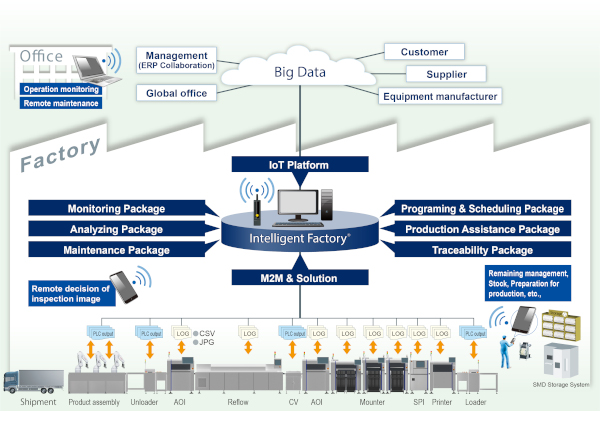
Yamaha Motor embraced this trend in a timely manner and developed the "Intelligent Factory," an Internet of Things (IoT)/machine-to-machine (M2M) integration system (Fig. 1) utilizing the latest technologies. For the implementation of Intelligent Factory, Yamaha Motor proposes a practical four-step process (Fig. 2). First, in Steps 1 and 2, the company focuses on and actively promotes the automation and labor savings of the surface-mount technology (SMT) line based on M2M connectivity.
 In this process, Yamaha has facilitated mutual cooperation, not only between Yamaha's SMT machines but also with machines from other companies. In fact, the company already has a track record of installing numerous production lines of this type.
As a practical problem involving M2M links between machines from different manufacturers with varying development approaches and business scales, there is a large amount of proprietary information that cannot be mutually disclosed. Therefore, information exchange is practically limited to standard basic information, such as board IDs and bad notes. Furthermore, it is considerably difficult for manufacturers with different resources and circumstances to develop software simultaneously for mutual cooperation. Therefore, there is naturally a limit to the synergistic effects that can be achieved through cooperation.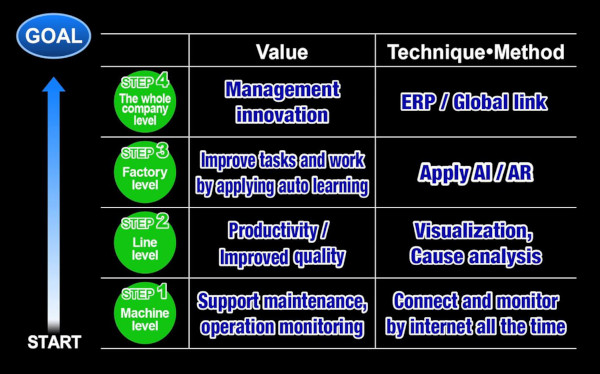
1 STOP SOLUTION
To achieve advanced M2M connectivity that overcomes these limitations, Yamaha Motor vigorously promotes "1 STOP SOLUTION," the company's original concept. It uses only Yamaha products to link intelligent SMT machines and software to maximize synergistic effects.
Yamaha Motor already has a complete line of core machines on an assembly line: surface mount device (SMD) storage systems, printers, dispensers, screen printing inspection (SPI) machines, assembly lines, and automated optical inspection (AOI) systems. Connecting each machine on an assembly line comprising these Yamaha products via advanced M2M connectivity—without a black box—in a "smart factory" maximizes the effects of machine-software cooperation. Therefore, a highly efficient assembly line can be achieved through true total management.
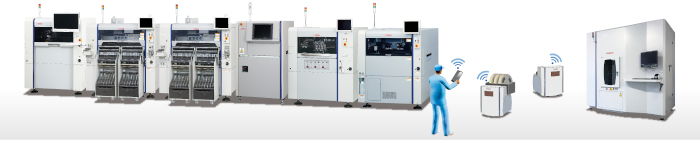 Figure 3 shows an example of a complete Yamaha SMT line through "1 STOP SOLUTION".
Some functions through M2M connectivity between machines include:
1) Transfer of instructions from the production plan or ID information from the plate read by the machine at startup, between machines allows production change and automatic configuration changes on the entire line without requiring special skills;
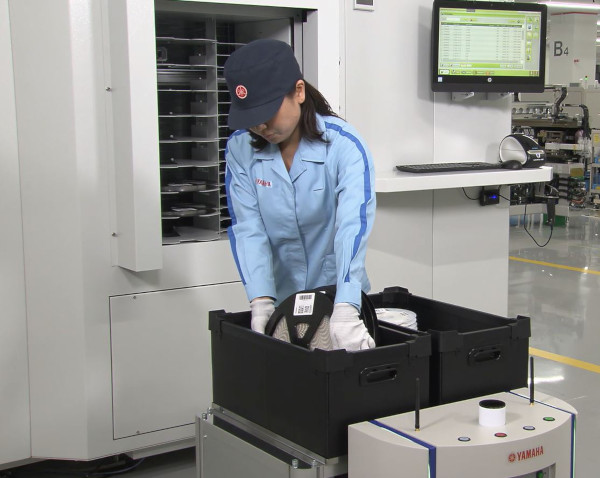
 2) Upon receiving information about the production change, the components are delivered from the SMD storage system and transferred to arbitrary configuration change locations specified via the link, using the automated guided vehicle (AGV) to reduce the operator's workload (Photo 1);
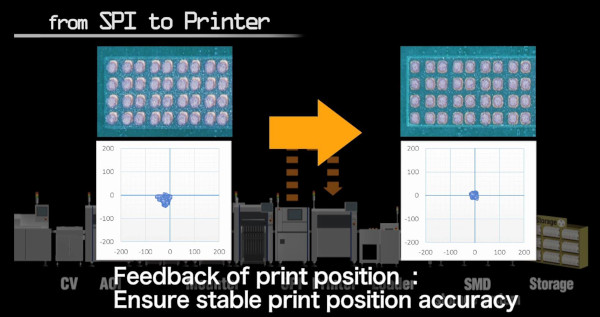
3) Feedback from the SPI print position to the solder paste printer ensures stable print position accuracy (Fig. 4);
4) The advancement of the bad SPI brand to the assembler reduces the loss of communication time (Fig. 5);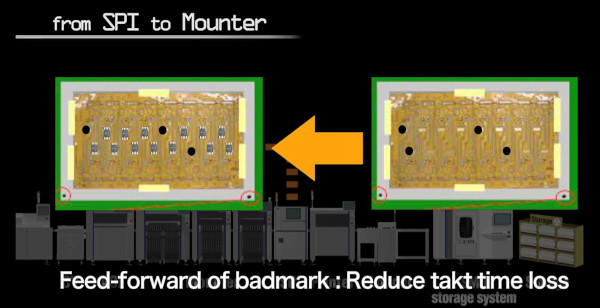
5) The components that need to be supplied are reported from the assembler to the SMD storage system at the necessary time, in order of precedence, to automatically deliver the necessary quantities of components and supply them at the same time;
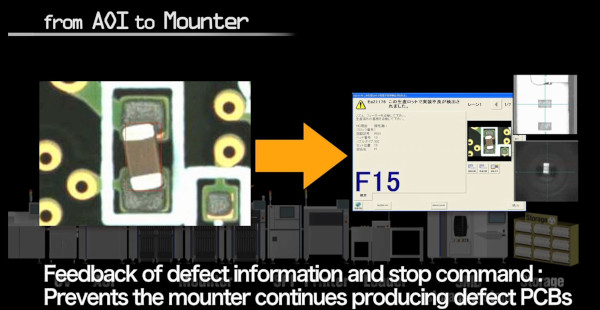 6) Feedback of the defect information and the AOI stop command instruction to the assembler prevents the assembler from continuing to produce defective PCBs (Fig. 6);
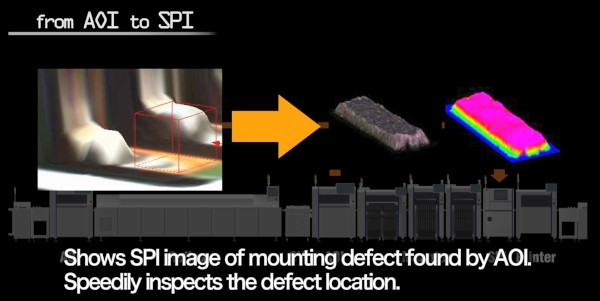
7) The SPI image of the assembly defect found by AOI is displayed instantly and at the same time all related images, such as those of the printer and the assembler, are displayed to quickly determine the cause of the defect (Fig. 7).
Future efforts
Based on the previous examples, advanced M2M through "1 STOP SOLUTION" enables a variety of mutual cooperation functions and results in reduced working time, labor and human errors, and improved quality through the rapid implementation of defect countermeasures, enhancing the capabilities of the entire assembly line and improving overall efficiency.
In addition to the examples described above, Yamaha Motor also offers several unique, mutually beneficial connectivity features for Yamaha machines. Furthermore, Yamaha is committed to developing more advanced connectivity features in stages to improve the overall efficiency of SMT factories.