In these dual-input (analog and digital) TVs, a critical factor is having a switching component that operates across the entire wide bandwidth and provides excellent linearity and isolation (both when connected to power and when not) to minimize signal impact on the tuner(s). In the past, achieving maximum isolation and linearity was achieved using mechanical relays or multiple solid-state switches. Engineers at Peregrine Semiconductor (San Diego, California) have recently applied the company's proprietary UltraCMOS™ technology to develop the PE42750 75W single-pole double-row (SPDT) solid-state RF switch (Figure 1), which delivers the broadband performance of a mechanical relay in a solid-state device. The new device also leverages the company's proprietary HaRP technology for low-power operation (typical supply current of 8µA from +3VDC at 25°C).
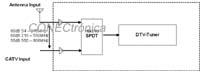
 Among the advantages of this type of solid-state switch for dual TV designs are its competitive cost, increased reliability, smaller footprint, and ease of implementation. The PE42750 switch operates between 5 and 2200 MHz and is targeted at broadband applications such as CATV, digital television (DTV), multi-tuner digital video recorders (DVRs), set-top boxes (STBs), PC TVs, and game consoles. And unlike GaAs-based solid-state RF switches targeting this market, the UltraCMOS PE42750 ensures excellent isolation even when the system is unpowered.
UltraCMOS is a patented silicon-on-sapphire (SOS) technology that is inherently well-suited to providing high levels of linearity and isolation. Because sapphire is a fully dielectric substrate that isolates each transistor, it eliminates parasitic drain capacitance and offers better isolation between circuit elements. Furthermore, because there are no variable voltage capacitances or parasitic diodes at the junctions, SOS enables good linearity and high isolation.
Linearity
indicates how well a device maintains signal integrity or how much distortion is added to the signal. To meet performance specifications in an RF signal chain and ensure an undistorted image, high linearity is required for all components in the tuner's signal path, including the switches. Linearity is especially important in applications with a crowded spectrum, such as CATV, because nonlinearity at any frequency will generate harmonics. In a densely populated spectrum, any harmonic will occur above another channel, canceling the signal and degrading or completely eliminating the image. In an SPDT switch, linearity can be measured at the second-order input intercept point (IIP2). The PE42750 SPDT switch, for example, offers +100dBm of IIP2, which is 10dB better than a comparable device, the M/A COM GaAs SPDT MASW-00801 pHEMT switch (source: M/A COM datasheet http://www.macomtech.com/datasheets/MASW-008801.pdf).
Isolation:
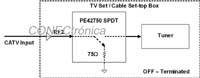
The other key specification for a CATV SPFT switch is isolation. Modern televisions have multiple tuners and signal inputs, necessitating high input and output isolation to prevent signal degradation and poor signal quality. As televisions become smaller and more complex, printed circuit boards are denser, making isolation more challenging. This necessitates switches with higher isolation levels that maintain a high level of isolation even when power is disconnected. In the US, this issue led the FCC to develop a spectral mask requirement (Part 15.115) for isolation, and the PE42750 is designed to meet all these isolation requirements, offering 80dB of isolation between 54-216MHz; 60dB of isolation between 216-550MHz; and 55dB of isolation between 550-806MHz. The PE42750 is designed to prevent CATV leakage through the antenna, even when power is disconnected, as all ports on the switch are terminated when not powered (see Figure 2). SPDT switches from other manufacturers do not guarantee continued isolation when the system is unpowered. Expressed as RFC-to-RFX isolation (preventing inter-channel interference), the PE42750 exhibits better isolation than approximately 10 dB compared to the comparable GaAs device, which offers
Environmentally Friendly:
In addition to its superior performance, the PE42750 RF switch offers one of the lowest current draws, with a typical value of 8µA from a 3VDC source. This is a significant advantage as consumer electronics designers strive to reduce the traditional power consumption of televisions. Furthermore, because it is manufactured using the UltraCMOS process instead of GaAs, the PE42750 SPDT switch offers inherent advantages in terms of ESD resistance, improving its robustness during manufacturing and consumer use. For example, the PE42750 incorporates 2kV HMB and 1kV CDM ESD protection on all ports, while a comparable GaAs device such as the M/A COM MASW-00801 specifies an ESD rating of
Designers of cable television (CATV), digital and PC television (DTV/PCTV) systems, multi-tuner digital video recorders (DVRs), set-top boxes (STBs), and game consoles who select devices for the RF signal chain can greatly benefit from the performance and reliability offered by UltraCMOS switches.
Author:
Peregrine Semiconductor