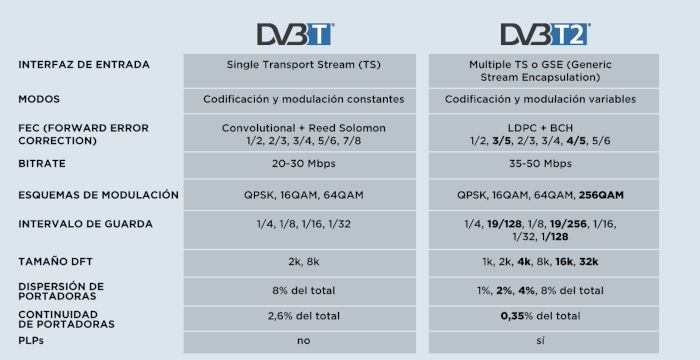
This change is justified by the need to transmit signals with much higher definition, which we call UHD-4K, and which have a much higher information content than HD signals. It's important to remember that we must use the same spectrum that remains after the successive cuts implemented by the Government through the first and second Digital Dividends.
Thanks to this more efficient use of the spectrum, we will be welcoming three new UHD channels in the coming months.
What technical changes do the three new UHD channels bring?
To fit these signals within current multiplexes, we need more efficient modulation that can transmit the image to televisions with guaranteed quality. This is what DVB-T2 achieves: an efficiency improvement of around 50%.
There is a very important digital television measurement called bitrate (which, of course, is provided by PROMAX meters). This measurement tells us the number of bits per second being transmitted by a channel and by a multiplex as a whole. DVB-T multiplexes have a fixed bandwidth of 8 MHz, allowing for rates of 19.6 Mbps, while with DVB-T2 modulation we reach 50 Mbps.
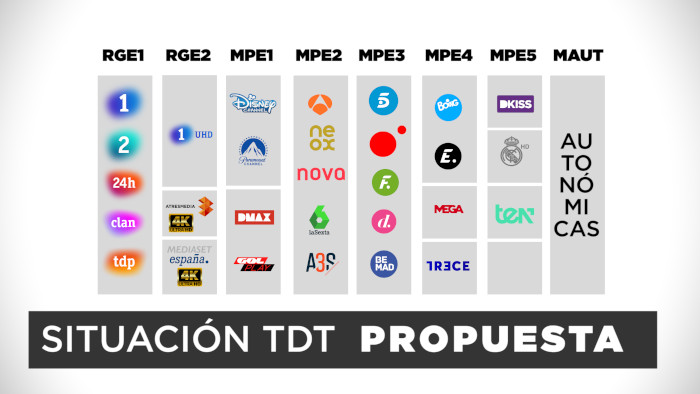
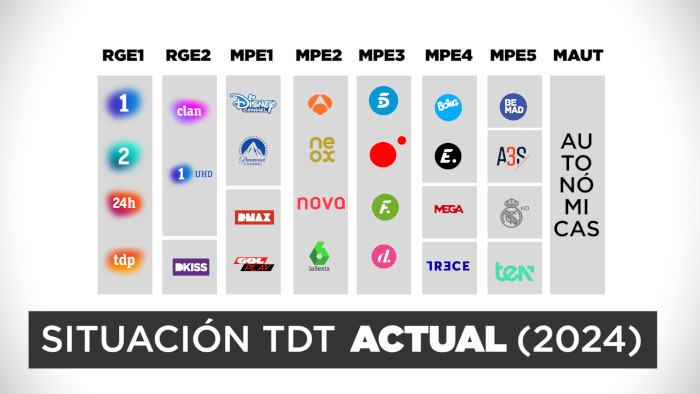
During the transition from DVB-T to DVB-T2, we will encounter all kinds of signals. A very colorful mix...
• HD signals modulated in DVB-T.
• UHD-4K signals modulated in DVB-T.
• HD signals modulated in DVB-T2.
• UHD-4K signals modulated in DVB-T2.
How does the transition from DVB-T to DVB-T2 affect the end user?
The roadmap for the transition from DVB-T to DVB-T2 will include phases in which signals will be simulcast to ensure everyone can watch television during the transition. This means the same signal will be broadcast in both DVB-T and DVB-T2 for those without DVB-T2 receivers, and the transmission of HD and UHD-4K information will likely be duplicated for those without UHD-4K televisions.
TVs larger than 32 inches sold from March 2020 onwards were required to include DVB-T2 demodulation. The number of TVs with UHD-4K resolution has been increasing in recent years, so every day more televisions are equipped to receive second-generation digital television in UHD-4K.
At the end of the transition, only UHD-4K signals modulated in DVB-T2 will remain on the air
Viewers with a television of this type will only need to retune their set to watch channels in UHD-4K quality. However, they may not have information about whether the signal is received via DVB-T or DVB-T2.
Those users who do not have a UHD-4K television will also have to retune because the channels will have changed location and with different groupings in each MUX, but for a while they will be able to see the signals in HD definition.
At the end of the transition, only UHD-4K signals modulated in DVB-T2 will remain on the air.
How does the transition from DVB-T to DVB-T2 and from HD to UHD-4K affect our field strength meter?
As we've mentioned, the spectrum of any antenna, in any province of Spain, will vary. Even if the channels themselves don't change, their content will be very different from what it is now. The different signals we've already described will be present, and the installer must be able to identify and differentiate them in order to act accordingly. If the meter isn't capable of doing this, it won't work.
First, the meter must be able to distinguish between DVB-T (current) and DVB-T2 (immediate future) modulations and perform the corresponding measurements by automatically adjusting its internal parameters to measure those specific signals without having to worry about making adjustments to the instrument.
Secondly, and equally important, you must distinguish between HD and UHD-4K resolution. This information is vital to assure the customer that they will see high-quality images of any type.

PROMAX field meters, starting with the RANGER range, automatically detect and demodulate any DVB-T and/or DVB-T2 signal by pre-adjusting the equipment to perform the necessary measurements.
Similarly, the RANGER Neo range of meters, including the most basic model (RANGER Eco), differentiate between HD and UHD-4K signals to provide information about their resolution and bitrate. Depending on the model, they may also display the image in different ways.
It's important to note that bitrate is a measurement provided by all PROMAX meters and indicates the amount of data each channel's service is carrying. HD services have a lower bitrate than UHD-4K services, and the now-defunct SD services had a significantly lower bitrate.
What about older PROMAX field meters?
Technology has already rendered older TV meters, such as the TV Explorer range and earlier models, obsolete. Despite serving their owners for many years, they are no longer capable of measuring the latest TV technologies.
In such cases, PROMAX has recommended that owners of this equipment take advantage of PROMAX's Renewal Plans to acquire modern Field Meters that will allow them to face all the changes that will occur in the coming months and even years.
And what about imported low-cost meters?
If your meter is a generic, very low-cost device, one of the many on the market designed to adjust a simple satellite dish and little else, it won't be able to distinguish between HD and UHD-4K signals, and it may not even be able to measure DVB-T2 modulation. In that case, we also recommend taking advantage of PROMAX's Trade-In Program, which will offer you a similar or even better value for that equipment than what you originally paid for it. What is certain is that with equipment of this type, you won't be able to handle the imminent technological advancements that will be implemented soon.
Author: Jordi Pallarés, PROMAX