 Today's portable devices (also called user equipment), whether low-cost feature phones, smartphones, tablets, or laptop data cards, are typically compatible with legacy 2G and 2.5G protocols and also support standard and enhanced 3G features: GSM (Global System for Mobile Communication), GPRS (General Packet Radio Service), EGPRS (Enhanced GPRS; also called EDGE, Enhanced Data Rates for GSM Evolution), W-CDMA (Wideband Code Division Multiple Access), and HSPA (High Speed Packet Access). When incorporating HSPA+ features according to 3GPP versions 7 and 8, developers must ensure they correctly interpret and implement the new features required while also ensuring they do not cause failures in the existing base product. Versions 7 and 8 are the first to incorporate multiple receivers into the same user equipment.
This is possible today thanks to advances in component and battery technologies. It has also become necessary given the demand for data-intensive applications on smartphones, tablets, and laptops using mobile broadband. With the integration of downlink MIMO (Multiple Input Multiple Output) and DC-HSDPA (Dual Carrier HSDPA, a new feature that allows the network to transmit HSDPA data to a mobile device from two cells simultaneously), the new tests will focus primarily on the additional capabilities of user equipment receivers, as well as ensuring that no adverse interactions occur. Specifically, receiver tests have been added, and existing HSDPA performance tests have been modified to include the new DC-HSDPA requirements. For example, reference sensitivity levels have been increased by 4 dB for DC-HSDPA testing, the block error rate (BLER) must be measured separately for each cell, and new tests verify that the user equipment is capable of providing accurate channel quality indicator (CQI) results for both cells. Test labs, whether independent or part of a manufacturer or network operator, use automated systems, such as Agilent's GS-8800, to run comprehensive sets of tests (called "campaigns" in industry jargon) and demonstrate that they have been performed correctly.
For the most up-to-date testing information, please refer to the 3GPP Test Equipment Compliance Specifications TS 34.121-1 V10.1.0 (2011-12) on Radio Transmission and Reception (FDD) at http://www.3gpp.org/ftp/Specs/archive/34_series/34.121-1/34121-1-a10.zip
In general, specification compliance testing covers both the physical attributes of the equipment (characteristics) and its expected behavior (performance requirements). Characteristics testing primarily involves traditional RF testing and, while it may evolve with technological advancements, it is relatively familiar to industry professionals. It measures parameters such as output power and receiver sensitivity, which can vary from device to device. Therefore, it is subject to thorough evaluation across the device's intended environmental range during the design phase, and a subset of these tests forms the basis of manufacturing testing. Performance characteristics, on the other hand, relate to the device's operation as a network component. They are closely tied to the device's design and control software, rather than the physical attributes of a specific device. The “enhanced performance characteristics” incorporated into the testing requirements specifically refer to classes of user equipment that have more than one receiving antenna and support diversity reception (multiple antennas transmitting data to a single receiver), MIMO, or DC-HSDPA. The manufacturer will verify these characteristics during development, and the devices will undergo extensive specification compliance and interoperability testing by independent testing companies, national specification compliance testing laboratories, and operators before they are deemed suitable for network use. Any modifications to the device's control software will require the devices to undergo all testing again.
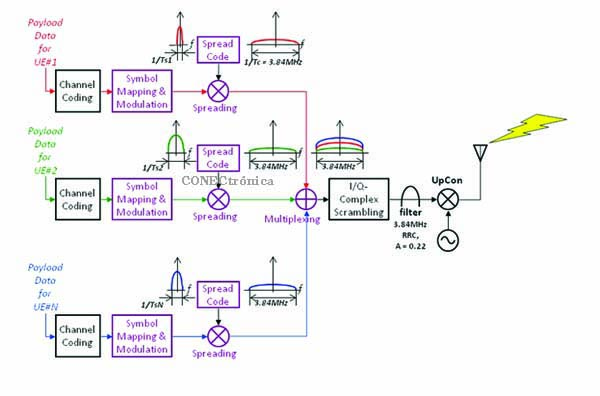
Let's analyze a specific type of requirement. W-CDMA and its evolutions are code-domain multiplexing systems, or simply put, each user uses the entire channel, and users are separated by a specific randomization code known to both the transmitter and receiver. Other transmissions on the same channel use different codes and, therefore, appear only as bandwidth noise. Figure 2 shows a conceptual block diagram of how the base station transmitter output is constructed.
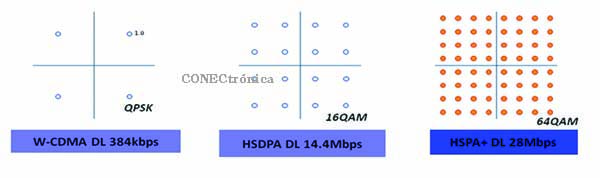
To ensure the base station receiver operates at peak efficiency at all times, the power transmitted from each user device is continuously monitored and adjusted to maintain a target error rate at the base station receiver while minimizing 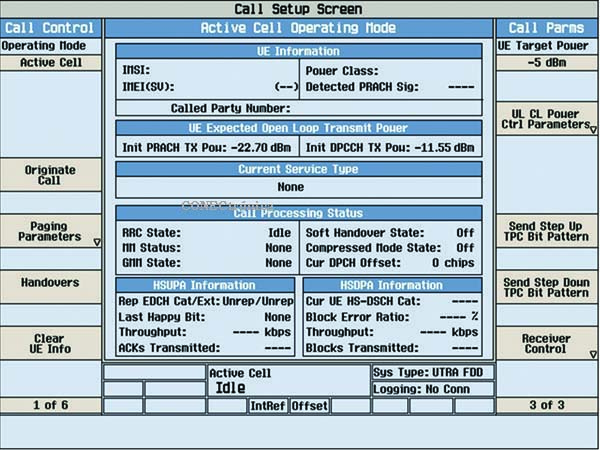 interference to other users. Although the error rate is far from perfect, data integrity is guaranteed through intensive Forward Error Correction (FEC) algorithms. This closed-loop power control is a fundamental requirement for user device performance and becomes even more critical as modulation density increases (i.e., less space between constellation points means the signal-to-noise ratio must be improved to maintain the same error rate). See Figure 3.
The Agilent 8960 Mobile Communications Test Kit is a base station emulator compatible with W-CDMA and all its 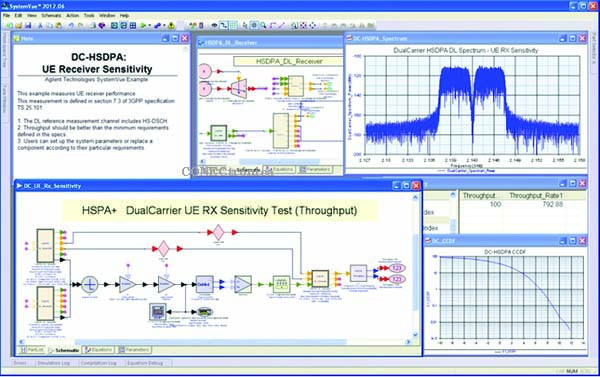 evolutions, and its lab application allows control of power boost and power-down messages via a keypad, enabling developers to thoroughly test the functionality of a new or upgraded device.
Currently, the development of a user device begins with a system simulation as the best way to shorten the design cycle and minimize costs. Design tools such as Agilent's SystemVue contain functional TX and RX models that include DC-HSDPA-specific features, enabling closed-loop BER/PER measurements across the entire system.
SystemVue libraries can interface with Agilent's signal generation and analysis test equipment and RF electronic design automation (EDA) platforms, enabling design to move from simulation to measurements on real-world system components.
Testing components in the mobile communications environment requires verifying components and subsystems using the complex signals they will encounter in real-world applications. Agilent's Signal Studio waveform generation software is a PC-based application that simplifies the creation of arbitrary W-CDMA test signals compliant with the 3GPP specification and is compatible with several Agilent vector signal generators.
 Regarding signal analysis, Agilent's VSA 89600 software supports the new features of versions 7 and 8, including MIMO and uplink transmission analysis to the service cell, as well as decoding of Ack/Nack and CQI reports from dual-cell HS-DPCCHs. The software also offers top-quality, standards-based signal evaluation and troubleshooting tools that engineers
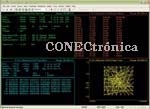 can use to view signals and gather the data they need to successfully resolve physical layer signal issues. Furthermore, it supports both two-channel and four-channel MIMO and more than 30 Agilent signal analyzers, oscilloscopes, and logic analyzers.
Figure 7 shows the error vector magnitude (EVM) and 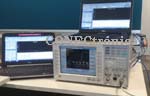 relative code-domain power of a 64 QAM downlink signal in tabular and graphical form using VSA.
Figure 8 shows a USB device under test with DC-HSPA capabilities. The PC on the left of the image is a server running IPERF, a utility developed to measure the maximum bandwidth throughput of the TCP and UDP protocols. In this case, the server sends a 42 Mbps bitstream through the Ethernet port of an Agilent 8960 mobile communications tester. The 8960 emulates DC-HSDPA transmission (i.e., it transmits the primary and secondary service cells from its front-panel RF output to the device). The 8960's data monitoring display shows both single-channel and overall data throughput, as well as detailed data rates for the primary and secondary service cells. Above the 8960 is the receiving PC, also running IPERF, which displays the received data rate. This same configuration can be used to allow the PC to receive files from the server via FTP using software like Filezilla, thus showing the performance difference in cases where data reception needs to be confirmed.
3GPP Channel and Signal Identifiers:
The 3GPP organization maintains a complete and up-to-date list of all technical abbreviations used in the specifications. For the complete list (in English), see http://www.3gpp.org/ftp/Specs/html-info/21905.htm.