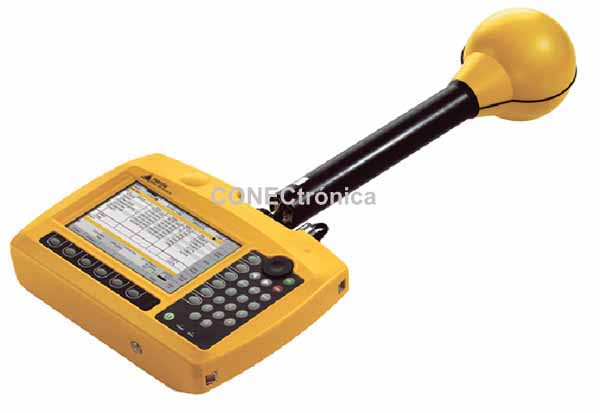
The SRM-3006 also displays the measured analog value, which corresponds to the actual field exposure, integrated onto a 5 MHz UMTS channel. The ease of switching from spectral analysis to UMTS P-CPICH Demodulation mode unlocks some useful features. Here are a few examples.
General information on measurement with spectral analysis
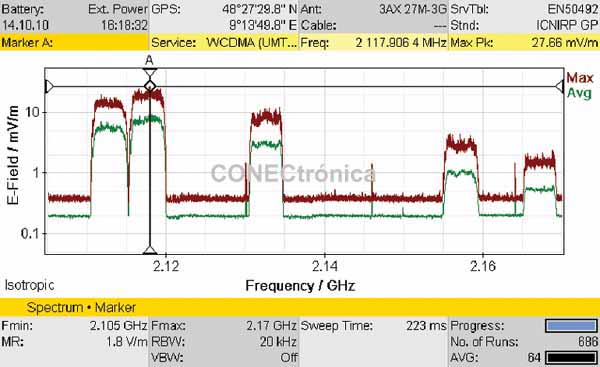
Spectrum analysis provides an overview of the UMTS frequency range, and accurately shows which UMTS frequency channels within the 5 MHz grid are occupied (Figure 1).
Determining the total channel power:
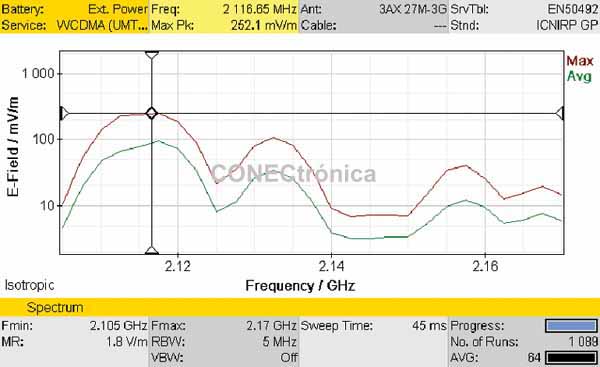
The measurement with a resolution of 20 kHz shown in Figure 1 provides an accurate visualization of the channel's frequency spectrum. However, the measurement is more precise if the resolution bandwidth is set to 5 MHz, which corresponds to the frequency width of a UMTS channel. The channel power can be read directly using the Peak Marker (Figure 2).
Determining the Contributions of Individual Cells:
All the measurements mentioned so far could have been generated using Spectrum Analysis mode. The UMTS P-CPICH Demodulation option, however, is essential for determining the contributions of individual cells within a UMTS frequency channel because the cells do not differ in their frequencies, only in their encoding. A P-CPICH (Primary Common Pilot Channel) for each cell is embedded in the multiplexed signal. This channel is continuously transmitted at a constant power level. Each cell has its own P-CPICH with its own random code. The SRM-3006 decodes the
P-CPICH and uses the encryption codes to match the measured field strength with the corresponding cell.
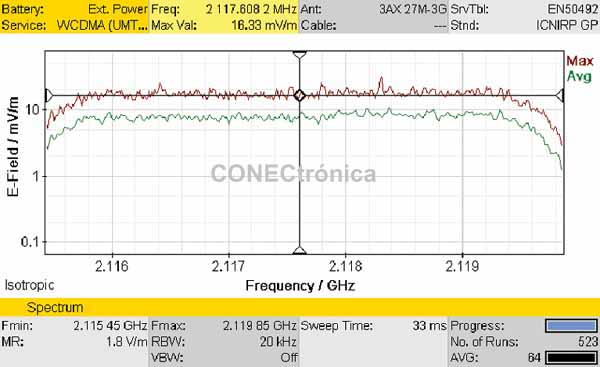
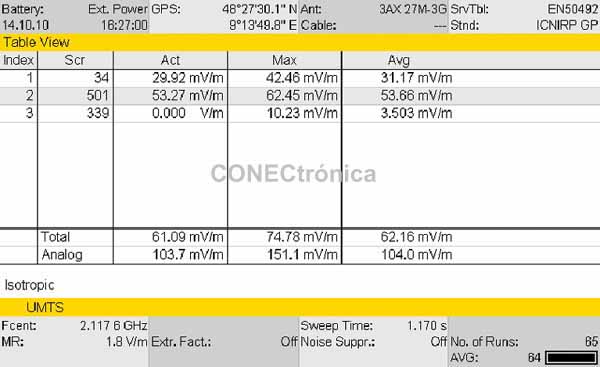
Switching from spectrum analysis mode to UMTS is simple: Just press the Extras -> Go to: UMTS keys. The SRM-3006 uses center frequency spectrum analysis with the formula Fcent = (Fmin + Fmax) / 2, or the active placeholder, i.e., Fcent = Fmarker. Some manual adjustments may be necessary, as the demodulation center frequency must be set to an accuracy of 100 kHz. If the service provider specifies the center frequency, it is more convenient to enter this value directly as a number. The SRM-3006 automatically sets the resolution bandwidth to 3.84 MHz, the filter bandwidth corresponding to the 3 dB UMTS channel.
This is the result of UMTS P-CPICH demodulation:
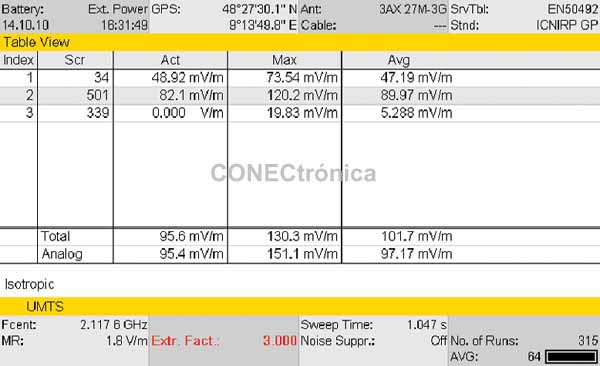
Extrapolating the maximum output power.
The difference between the total and analog values is shown in Figure 4. This is due, among other things, to the fact that the values obtained through decoding only considered the
P-CPICH, while the analog values include the pilot and traffic channels.
If the maximum proportion of traffic channels to P-CPICH is known (the service provider knows this), you can use the extrapolation factor (Extr. Fact.) to determine the level of field exposure that would occur if all traffic channels were occupied. This is important when assessing safety in the vicinity of the UMTS antenna.
Determining the Coverage Level:
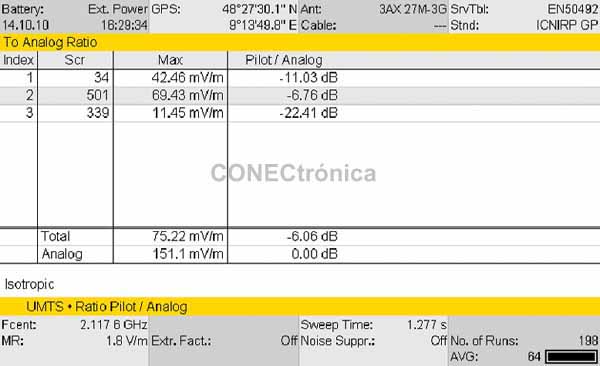
Although it is desirable, for safety reasons, to keep field exposure levels as low as possible, a certain field strength is necessary to ensure a reliable connection. In particular, the differences in field strength between different cells on the same frequency channel should not be too large. For this reason, service providers measure the ratio between the
P-CPICH field strengths and the total analog field strength measurement. The SRM-3006 displays the ratio between pilot and analog directly in dB (Figure 6).
Narda Safety Test Solutions Technical Notes
These technical notes describe, in no particular order, the possible applications of the NARDA-STS measuring equipment. Typical applications of the SRM-3006 Selective Radiation Meter for safety measures include:
• Radio and TV transmitters (AM, FM, DAB, DVB-T).
• Mobile phone base stations (GSM 900, GSM 1800, UMTS, CDMA, W-CDMA, LTE).
• Wireless communication networks (WiFi, WLAN, WiMAX, DECT, ZigBee, Bluetooth).
• Radio controls using ISM frequencies.
With the guidance provided in this article, you will be able to make more effective use of the capabilities of your NARDA portable spectrum analyzer when conducting studies and finding signals that would otherwise be difficult to locate.
Author: Article provided by the Electronics Business Unit of Inycom, official distributor of NARDA in Spain.