SignalShark originally covered frequencies between 8 kHz and 8 GHz and combined real-time spectrum analysis and direction finding. The new antenna allows the system to be used to locate signals in SHF bands above that range.
One of its applications is detecting interference in satellite communication uplinks. The antenna's directivity allows the direction of a signal's arrival to be determined, and this information can be used to locate its source on the ground, including SatCom terminals.
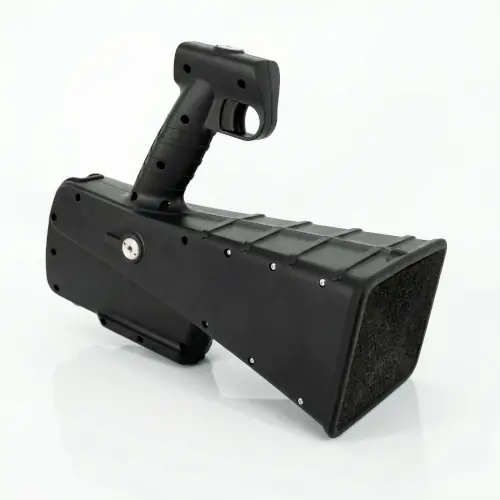
The device covers the 7-26.5 GHz range with a single antenna. In addition to satellite communications, it can be used to locate radar and microwave transmitters and other high-frequency emissions.
Frequency conversion at the antenna
Operating in SHF bands presents challenges due to increased cable losses as frequency increases. These losses can particularly affect the reception of low-intensity signals.
To reduce this effect, Narda has integrated some of the RF processing into the antenna itself. The device incorporates a low-noise amplifier (LNA), which amplifies the received signal before performing the downconversion. Once downconverted, the signal is transmitted via cable to SignalShark for analysis. The antenna provides a gain of up to 20 dBi. SignalShark automatically identifies the type of antenna connected and applies the corresponding frequency response corrections.
The DF Downconverter Antenna also incorporates an electronic compass and sensors to determine the tilt angle and polarization. This data provides information about the antenna's orientation during manual direction finding. The operator can then combine signal level and spectrum data with the orientation information to determine the direction from which the transmission originates.
Design for on-site measurements
The antenna is designed for mobile location tasks and features an IP54-rated housing. The connection cables are interchangeable, and power is supplied directly from SignalShark, so the antenna does not require a separate battery or power source.
The device also features several 1/4-inch threads for mounting on tripods and other platforms. Narda also envisions future applications on unmanned aerial vehicles (UAVs).
With this addition, SignalShark expands its manual directional locator functions to frequencies up to 26.5 GHz, covering bands used in satellite communications, radar systems, microwave links and other SHF applications.