These systems provide global and consistent visibility into the performance of uplinks and downlinks, a critical aspect for applications ranging from GNSS integrity and spectrum monitoring to interference detection and system validation.
Monitoring Objectives and System Architecture
The primary objective of satellite monitoring is to maintain the integrity of space-to-ground and ground-to-space links. This requires verifying the quality of uplink and downlink, detecting accidental or malicious interference, and ensuring regulatory compliance. From an architectural standpoint, monitoring systems are typically based on three elements: the space segment, consisting of satellites with transponders and antennas operating within defined frequency bands; the ground segment, comprised of monitoring stations equipped with large antennas, RF front-end modules, and digitizers; and the user segment, where specialized software and hardware analyze and visualize the captured data.
Frequency Bands and Sampling:
Satellite services use designated radio frequency bands, each of which is divided into subbands for uplinks and downlinks in bidirectional systems to minimize mutual interference. Downlinks are typically found in the lower part of a band due to their lower atmospheric attenuation, while uplinks occupy higher frequencies to achieve higher data transmission speeds. Subband definitions vary depending on the system; for example, Galileo uses the designation "E" within the L band instead of the "L" nomenclature used by other GNSS constellations.
From a monitoring perspective, this diversity places paramount importance on frequency planning and sampling strategy. The sampling rate must ensure that the signal in question occupies a single Nyquist region without out-of-band components that have been suppressed by analog filtering. For direct sampling, this typically translates to minimum rates of approximately 2 GSPS for the L-band, 4 GSPS for the S-band, and 8 GSPS for the C-band, provided that appropriate bandpass filters are applied.
Digitization and Signal Capture in the Front-End Module:
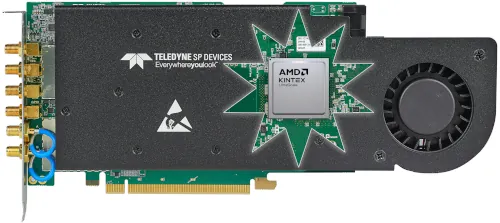
Modern monitoring stations rely on broadband digitizers to convert analog RF signals into digital data streams. Devices such as the Teledyne SP Devices ADQ35-WB enable direct sampling of L- and S-band signals without frequency mixers, thus reducing system complexity and simplifying calibration. With 12-bit resolution and a usable input bandwidth of up to 9 GHz, these digitizers can be flexibly deployed across various satellite bands. External low-noise amplifiers and anti-aliasing filters remain essential to protect signal fidelity and prevent spectral folding during A/D conversion.
The selection of the sampling rate directly affects data integrity and the efficiency of subsequent processing. For example, sampling the L-band at 5 GSPS places the signal entirely within the first Nyquist zone, while subsampling the S-band at 4 GSPS confines the signal to the second Nyquist zone with sufficient buffer bands. Conversely, incorrect sampling rates can split the signal at the Nyquist boundaries and thus introduce aliasing.
FPGA Preprocessing and Data Rate Reduction:
The raw data rates at the output of broadband digitizers can exceed practical transfer and storage limits. At 10 billion samples per second and two bytes per sample, a single channel generates approximately 20 GB/s. To manage this volume, FPGA processing is used to reduce data rates before transmission over PCIe links.
Satellite monitoring relies on two main techniques. Bit compression reduces the number of bits per sample, enabling continuous transmission within the limitations of PCIe bandwidth while preserving information across the entire band. Digital downconversion, implemented on an FPGA using numerically controlled oscillators, filters, and decimation stages, translates selected RF channels into baseband or intermediate frequencies. This not only reduces data rates but also improves the signal-to-noise ratio through filtering and coherent processing.
High-speed data transfer and GPU processing:
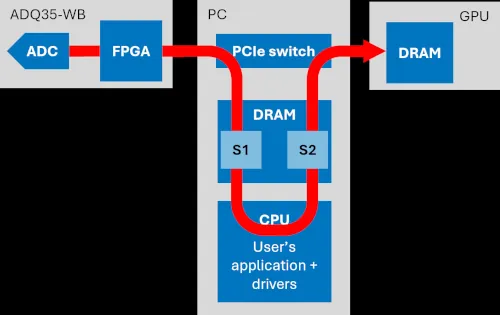
For real-time and near-real-time analytics, PCIe-based architectures are preferable. Peer-to-peer data transfer allows digitizers to send data directly to GPUs via DMA, bypassing the host CPU and system memory. This minimizes latency and brings overall performance close to the limits of PCIe Gen5, supporting multiple simultaneous streams from multiple digitizers.
GPUs complement FPGA processing by taking over tasks that demand high computing power but where latency is less critical, such as pipelining, demodulation, and long-term statistical analysis. For example, extracting each Galileo subband from a broadband L-band capture can reduce data rates from hundreds of megahertz of the spectrum to a few gigabytes per second, which falls within the capabilities of modern GPUs.
High-Speed Recording and Storage Strategies:
When long-term recording is required, storage bandwidth can become a limiting factor. RAID configurations based on NVMe SSDs and connected via PCIe carrier cards allow parallel writing to multiple drives. Enterprise-grade SSDs maintain high write speeds for extended periods, enabling total record speeds on the order of tens of gigabytes per second, with total capacities reaching up to one petabyte per slot. Consumer drives are suitable for shorter capture times but experience a performance drop when their internal SLC caches are full.
Relevance for Modern Satellite Monitoring:
The combination of broadband digitization, FPGA-based preprocessing, GPU acceleration, and scalable PCIe storage makes modern satellite monitoring systems a cost-effective and flexible foundation for RF intelligence. This architecture adapts to evolving requirements such as multiband monitoring, real-time interference detection, and large-scale data acquisition, making it suitable for both operational monitoring networks and research-based measurement campaigns.
Article provided by Teledyne