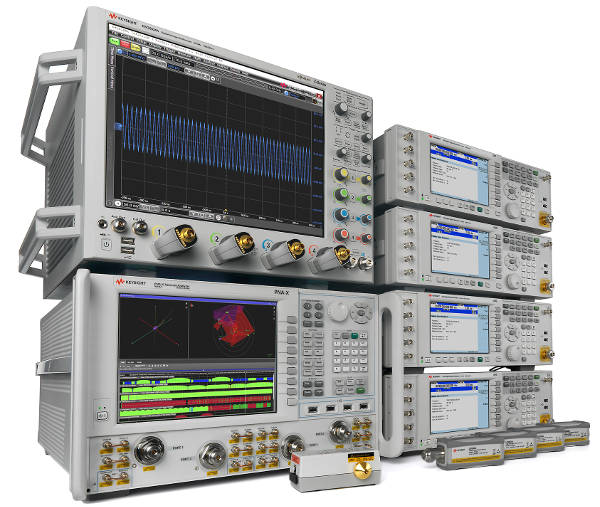
The new multi-emitter scenario generator reference solution, a addition to Keysight's reference solution series, is based on a set of coherent, agile UXG N5193A signal generators. Thanks to the industry-leading UXG generators and Signal Studio N7660B multi-emitter scenario generation software, this reference solution enables engineers to quickly and accurately simulate realistic and dynamic radar threats at a significantly lower cost than similar systems.
 Creating realistic multi-emitter signal environments or scenarios is complex. It requires correctly interlacing multiple pulse trains, as well as identifying, counting, and prioritizing pulse conditions. With hardware configurations that easily adapt to an engineer's office, this reference solution coherently switches frequencies and sets the amplitude to 180 ns, enabling the simulation of thousands of threat emitters with millions of pulses per second.
The complexity increases further with kinematic and angle-of-arrival (AoA) simulations within the multi-emitter signal environment. Kinematics provides dynamic power levels, Doppler frequencies, and pulse amplitude, phase, and time offsets for AoA simulation. To perform AoA simulation, the reference solution offers a custom calibration system capable of aligning the different UXGs in time, amplitude, and phase. The calibration system consists of calibration software, Signal Studio N7660B software, and state-of-the-art Keysight hardware: PNA or PNA-X vector network analyzers for amplitude and phase calibration; Infiniium Series oscilloscopes for time, amplitude, and phase calibration; and U2000 Series USB power sensors for low-cost amplitude-only calibration.
“The reference solution with a multi-emitter scenario generator offers support for generating realistic radar threat emitter signals at different stages of the development cycle,” explained Mario Narduzzi, marketing manager for Keysight’s Communications Measurement Solutions division. “Engineers working in reprogramming labs or developing new platforms can now obtain and deploy an electronic warfare test system in two months, instead of the two years the provisioning cycle typically takes.”
It is now possible to easily configure radar parameters such as frequency, amplitude, antenna scan, pulse repetition interval, pulse width, and pulse modulation, and then interweave multiple radar threat emitters using Signal Studio's graphical user interface. Electronic warfare engineers can combine different threat emitters in scenarios and use pulse drop reports to optimize pulse density and reduce pulse collisions by adjusting emitter start times, priorities, and pulse repetition intervals. Furthermore, Signal Studio allows for direct control and configuration of kinematic and AoA parameters such as time offsets, power levels, signal phases, and interport Doppler frequencies. Users can visualize all these elements with the new time-domain analysis feature, which displays antenna scan patterns and the movement of any emitter and its associated platforms.
Multi-emitter scenarios created with Signal Studio can be downloaded directly to one or more UXGs as pulse descriptor word lists (PDWs). Additionally, PDWs can be calculated and sent to UXGs over LAN to simulate virtually endless scenarios. The high-performance UXG offers phase-coherent frequency and amplitude transitions as low as 180 ns, timing resolution of 10 ps, and a spurious-free dynamic range of -70 dBc. The UXG can also be used as a highly reliable local oscillator or a scalable threat simulator. Its capabilities enable aerospace/defense engineers to generate increasingly complex and realistic simulations, thereby increasing their confidence in electronic countermeasures (ECM) systems.