Femtocells are used to extend the range of cellular networks, primarily 3G, inside buildings. Their function is similar to that of gap fillers used for digital terrestrial television (DTT). They are essentially mini base stations with radio equipment equivalent to that used in a mobile phone operator's communications tower. There has been a growing interest in these systems, evidenced by the creation of various forums (femtoforum.org) and dedicated conferences, although their deployment is still quite slow. Most operators are evaluating the equipment in the laboratory, others have conducted pilot tests, and very few are offering a commercial product to their customers. However, this situation is expected to change in the coming years, as a recent study by ABI Research forecasts approximately 150 million users and 70 million access points worldwide by 2012. This article focuses on analyzing the existing technology.
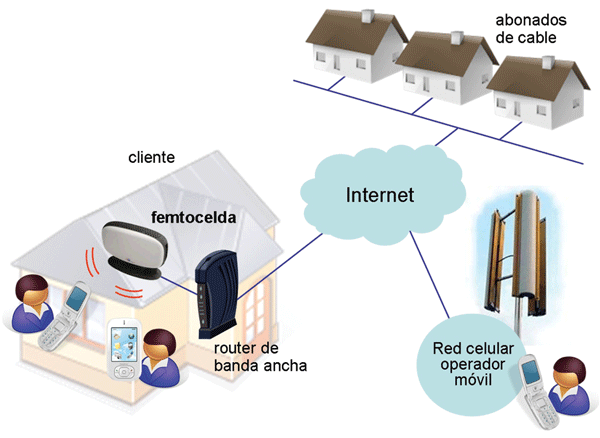
The typical architecture of a femtocell is shown in Figure 1. The radio equipment, located at the customer's premises, is very similar to that of a Wi-Fi access point and is designed for easy installation. An Ethernet connection allows the equipment to be connected to an ADSL or cable modem to link to the operator's cellular network via the subscriber's internet connection. In this way, the operator extends the reach of its network within the building by leveraging the customer's internet connection, while the customer benefits from improved communication quality at reduced costs. This is a clear example of fixed-mobile convergence, where, unlike other architectures, no dual-mode terminal is required; existing 3G phones can be used.
 However, installing a femtocell in a customer's home involves a number of issues that cannot be overlooked. First, it is important to know the equipment's geographic location for several reasons, including the proper routing of emergency calls and the correct planning of RF power and channels to avoid interference. Specifically, an operator may have different RF channels, and even spectrum bands, in adjacent geographic areas, so knowing the femtocell's position is crucial to avoid interference with the macrocell of the same or other operators. Commonly used methods for locating mobile users include GPS and base station triangulation, but obviously neither of these works indoors. Another possibility is using the IP address of the internet connection, but this is not always reliable except in the case of operators that offer both fixed and mobile services and have control over this. Adding to this is the problem that customers can move the equipment from one place to another, even though operators insist against it, which greatly complicates the tracing process. For example, residential customers might take the equipment to offices or other locations with different call rates. In an extreme case, moving a femtocell across international borders would very likely constitute a violation of spectrum usage licenses.
 Another concern for operators is the quality of service (QoS) experienced by users. As demonstrated in numerous pilot tests, the low radiation power of femtocells causes many mobile phones to operate near the coverage limit, increasing the likelihood of communication failures in large or multi-story homes. Furthermore, the internet connection is shared with voice calls, which require a minimum capacity of 500 kbit/s with very low latency. In fact, calls have been found to drop when a family member connects to the internet to download a bandwidth-intensive video. Again, only operators providing combined fixed-mobile services can implement mechanisms to coordinate internet usage with femtocells and ensure a minimum QoS. Given that the latest 3G phones advertise speeds of 2 Mbit/s, and that access to these services at home is a priority, operators must undertake significant work to ensure that quality commitments are maintained in femtocells.
Market and Devices:
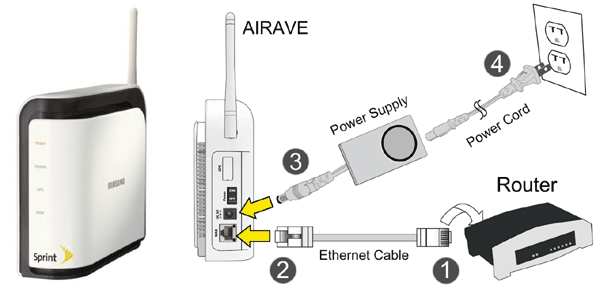
We can say that Sprint is the company that has most successfully implemented femtocell service. Its service, called Airave, is already being used in many homes in the United States. The device, manufactured by Samsung, costs around $100, which is passed directly on to the end subscriber, although the company offers calling plans that allow for significant savings on the monthly bill. Figure 2 shows a photograph of the device along with a diagram that illustrates how easy it is for the subscriber to install.
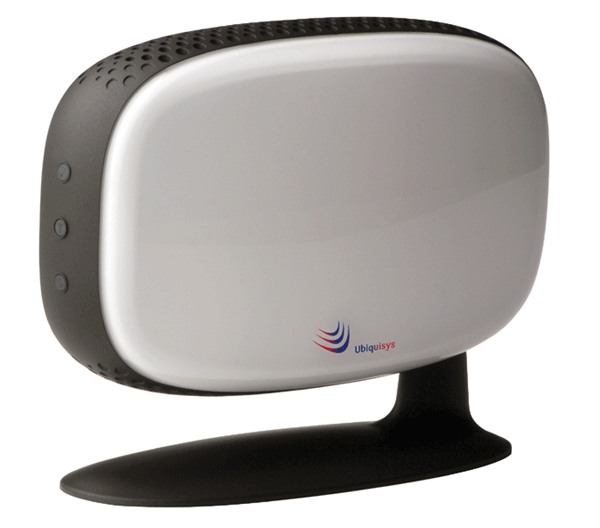
In Europe, several operators continue to conduct femtocell pilot tests, with Vodafone and O2 being particularly noteworthy. Forecasts indicate that they will announce their first products and calling plans soon. As an example, the British company Ubiquisisys recently launched the ZoneGate product, shown in Figure 3. Its main features include the following:
- Future migration to the 3GPP Iu-h femtocell standard.
- Continuous monitoring of neighboring GSM and UMTS macrocells to adapt to the environment.
- Output power, frequency, and pseudo-random coding optimization algorithms to ensure coverage and minimize interference.
- Transparent handover between the femtocell and the operator's network.
- Supports HSPA with downlink speeds of 7.2 Mbit/s and up to four simultaneous voice or data user connections.
- Multiplexed, prioritized, and encrypted voice and signaling traffic using IPsec.
- Web 2.0 services architecture.
According to the ranking compiled by the consulting firm ABI Research in May 2008, Ubiquisys ranked first among femtocell vendors based on product implementation and innovation criteria. The remaining companies are detailed in Table I. Specifically, the femtocell market is expected to have an economic evolution like that shown in Figure 4, exceeding $1 billion in 2012.
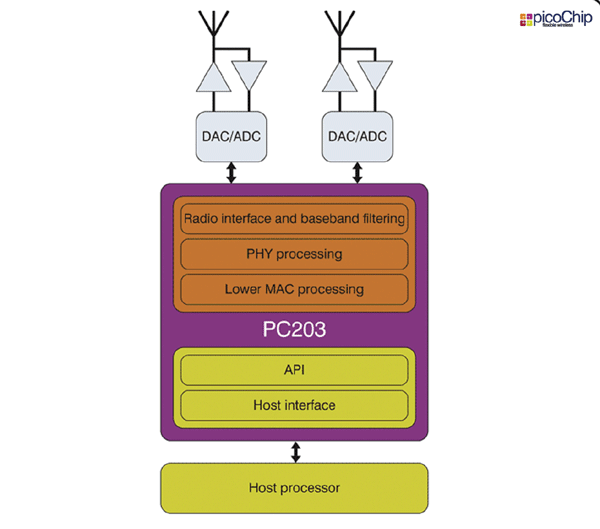 So far, we have focused on the case of 3G femtocells, although this is not the only option. For example, the American operator Comcast plans to deploy WiMAX femtocells in the second half of 2009. The equipment will also be used to extend coverage inside buildings, while routing VoIP calls over the operator's cable network. Since the operator offers HDTV, VoIP, and broadband Internet services (triple-play), in this case, the WiMAX femtocell enables home mobility. The chip manufacturer picoChip offers a whole series of software-configurable reference modules for the development of 3G and WiMAX femtocells. In the latter case, the PC8530 reference design provides the IEEE 802.16e OFDMA PHY and lower MAC implementation (Figure 5). This design can be upgraded to the PC8532 to support WiMAX Wave 2 and IO-MIMO.
It is clear that 3G and WiMAX technologies will compete fiercely in the access network over the next few years. It is still too early to predict the outcome, although a compromise solution will likely be reached where both technologies complement each other depending on the service or application and the type of end user.
Francisco Ramos Pascual. PhD in Telecommunications Engineering. Full Professor at the Polytechnic University of Valencia.