In recent years, advancements including improved performance of general-purpose CPUs and the virtualization of wireless signal processing and control technology (telecommunications function) have opened up an exciting array of new possibilities for technological innovation in communications, among which the emergence of vRAN technology stands out. The introduction of vRANs composed of general-purpose servers, which do not require the costly development of specialized hardware, is currently attracting attention as an attractive alternative to conventional base stations. Despite their promise, existing vRAN technologies continue to face obstacles to wider adoption. For example, vRANs not configured with specialized equipment often have lower performance efficiency than conventional base stations. To maintain the same performance, more hardware must be incorporated, which increases the environmental impact in areas such as power consumption. Regarding stability and redundancy, there have also been cases where conventional vRANs cannot adequately guarantee the quality of communications at the carrier level.
Features of the Fujitsu vRAN
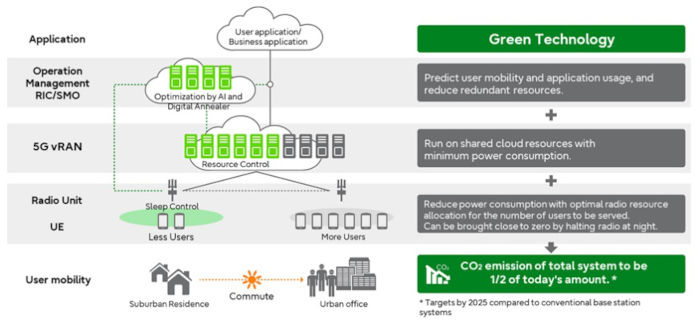
Fujitsu's new vRAN technology is 5G SA compatible and conforms to O-RAN specifications, while leveraging the following proprietary technologies to successfully address some of the challenges surrounding conventional vRANs. By optimizing the entire 5G wireless network and reducing equipment requirements and power consumption, Fujitsu's vRAN offers the potential to contribute to a significant reduction in total CO2 emissions across all operators' 5G wireless systems. 1. Fujitsu's Customization Approach to High-Performance, High-Capacity Communications: Enhanced software control methods for high-performance and high-capacity communications. Increases communication speed and coverage area by two to four times. 2. Dynamic Resource Allocation Technology: Fujitsu has developed its own dynamic resource allocation technology that reduces resource waste and power consumption by flexibly adjusting server computing resources based on the usage status (traffic volume) of base stations, which varies by region and time of day. By linking the RAN's Intelligent Control Unit (RIC) and the SMO that orchestrates and manages the entire network, this technology estimates mobile phone user movements and application usage, achieving optimal resource allocation. 3. Automatic Cell Redesign Technology In addition to using AI to predict future traffic fluctuations, this system leverages Fujitsu's quantum-inspired Digital Annealer computing technology to enable optimal allocation of computing resources by rapidly solving problems that are difficult to solve with current general-purpose computers. Using the Digital Annealer's superior combinatorial optimization capabilities, it is possible to derive optimal connection destinations from various combinations of Radio Units (RUs) and vRANs (Central Unit/Distributed Unit) in environments where the radio waves of many base stations overlap.