 The data center industry is experiencing rapid innovation. Hyperscalers, colocation providers, and other large data center owners and operators have led the way in implementing the latest computing, power, and cooling technologies in their designs to meet growing market demand. This is driven by the desire to optimize operations, reduce resource consumption, and lower costs, among other objectives.
However, the challenges of data center design and development are growing. The industry is experiencing widespread material shortages due to supply chain issues, according to 87% of respondents in a recent survey. Furthermore, 89% of data center professionals are struggling to find enough skilled labor. This shortage is driving up construction costs and extending timelines. As a result, it is becoming increasingly difficult to meet customer demand for new data center capacity within an accelerated 12-month timeframe, instead of the previous standard 18-month schedule.
Furthermore, data centers are increasing power density, packing more computing power into smaller spaces to support big data analytics and other digital workloads. This is creating new requirements for cooling systems, which must ensure the continued operation of these critical systems.
The good news is that owners and their teams have new options for building data centers, thanks to innovations in cooling systems. For decades, data center owners have widely adopted raised-floor cooling to enable more efficient cooling technology. With raised-floor airflow systems, air flows upward through floor grilles to cool the technology placed directly above. This gives operators exceptional flexibility when designing empty spaces in the data center and when deploying and operating equipment.
However, over the last decade, Colocation and Hyperscale service providers have been able to experience the reality of implementing data centers without raised floors, thanks to the use of various chilled water cooling solutions.
Simplifying the design of data centers without raised floors allows data center owners to build new data center rooms more quickly and cost-effectively. They can save on the skilled labor and materials needed to design and install raised floors, as well as avoid the complex engineering required to support them.
As a result, data center investors and owners can reduce their cost structure and accelerate time to market. Furthermore, data center teams can forgo raised floors to design and utilize new cooling unit concepts. Some of these solutions will allow data center teams to increase unit cooling density within the same footprint.
However, constructing facilities with raised floors presents new cooling challenges that teams must consider before embarking on new projects. As a result, the debate between building a data center with or without raised floors requires careful consideration of both business and technical objectives.
Vertiv predicts that data center owners will increasingly forgo raised floors for large data rooms of 2MW to 5MW. Smaller installations under 2MW will only make a partial transition to non-raised floor solutions.
 How to Solve Data Center Cooling Problems Caused by the Absence of Raised Floors:
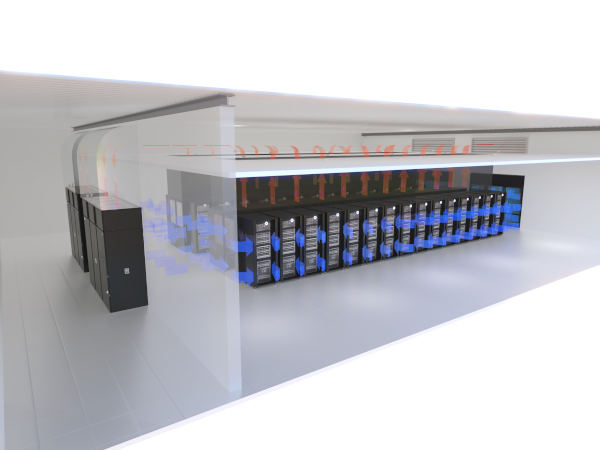
Overcoming the Challenges of Cooling Data Centers Without Raised Floors analyzes the challenges of designing HVAC systems for facilities without raised floors, including the airflow control strategy for these applications. As all data center cooling experts and their partners know, it is more difficult to control air distribution when air travels freely through the racks, rather than being distributed by a raised floor.
There are two main risks with air distribution in facilities without raised floors. High-velocity air reaching the first few rows of servers creates negative pressure, while airflow decreases as it moves, making it difficult for it to reach servers located further away. Both scenarios negatively impact the systems' ability to consistently cool the servers, increasing the risk of overheating or failure.
The document proposes that data center teams adopt the Delta T method (which measures temperature variations between hot and cold aisles) to control fan speeds, maintaining a more uniform airflow distribution. In this document, we take that knowledge a step further by analyzing new cooling system options for data centers without raised floors. Data center operators who select the appropriate cooling solution can use it to apply uniform air pressure to racks, protect equipment, and prevent temperature-related outages. This document focuses on exploring the benefits of chilled water cooling solutions, which teams can use in data centers without raised floors, as well as for retrofitting existing space.
Why is a new design approach needed to adapt chilled water cooling units?
If standard perimeter chilled water units are placed in a data center environment without a raised floor, they increase the risk of high-velocity airflow, creating turbulent air distribution and potentially damaging servers. Therefore, a new approach is required. However, there is no single solution for cooling equipment in data centers without raised floors.
For this reason, Vertiv offers multiple cooling solutions to provide its customers with different options and flexibility in how they address the challenges of bare-floor installations and meet their specific business requirements.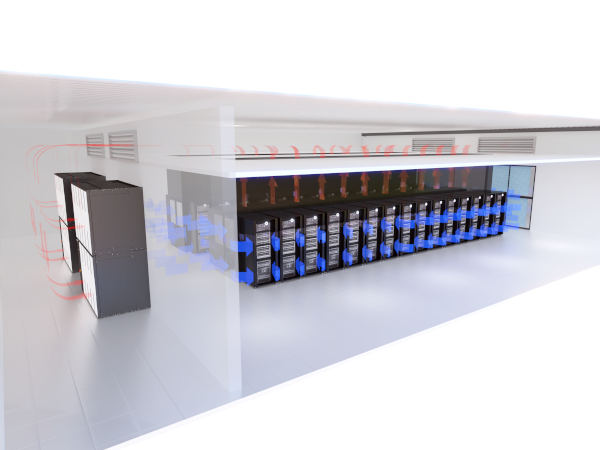 These new solutions include:
Perimeter Units: Vertiv has redesigned its standard Liebert® perimeter cooling solutions to meet the demands of bare-floor applications. The fans are installed on top of the unit. The units draw air from the coil section, taking advantage of this larger surface area and reducing air velocity to create better airflow distribution. The product provides airflow and cooling capacity similar to a standard server room air handling unit (SRAH).
Data center operators gain the ability to implement a well-known and established technology that requires minimal design modifications. These units are available with rear or front air discharge. As a result, they can be flexibly installed in the service aisle or directly within the data center itself.
As with other perimeter units, it is possible to duct the return hot air. Therefore, it is possible to physically separate the data center's air volume from the service aisle. From a design and operational perspective,
this is a significant advantage, as the service aisle does not require any special design since it is not pressurized. Furthermore, workers will have a more comfortable operating environment because the temperature in the service aisle is lower than in the hot aisle area.
Thermal Wall units installed in service aisles:
Vertiv also offers a standard Liebert Thermal Wall unit solution, based on the air handling unit (AHU) concept. Thermal Wall units blow air horizontally directly into the server room.
Thermal Wall solutions are gaining popularity. They can be used to cool data centers with high-density IT equipment by moving large volumes of air at low velocities. However, using these
products requires data centers to be redesigned to provide more space in the service aisle.
The advantages of using a Thermal Wall unit include the ability to achieve high cooling density and operate with extreme efficiency. Improving these two variables allows data center operators to optimize the power usage effectiveness (PUE) of their data center facilities.
Customized Thermal Wall Units: Vertiv can also create customized Liebert cooling units to better suit specific customer needs.
They have developed several highly innovative air handling units (AHUs) as customized solutions for seamless integration into customer buildings.
Data center teams implementing these customized solutions can optimize space utilization and gain greater business and operational flexibility. They can also utilize increased capacity to cool high-density servers or plan for future IT equipment growth.
Because customer buildings have countless layouts and equipment configurations, Vertiv provides design expertise and advice to create the right solution for their specific data center technical room requirements.
How to Choose the Right Chilled Water Solution for Your Application.
For applications without raised floors, multiple cooling technologies are available. As a result, it can be difficult to know which indoor chilled water cooling solution is best for specific data center applications. Data center and facility teams should follow the steps below to choose the right product. The initial work required for
designing applications without raised floors should not be underestimated. Teams can select the correct product when they have considered the key variables and have the correct data on hand.
They should:
Determine server heat density and airflow requirements: Teams should calculate the total cooling capacity required for the IT equipment, as well as the necessary airflow.
Define the number of units based on system redundancy: Teams should consider the desired level of cooling redundancy and then determine the number of units to be placed within the IT room.
Evaluate the IT room layout specifications: Teams must define the location of the cooling unit within the room, assess the server row placement, and consider the IT room's dimensions and height, the service aisle space, and the return air duct location.
Verify airflow distribution under different scenarios: Using computational fluid dynamics (CFD) analysis, teams can verify airflow and temperature distribution for various load scenarios. Simultaneously, they must determine the impact of cooling unit failures on their networks and other equipment.
Define the right product: After conducting this analysis, teams should have the necessary data to select the appropriate chilled water indoor cooling unit for their application. However, they should still carefully consider the design pros and cons of each unit before making their
final decision.
Conclusion:
As the data market accelerates, data center investors, owners, and teams are looking for ways to speed up deployment and reduce costs. To simplify data center design, they are considering deploying bare-floor facilities that don't require special engineering or materials for floor construction. However, using bare-floor solutions forces teams to adopt a new approach to cooling, requiring expertise and effort in data center cooling design.
Vertiv has designed Liebert Indoor Chilled Water Data Center Cooling Systems that help these customers design for continuous cooling for mission-critical workloads. We offer design expertise, global manufacturing capabilities, and a range of solutions to meet the cooling technology requirements of data center teams.
We provide standardized data center cooling solutions that teams can quickly evaluate and deploy across facilities and regions for exceptional performance and operational cost efficiencies. We also offer customized cooling solutions for customers who want greater flexibility and capacity.