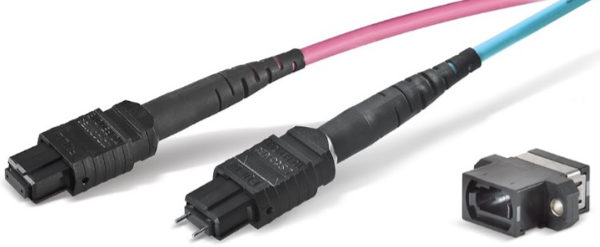
Ultimately, trunk cables represent a significant investment, and every operator's goal is, of course, to use them for as long as possible. With each interface change in the active device, the original purchase decision could become obsolete. Therefore, at that time, trunk cables with MTP® connectors were preferred, and the infrastructure interfaces were adapted to those of the active components using module cassettes—such as MTP®/LC and MTP®/SC—allowing for patch cables with identical connectors to be used across the equipment.
A change of interface in the active component then only required replacing the module cassette, reusing the entire backbone infrastructure. Besides significantly shortening reinstallation times, this protected the investment made in the cabling. Thus, the MTP® connector was simply a "docking point" within the structured cabling, grouping the channels, typically six, into a single connector. Naturally, this resulted in a reduction in overall installation time, not just for reinstallations, since only one connector needed to be plugged in instead of six.
Only in a very specific niche was the MTP® connector also used as a direct interface connector for InfiniBand applications, which was the first parallel optical transmission technology in the data center.
The standardization of data center cabling infrastructure that began in the early 2000s and the publication of the DIN EN 50173-5 standard in 2007 put an end to the diversity of connectors: the LC connector was retained for duplex applications and the MPO®/MTP connector for multi-fiber applications.
In cabling infrastructure, as a pure mating point, the MPO®/MTP connector gradually lost acceptance and importance as, with the rapid increase in data transmission speeds, loss budgets (attenuation budgets) decreased dramatically from over 7dB to less than 2dB.
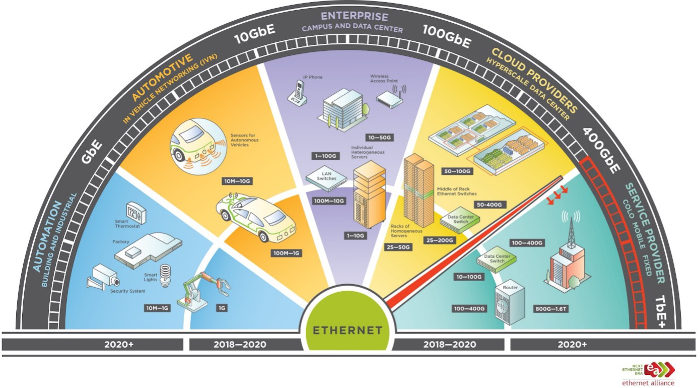 To serve longer distances, cassette solutions were replaced by direct cabling with LC connectors. Since the DIN EN 50173-5 standard, the use of the LC connector as the mating face no longer poses any restrictions on future reliability. Consequently, the importance of the MTP® connector in the data center declined during the 2000s.
With the demand for ever-increasing volumes of data transmission that characterizes today's society, serial transmission speeds are barely sufficient, even though they already reach 25GB Ethernet over multimode fibers.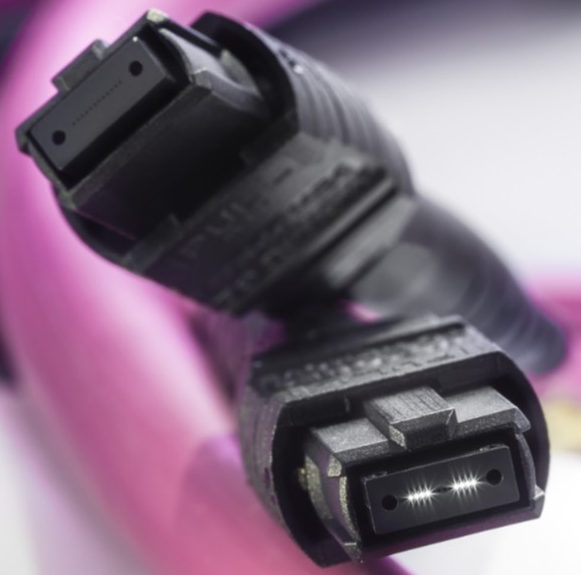
Therefore, parallel optical transmission technology is becoming increasingly important. While in the 1990s only niche applications like InfiniBand required it, today it has become almost a necessity to support the 40/100Gb Ethernet applications demanded in data centers.
In addition to the classic 12-fiber MTP® connector for SR4 applications, the 100GBE-SR10 uses the 24-fiber connector as an interface in active components, such as central switches and mainframes.
Therefore, we can consider that the MTP® connector is experiencing a true renaissance in the market, which not only affects the well-known nx 12 fiber matrix connectors (especially n = 1 and 2) for 40/100 GB Ethernet, but new connectors based on MT ferrules have also been developed.
 One of these developments is the family of connectors based on 16 fiber arrays (nx 16), primarily MTP®16 (for the future SR8 application based on 50 GB Ethernet channels) and MTP®32 (defined for the 400 GB Ethernet SR16 based on 25 GB Ethernet channels).
The 16-fiber array connectors have the same dimensions as the 12-fiber array connectors. To prevent confusion or incorrect mating of components from both families, the 16-fiber array connectors have an offset keyway and a larger pitch between the male pins or female holes.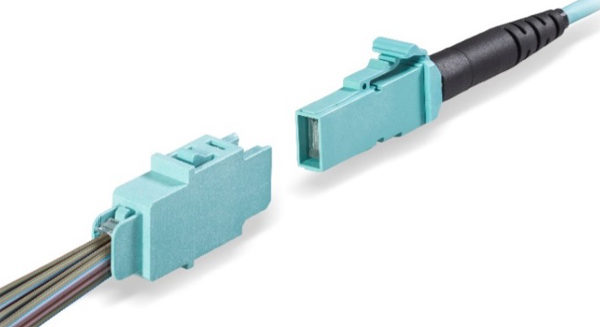
In addition to these "classic" MTP® connectors, i.e., the MT ferrule in a standard connector housing such as MTP®12, MTP®24 and the new variants MTP®16 and MTP®32, there are other modifications based on the MT mating face as a basic component: the PRIZM® MT and PRIZM® LightTurn®.
These are MT ferrules equipped with lenses (PRIZM® MT) or prisms (PRIZM® LightTurn®) on their surface. The PRIZM® MT ferrule is then installed in a special type of housing, thus establishing the MXC® connector family.
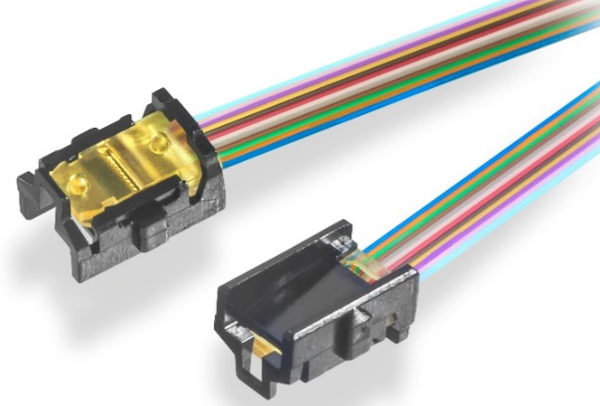 Both MXC® and PRIZM® LightTurn® connectors are used in "on-board optics" applications. This means that MT interface-based technology is being integrated into active components and is no longer just the interface between active components and the "outside world." With these two connector types, optical fiber is brought closer to the chip or serves as a connection medium between printed circuit boards, replacing copper-based data transmission even within active components.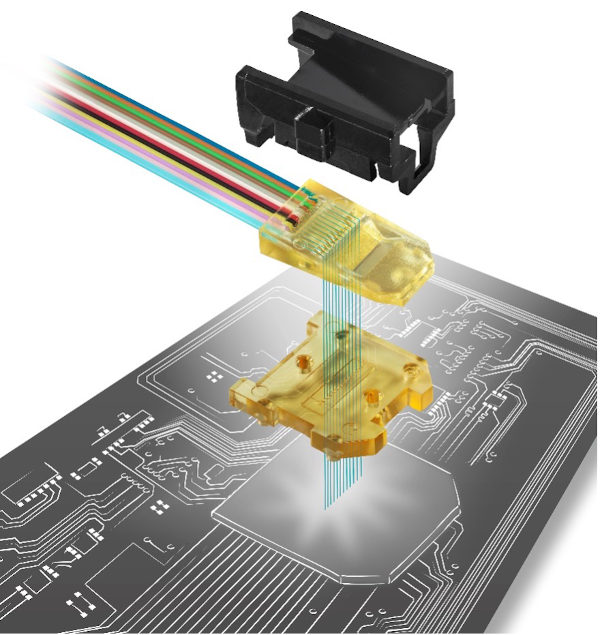
In this way, the fiber optic connection extends beyond the traditional interface within the device, aiming to provide the highest possible performance. This high performance is achieved through parallel optical transmission, which, in terms of connectorization, primarily uses MT solutions.
In addition to parallel transmission over multiple fibers, and therefore using MT variants as the connection technology, transmission solutions based on WDM technology are also available on the market. For example, the 100 Gbps SWDM4 application transmits with four wavelengths over the duplex infrastructure, using the duplex LC connector. The 40 and 100 Gbps applications also use the duplex LC connector as the interface, relying on only two wavelengths. Even so, it appears that these two wavelength-division multiplexing-based transmissions are far from achieving the same status as MTP® applications.
Ultimately, the story of the MTP® connector demonstrates how versatile cabling infrastructure can be and the opportunities that arise when existing technologies are intelligently combined with new trends.
 Author: Manuel Leardy, Sales Manager for Data Centers in Spain and Portugal at Rosenberger OSI.