 Communication between individual devices is the foundation of automation, both in homes and industry. Wireless connections are currently being developed. However, these are susceptible to interference and are characterized by a certain signal transmission delay, so they are primarily used in smart home systems and much less frequently in industry.
 The communication requirements for industrial devices have changed over the years, and new technologies have emerged alongside them. Currently, Ethernet cables are commonly used for communication between individual network elements. They allow for very fast data transfer (up to 40 gigabits per second) and can therefore transmit complex instructions between computers or controllers and operator panels or control units. However, before twisted-pair cabling became standard in industrial facilities, connections based on D-Sub connectors were the norm.
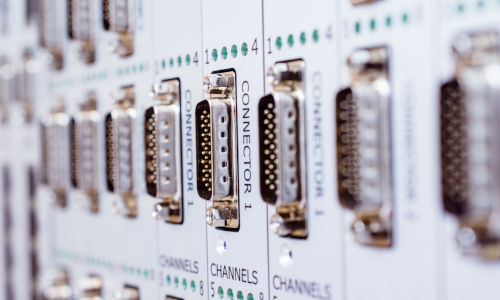
D-Sub (D-subminiature) is a family of connectors used for communication between electronic devices. The "D" in the name comes from the characteristic shape of the plug or socket, which resembles this letter. There are many types of D-Sub connectors. The smallest in the standard version have 9 pins, while the largest have 104 pins.
The history of D-Sub connectors dates back to the 1950s, yet they are still widely used today. This is partly due to the fact that many places still use devices manufactured in the last century, when they were more common. The most popular application of D-Sub connectors is communication via RS-232 and RS-485 interfaces. They allow you to build relatively large networks of connections between devices used in industrial settings.
The first of these interfaces—RS-232—was used in the past primarily to connect end devices and various peripherals, such as printers or keyboards, to the computer. It was also used to connect the computer to the modem. In everyday use, it has been largely replaced by the USB and Ethernet connectors that are now widely used.
D-Sub Connectors and RS-232 and RS-485 Interfaces.
In industry, however, RS-232 is still used. Where it hasn't been replaced by twisted pair cabling, it's still used for communication between computers and PLC modules or HMI panels. However, it has a drawback. Because the transmitted voltage signals—from -3 to -15V are logic "1," +3 to +15V are logic "", and the voltages from -3 to 3V are unused—the RS-232 interface is only possible for a maximum length of 15 meters, with a speed of 20 Kbit/s. With longer cables, the voltage drops can be too great to effectively transmit the signal to the connected device. Initially, RS-232 was used for the Modbus protocol, but over time this function was taken over by RS-485.
RS-485 is, in a way, an extension of the RS-232 interface. It allows data transfer in a bus-like fashion between multiple devices. It is faster than the aforementioned interface and more resistant to interference. RS-485 can operate at 35 Mbit/s over a length of up to 10 meters, but depending on the requirements, a single cable can be up to 1200 meters long. Beyond that point, the transmission speed drops to 100 Kbit/s, which is still several times faster than RS-232. Furthermore, up to 32 devices can be connected using the RS-485 protocol. These numbers (both in terms of cable length and the number of connected devices) can be increased.
The repeater allows you to connect additional devices operating on a line, or to extend the range by up to 1200 meters, potentially splitting individual devices.
Unlike RS-232, RS-485 uses a differential voltage, enabling it to operate over greater distances than the simpler RS-232 interface. A logic "1" for RS-485 occurs below -200mV, and a logic "" appears when the voltage exceeds +200mV.
Application of D-Sub Connectors in Industry:
Due to the fact that RS-232 or RS-485-based networks are still functional in many cases, companies continue to use D-Sub connectors. Many older machines and devices are not compatible with Ethernet control, but they are still fully operational and perform their functions. Therefore, there is no need to rebuild what works well.
In addition to Modbus RTU networks, RS-232 and RS-485 connectors, i.e., D-Sub connectors, are used in Profibus DP networks. In both cases, operation with the RS-485 interface is similar.
D-Sub connectors are sometimes used for control where there is no need to transmit complex commands. An excellent example of this type of solution is the control of valve terminals. In this case, a high state on the plug pin is responsible for activating one of the coils.
A characteristic feature of the D-Sub connector is the screws on both sides of the plug. These help to securely fasten the plug to the socket and also prevent accidental unplugging. This is one of the reasons why D-Sub connectors are still common in the railway industry.
The fact that the connection is secured with bolts reduces the risk of the cable coming loose due to vibration. When we talk about a moving train, vibrations are undeniable and, in extreme cases, can loosen the connectors, which is definitely not desirable. This is especially true in an industry where control errors can lead to disasters in road traffic.
The most popular, but now obsolete, application of D-Sub connectors is the classic VGA connector for connecting monitors. This standard was initially replaced by the DVI connector, but over time, HDMI has become the most popular connector for connecting monitors to computers.
The Future of D-Sub Connectors in Industry:
Progress is essential, and innovations implemented in industry are of great importance. It's difficult to argue that communication using twisted-pair cables would be worse than decades-old protocols that use D-Sub connectors. However, it's worth noting that revolutions in the industrial sector occur much more slowly than they seem. Innovation is often associated with very high costs and a certain degree of risk, which not all companies can afford. Technological changes can also force modifications to work organization and building infrastructure. Therefore, despite the passage of time, many devices continue to use what may seem like obsolete technologies. Not only that, but new devices are still being produced that can communicate via D-Sub connectors. This allows for the easy replacement of elements included in the network years ago with new ones, without needing to change the communication method, for example, to twisted pair.
Content produced by Transfer Multisort Elektronik Sp. z oo