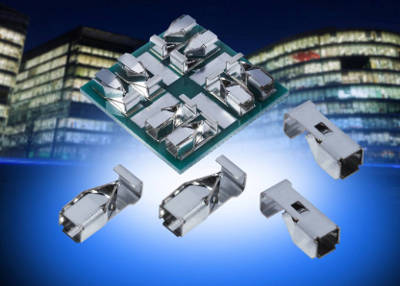
 The complete series offers 4mm, 3mm, and 2mm single-push contacts, now capable of handling solid or stranded wires from 12-28AWG with currents up to 20A. This facilitates greater design flexibility and enables simple, reliable, and solderless wire termination in an even wider range of solid-state and industrial lighting applications. Integrating several key design features within the stamping process for easy SMT pull-out, wire guidance, high retention force, and simple wire removal, the 70-9296 contact series provides all the benefits of a full-function connector while eliminating the labor and material costs associated with insulation, contributing to smaller, more cost-effective final designs.
“The complete 70-9296 single-push uninsulated connector family provides design engineers with full connector performance, maximum mechanical stability, and greater design flexibility for a wide range of rugged wire-to-board applications, giving them a solution to meet the ongoing demand for designs with lower end costs and smaller sizes,” says Tom Anderson, Product Manager at AVX.
Featuring a reinforced solder pad for maximum mechanical stability on the printed circuit board and a unique enclosed design with double opposed spring contacts for superior wire retention, the AVX 70-9296 contact series has upper and lower barbs that guide stripped wires through the center of the contact area and an integral limit switch to ensure proper insertion depth. The series also facilitates easy wire removal, which can be achieved by twisting or using a small blade tool to help release some of the contact force.
Packaged on tape and reel for automated SMT placement, the 70-9296 Series contacts are RoHS compliant, made of tin-over-nickel plated phosphor bronze, and rated for five-cycle durability and operating temperatures from -40°C to +125°C. The voltage rating for the series depends on the placement distance.
Radical miniaturization in PCB termination technology
HARTING is expanding its range of PCB terminals and PCB connectors, effectively supporting the trend towards modularization and miniaturization in industrial electronics. Product developers have maximum design freedom at their disposal.