 It is possible to do without the usual configurations up to now, which means that circuit boards are not only getting smaller, but the rigid arrangement is also disappearing.
Increased complexity
Although they are used in different ways and in different sectors, modern industrial devices are often designed with the same principles to save costs.
Functional differentiation is achieved through the structure and composition of the devices themselves. Therefore, integrated components, particularly in the connectivity technology sector, must be even more flexible so they can be inserted without fundamentally altering the interfaces. This modularity and ease of use enable a wide range of variations for the same device.
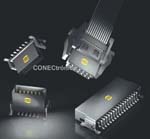
HARTING's har-flex® intermediate connectors, available in straight and angled versions for modular device design, are being used in a growing number of applications. The har-flex® variant for flat cables enables a wide range of board layouts on the device. Developers are even free to create new base designs, as the previous rigid right-angle configuration is no longer required. All har-flex connectors are freely combinable and adaptable to the base.
For example, har-flex connectors are perfect for all devices that incorporate a human-machine interface.
Depending on the configuration, the displays and buttons must be flexibly combined with the board. This is made possible by the har-flex connector for flat cable with Insulator Displacement Connection (IDC) technology.
Connectors must offer compatible and homogeneous solutions, regardless of whether they are used for board-to-board or cable-to-board applications.
 Spectacular performance.
Today's devices and machines must be extremely efficient and powerful. Increasingly, critical systems and networks are equipped with backup structures and controls. Machine status must be analyzed on-site, and controls must be directly accessible. On-site response times are accelerated, and not just for personnel.
It is increasingly common for automated control mechanisms, such as camera inspection, to access processes independently and continuously, in real time if possible.
Given this, components and machines must be equipped with increasingly intelligent and rapid control elements. Data transmission speeds within the device must be as fast as those of the external receiver, especially due to the demands of image processing. Central control systems must receive sufficient levels of data and information.
Data consistency plays a critical role in an increasingly automated and Ethernet-dependent world. HAR-FLEX connectors meet the requirements of the latest transmission protocols, such as Gigabit Ethernet and PCI Express. Data transmission speeds of up to 3.125 gigabits can be easily achieved. HAR-FLEX connectors can be installed in both switching boxes and portable devices.
It is now considered a minimum requirement that the system as a whole support demanding industrial environments. Miniaturization alone is not enough, and the load capacity must also be high, as end users will not tolerate performance or availability limitations.
 Shocks, vibrations, dust, and water cannot affect operational reliability, which obviously has significant repercussions for the device, the machine, and its components. The robust and compact design of har-flex ensures reliable operation, even under the most adverse conditions. It combines the serviceability of the latest computers with the durability of industrial equipment.
The systems must also be extremely easy to use and maintain.
Devices and machines are configured modularly, and components must be replaceable quickly and easily with minimal time and labor costs. Faults must be accurately identified as soon as they occur, reducing downtime. HAR-FLEX connectors provide this level of flexibility to devices.
The decentralized structure of modern facilities offers enormous advantages from the design phase onward, which also have positive effects on costs: machines no longer need to be integrated into the overall system for functional testing. The system and its functional capacity can be verified independently.
Intelligent Partners:
This requirement is also met by increasing decentralization in industrial automation and large-scale production machinery. Large components and machines incorporate decentralized control elements that allow for their direct activation on-site and in the field.
Queries about machine status, logging, and analysis of error reports and damage correction are decentralized to the individual components and the machine itself. This reduces the load on networks and central controls.
Therefore, components and machines must be equipped with smarter control elements without compromising the demands of the industrial environment. Data transmission speeds must also increase simultaneously to provide central controls with sufficient information and data for precise plant and production control procedures.
The launch of the new har-flex product range has attracted considerable attention in the international market. Users in the industrial automation technology sector, in particular, can see significant advantages for their applications. har-flex has already been incorporated into various new devices.