Throughput being
allocated. For example, if a 100 Mbps line is deployed, but you can only achieve a Committed Information Rate (CIR) of 50 Mbps through it, there is a problem. If you have a 10 Gbps link, but you can only receive 1 Gbps due to link reliability issues, the rate is unacceptable.
Latency (round-trip delay) –
This refers to the time it takes for a packet to reach its destination and return. This type of testing has been popularized by ping tests – an ineffective method for testing the link for reasons that will be discussed later. In any case, it is clear that long delays will negatively affect the end-user experience (although sometimes unavoidable, as is often the case with satellite links).
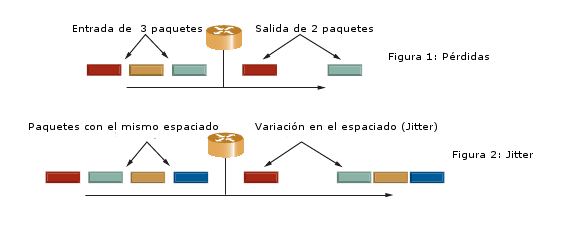
 Frame loss
occurs when packets sent from one end are not received at the other. Because Ethernet operates at the physical layer, the reliability of the Ethernet connection is important for the upper layers of the OSI model and can drastically impair it. For example, a 1 percent packet loss can degrade the Transmission Control Protocol (TCP) to as much as 80 percent, so even a small percentage of loss can drastically affect the quality of experience (QoE) for the end user.
The last parameter to test is the presence of jitter in the network. Jitter has little effect on a data-only network; however, excessive packet fluctuation (jitter) can disrupt service on a network transmitting IP television (IPTV) or Voice over IP (VoIP) traffic. Higher-level protocols cannot utilize late-arriving data packets. For example, in a telephone call, data packets arriving too late to the speaker's ears would be lost, resulting in degraded voice quality.
Testing Key Parameters:
It is important to conduct all tests at maximum CIR when testing an Ethernet connection. Problems rarely occur when the link is running at 0.1 percent utilization or less (as a continuous ping test often does), but rather at 100 percent utilization. Incorrect priorities, faulty line configurations, auto-negotiation problems, poor network planning, and even faulty cabling or network equipment rarely show problems at low utilization. A true assessment of link quality can only be determined when a network is operating at full capacity. Therefore, the first step in testing is to ensure that the committed data rate is being delivered correctly. While a customer who purchases a 10 Mbps link and receives 100 Mbps will certainly be satisfied; Another person who buys a 100 Mbps link and receives 10 Mbps won't be satisfied. Network planners and traffic managers don't like giving away bandwidth. Therefore, the first step in any kind of test is to determine if the link is delivering the expected performance.
Once throughput has been determined, the next step is to measure the frame loss rate across the network to determine if traffic is passing error-free. Because frames with an error-check sequence (FCS) are lost at a switch or router, erroneous frames will be lost across a network before reaching their final destination. Therefore, to determine connection reliability, each frame must be generated with a sequence number. Incoming frames are then checked for the correct sequence number, and any erroneous or lost frames are detected, allowing us to determine the frame loss rate.