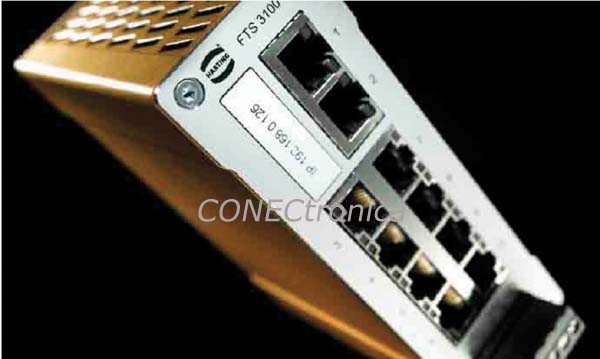
PROFINET managed available on the market) in the HARTING test laboratory (CTS) by measuring delays in two types of switches and in a linear topology.
In networking technology, two switching technologies are distinguished: Store & Forward and Cut-Through. Many industrial Ethernet switches operate in Store & Forward mode, where incoming frames are temporarily stored in the switch before being forwarded. In Cut-Through technology, the frame is transmitted as soon as the destination address is recognized. HARTING's Fast Track Switching technology identifies automation frames (e.g., PROFINET), prioritizes them over IT frames, and forwards them in Cut-Through mode.
Different switching technologies can be compared by determining their latencies. This parameter, which describes the time a frame spends in a switch, is defined in the technical documents RFC 2544 and RFC 1242.
Single-Device Latency:
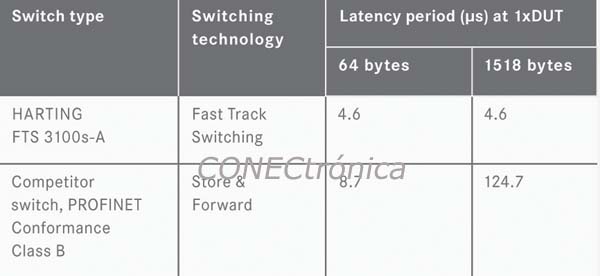
In a comparative measurement, the latency of the minimum and maximum frame lengths of 64 bytes and 1,518 bytes was examined (see Table 1). The parameters for all measurements were a data transmission rate of 100 Mbit/s, a maximum cable length of eight meters, bidirectional data traffic, and the use of the bit-send method for measuring latency. FTS technology reduced the latency at 64 bytes to approximately half that of Store & Forward technology, using a commercially available PROFINET switch as an example. Furthermore, latency is independent of frame length with FTS.
Frame Delay in the Network:
Frame delay in a network depends on parameters such as latency, the number of switches in use, network load, frame length, data transmission rate, topology, number of users, and cable length. Measurement configurations with two or eight devices in a linear topology were selected to examine these parameters.
'

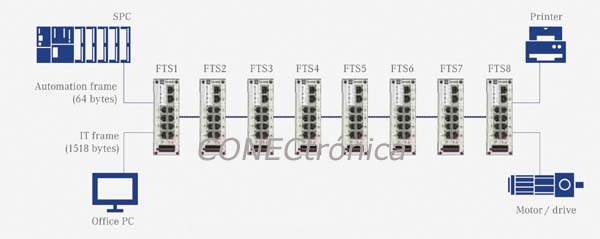
 With these configurations, a practical scenario was simulated in which a controller (e.g., a PLC) accessed an actuator (e.g., a disk drive), while simultaneously an office application traversed the same network path (see Figure 1). The shorter frames typically used in automation technology can be affected by the traffic of longer IT frames.
A comparison can be made between HARTING's Store & Forward and Fast Track Switching technologies in a configuration with FTS devices because FTS operates in Store & Forward mode if no automation frames are sent to the switch. For the measurement, short frames of 64 bytes were sent through one port, and long frames of 1,518 bytes were sent through a second port.
Because frame delay depends on traffic, a distinction was made between maximum and minimum throughput. The incoming data traffic was chosen to achieve a maximum throughput of 100% at the output of the first switch (Figure 2). Therefore, the throughput resulted from an approximate 5% load on the port with 64-byte packet lengths and an approximate 95% load on the port with 1,518-byte packet lengths. The abbreviations P and I used (Figure 2) refer to the preamble (8 bytes) and interframe spacing (minimum 12 bytes) as defined in the Ethernet standard. The minimum throughput was achieved by increasing the interframe spacing on the port for long frames (virtually 0% load). The conditions on the port for short packets were not changed. The result was an throughput of approximately 5%.
Conducting the experiment:
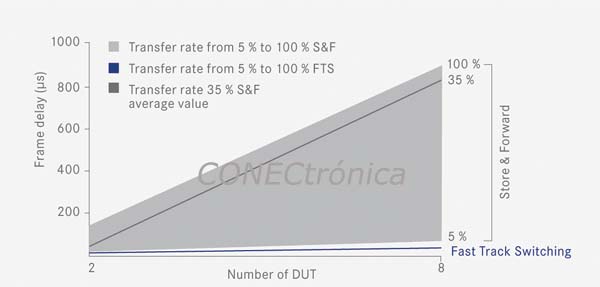
First, the experiment was conducted with unaccelerated frames, so that the Store & Forward conditions were very general. (The delays of the short 64-byte packets are shown in Figure 3).
The wide variation in cumulative latency between maximum and minimum throughput is particularly striking. The maximum frame delay measured in Store & Forward mode, at 887.6 µs, is noteworthy. This delay is due to the 1,518-byte frames. Upon exiting the switch, long packets occupy the output port for approximately 123 µs, causing short packets to be delayed several times. Since this bottleneck does not occur at the last switch, this delay happens a maximum of seven times. A response curve with a relatively low throughput of 35% was also recorded. The average frame delay measured here for eight devices was already 825.5 µs. This indicates that, in a real-world application, short frame delays are rarely achievable with Store & Forward technology.
The experiment also involved sending automation frames to the 64-byte port. The FTS recognized and accelerated these frames. As before, long IT frames were sent to the other port. Frame delays were measured again in both cases, at maximum and minimum throughput. As shown in Figure 3, frame delay variability was significantly reduced. The maximum frame delay for eight switches was reduced from 887.6 µs in Store & Forward mode to 45.1 µs.
This was possible because the FTS technology allows automation frames to be forwarded.
Results:
The measurement results clearly demonstrate the advantages of HARTING's Fast Track Switching: when using HARTING's Fast Track Switching, the latency of short frames is only half that observed when using a conventional Class B managed PROFINET switch. Furthermore, this result is independent of frame length. In an application example with eight switches in a linear topology, it was shown that FTS technology transmits frames at a significantly higher speed than Store & Forward. The Fast Track Switch significantly reduces the dispersion of Store & Forward delay, which is highly dependent on network load.
Perspective:
The management functions and the PROFINET IO stack do not affect performance analysis. However, the PROFINET IO stack offers the advantage that the engineering tool allows users to view, configure, and diagnose the switch. HARTING will soon offer managed FTS switches incorporating the PROFINET IO stack in addition to various management functions. The PROFINET IO stack will simplify device configuration and diagnostics in a PROFINET environment. In network planning configuration tools, such as Siemens Step 7, switches are integrated into the device libraries via the GSD file. During operation, diagnostics are transmitted to the control environment in a standardized format and can be accessed by users as usual.
These conveniences simplify working with the components without impacting performance. Combined with integrated Fast Track Switching technology, which enhances performance, a standard Ethernet communication system can now also meet field-level requirements. Therefore, the concept of a converged Ethernet network, from the control level to the field level, has become a reality. HARTING systematically focuses on these user-oriented concepts with its Automation IT product range.
Authors:
Torsten Halstenberg, Lab Engineer, Germany, HARTING Technology Group,
Thomas Korb, Director Product Marketing ICPN, Germany, HARTING Technology Group,
Julia Noel, Lab Engineer, Germany, HARTING Technology Group,