Existing Network Redundancy Technologies
Another common problem is the future expansion of the implemented network, or the long recovery times in case of failure, which can often occur. Many existing systems can improve the fault tolerance of an Ethernet network. The most common of these are STP (Spanning Tree Protocol) and RSTP (Rapid Spanning Tree Protocol), as well as various proprietary ring redundancy protocols.
Turbo Chain™
Moxa's new Turbo Chain™ technology addresses the slow recovery time of STP/RSTP and the inflexibility of ring topologies based on redundant technologies. Turbo Chain can be used with any Moxa managed Ethernet switch to implement a robust foundation for mission-critical applications with multiple redundant network connections, fast recovery time, flexible topology, and unlimited scalability—all at no extra cost, ensuring future-proofing.
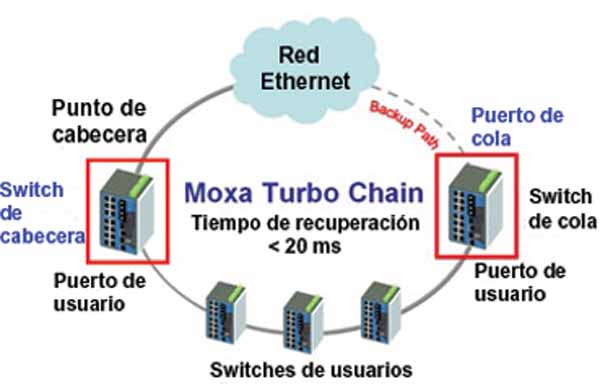
Using the innovative "chain" concept, network administrators can create any type of redundant topology across any network segment. Turbo Chain setup is simple: just connect the various switches in a chain, where one switch is defined as the "Head" and another as the "Tail" (the switches at the ends of the chain). The remaining switches are defined as "Members," and the chain is ready to be connected to any Ethernet network. No further configuration is required. See Figure 1.
 Turbo Chain provides the rapid recovery time required in any industrial application. Once a network segment fails, the blocked path (between the "queue" switch and the external network) is instantly enabled, with a recovery time always less than 20ms. This low recovery time ensures that the network remains available, with virtually no downtime.
Turbo Chain Benefits:
Turbo Chain offers significant advantages for industrial applications, which typically require complex and redundant topologies, and provides the highest reliability and availability for Ethernet network applications. When a network needs a multi-ring architecture, Turbo Chain is the best solution for several reasons: flexibility, scalability, recovery time, and cost savings.
- Implement redundant, scalable, and highly flexible topologies. Turbo Chain offers great versatility to accommodate complex network topologies. Using the chaining method, network engineers can now create as many redundant connections as they need simply by linking a Turbo Chain chain to any segment of an Ethernet network.
- Unlimited expansion to form scalable redundant networks. Turbo Chain allows for easy and unlimited expansion. Engineers don't need to reconfigure existing networks; instead, Turbo Chain allows them to scale directly onto existing networks. Furthermore, Turbo Chain can connect to networks that use other redundancy protocols, such as STP/RSTP or Moxa's Turbo Ring.
 - A reliable and immediate recovery mechanism. Turbo Chain offers high redundancy and can tolerate failures in network segments. If a specific network link fails, Turbo Chain will activate the blocked path and continue sending data, always with a recovery time of less than 20 ms.
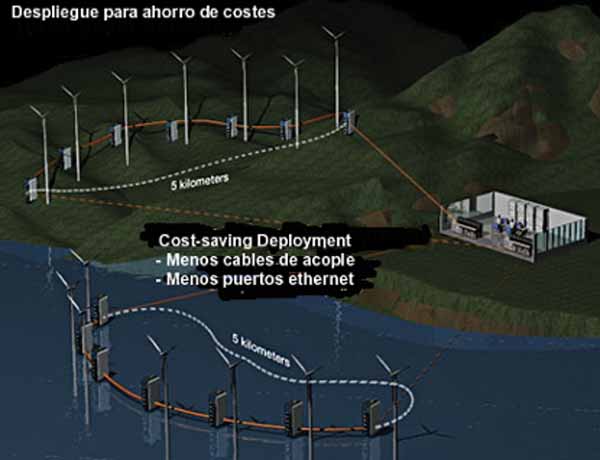
- Cost-effective implementation. Turbo Chain reduces installation time, effort, and costs, as the connection of the different redundant networks can be made without ring coupling cables. Compared to ring coupling technologies, Turbo Chain offers considerable cost savings, as the Ethernet ports and kilometers of fiber used in coupling links are eliminated.
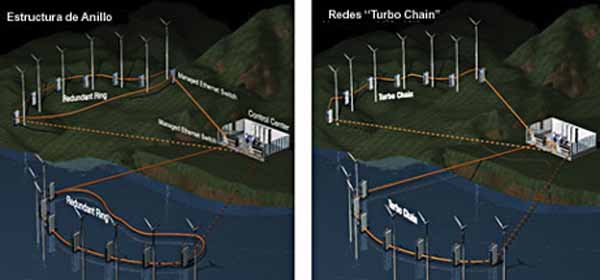
This type of implementation is ideal for applications that require network redundancy and have limited budgets, or where cable installation is costly. Figures 2, 3, and 5 show how significant budget savings can be achieved using Turbo Chain.
With Turbo Chain, 10 km of coupling cable are saved in the wind turbine installation shown in Figure 5, based on a real-world case. Turbo Chain allows unlimited redundant network expansions without reconfiguration, and since Turbo Chain is compatible with IEEE 802.1w/D RSTP, STP, and Turbo Ring standards, it can be integrated with any other Ethernet network.
Real-world applications
Wind turbine systems
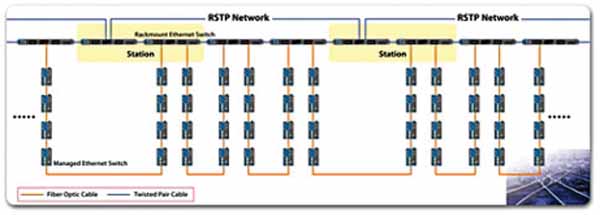
Wind energy installations consist of a series of wind turbines spread over a large area of land, where redundant Ethernet connections are an ideal solution for connecting devices on each turbine to the same network. However, typical ring network technologies are expensive, cumbersome, and cause problems when all nodes are connected. Turbo Chain is the best solution, as it meets all the application requirements: a reliable and fast-restoring network (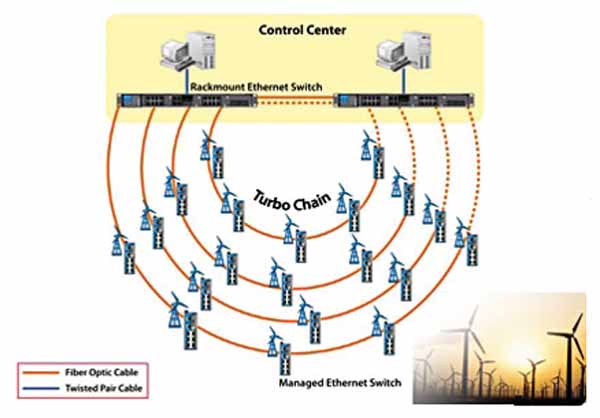
Railway systems
use a centralized, redundant monitoring system to connect different communication stations for real-time operation, ensuring safety. Turbo Chain allows the system to be easily and quickly scaled when the network needs to be expanded. Instead of creating new sub-rings for a new network, or routing or reconfiguring the existing network, administrators simply chain the new nodes together and connect the chain to the existing network (Figure 6). Whether the current network operates using STP, RSTP, or Turbo Ring protocols, Turbo Chain can reliably interface with any of them.
Author: Article provided by Tempel