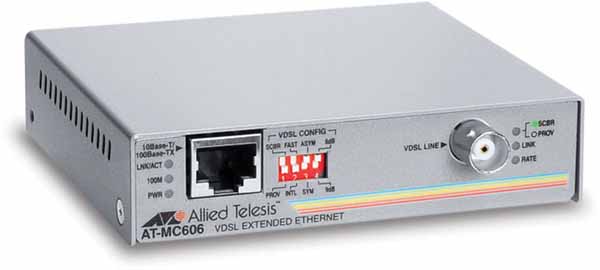
The AT-MC606's capabilities are particularly well-suited to the IP surveillance market. This market has a large installed base of analog cameras, which rely heavily on coaxial cable to connect the camera to both the control center and an encoder that converts the analog signal to digital. However, these are being replaced by digital cameras that offer higher image quality, no signal degradation, and are easier to install and maintain. The challenge with upgrading to digital cameras is that they require an Ethernet network, based on either twisted-pair copper cable or fiber optics, and until now, this has necessitated a network upgrade.
The AT-MC606 is a standalone media converter, the same size as other Allied Telesis media converters, making installation and setup simple, and offering redundant power supply options. It features two front-panel connectors for easy installation and management: an RJ45 connector for 10/100T Fast Ethernet and a BNC coaxial connector for 50 or 75 Ω cable. It's simple to set up, works right out of the box, and requires no management configuration via a web-based graphical user interface.
The AT-MC606 can deliver up to 100 Mbps in asymmetric mode and up to 85 Mbps in symmetric mode over distances of up to 200 m. Over cable lengths of 2 km, the product can deliver up to 20 Mbps in symmetric mode and 30 Mbps in asymmetric mode.
Asymmetric mode is useful for IP surveillance because it allows downlink instructions/information, such as framing and zoom, to be sent to the camera with minimal bandwidth, while allocating maximum bandwidth to the uplink for video sent to the servers. It provides sufficient bandwidth to support multiple IP cameras over a single existing coaxial cable.
Control of RS232/422/485 serial devices via Ethernet TCP/IP or Internet.
NetCom Servers are devices that allow you to connect RS232/422/485 devices virtually via Ethernet and the Internet, as the NetCom creates a remote serial port to act as a local virtual COM port.