
Original Features:
- 11-bit identifier (2048 different) including message priority.
- 0-8 bytes of data and 16-bit CRC resulting in a Hamming distance of 6, offering a high level of security against communication errors.
- CAN-Bus gained success based on its Multi-Master Data-Producer/Data-Consumer model versus other Data-Source/Data-Destination models.
- Communication speed 10 Kbit/s - 1 Mbit/s. The maximum is determined by the speed of light in a cable and the maximum cable length.
Bosch subsequently published the CAN 2.0A and B specification in 1991, with 11-bit and 29-bit IDs.
- 29-bit identifier (allows for more than 500 million different IDs) including message priority.
CAN-Bus gained great popularity due to its excellent characteristics and came to form the basic layers (1: physical and 2: data-link) in well-known protocols such as:
- Devicenet from ODVA
- CANopen from CIA
- J1939 from SAE
- NMEA-2000….
But the maximum speed of 1 Mbit/s and a maximum of 8 bytes per frame put a limit on applications with ever-increasing demands for data and speed.
Ethernet and Flexray began to compete despite their lack of simplicity and flexibility...
Bosch began working on a new evolution of CAN. In 2012, they launched CAN FD 1.0
CAN FD Features:
- 11 or 29-bit ID identifier including message priority, equal...
- 0-64 bytes of data and 16/18/22-bit CRC resulting in a Hamming Distance of 6 (equal good)
Among the new devices presented by IXXAT, represented by ER-SOFT, for CAN FD are:
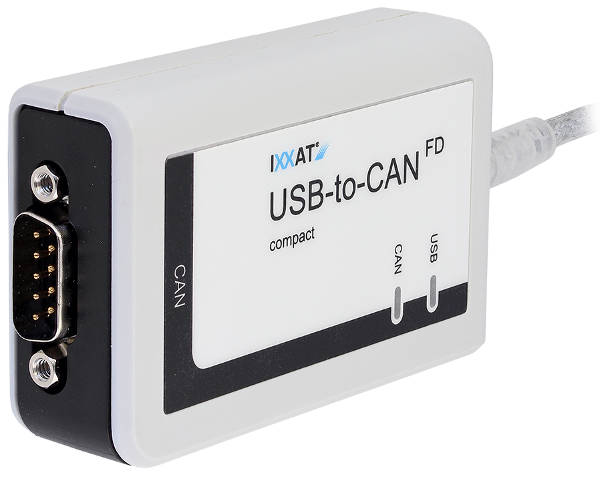 * USB-to-CAN FD
The USB-to-CAN FD has one or two channels (depending on the device variant) and supports three operating modes configurable via a switch: ISO CAN FD, non-ISO CAN FD, and CAN High-Speed. The automotive version provides a LIN channel.
- CAN, CAN FD, and LIN in a single device
- Robust, cost-effective, and extremely versatile
- For industrial and automotive applications
- Galvanic isolation
'
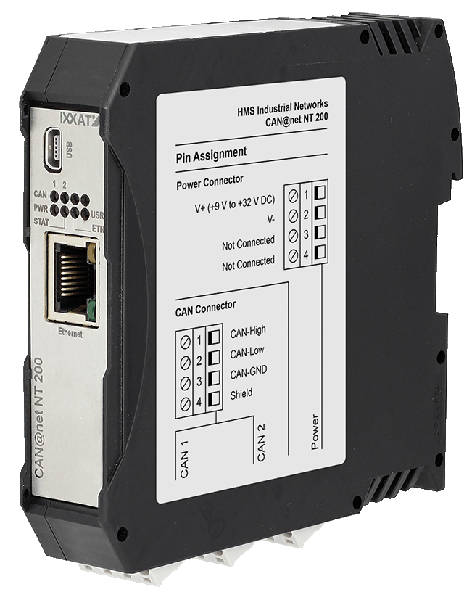 * CAN@net NT 420 (CAN and Ethernet)
The CAN@net NT 420 can control up to four CAN channels (two CAN FD channels) and can function as a CAN-Ethernet gateway, bridge, and PC interface. It offers easy coupling between CAN systems, CAN FD devices, and other devices.
Bridging over long distances and easy remote system access are all achieved via Ethernet.
Cost savings are ensured through simple cabling, and it is designed for high performance in harsh environments. It supports
up to four independent CAN channels (two CAN FD channels) and features powerful filtering, ID translation, data mapping, and multiplexing functionality.
A Windows configuration tool allows for easy setup via USB or Ethernet.
'
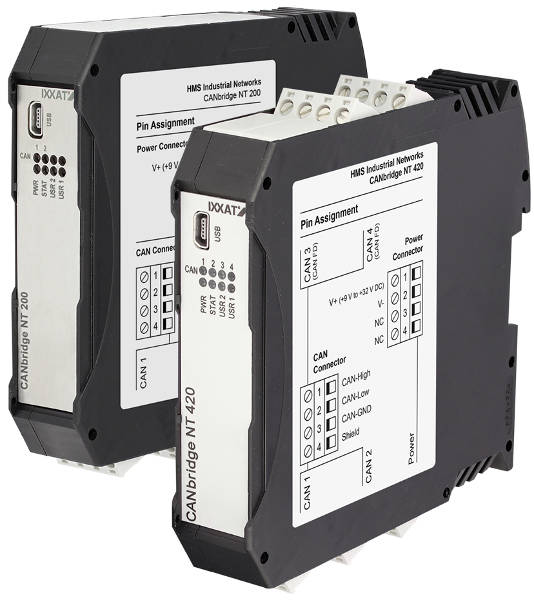 * CANbridge NT420
The CANbridge NT 420 can control up to four CAN channels (two CAN FD channels), is easy to integrate into CAN networks (CAN FD), and offers seamless integration between CAN systems, CAN FD devices, and other devices.
It enables the expansion of tree and/or star topologies and offers cost savings thanks to simple wiring.
The line is protected by galvanic isolation and is designed for high performance in harsh environments.
'
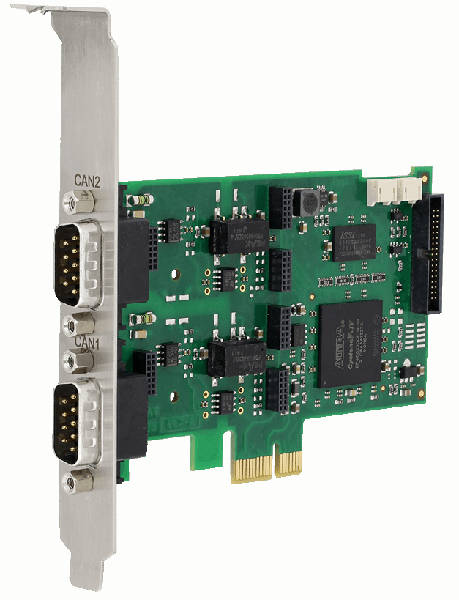 * CAN IB500 - CAN IB600
The PCIe CAN IB600 and IB500 cards offer one or two CAN 2.0A/B and CAN FD interfaces. These cards are based on a modern, highly modular, and flexible architecture that allows for easy expansion with customer-specific interfaces via piggyback modules/plugins/extensions.
They are active cards with a 32-bit microcontroller and up to two CAN channels (High-Speed CAN or CAN FD).
Available in standard or low-profile versions with galvanic isolation.
* CAN Analyser Standard or Lite (Lightweight/Economical)
The canAnalyser is a versatile and valuable tool for developing, testing, and maintaining CAN, CAN FD, and LIN-based systems. The software is based on a modular concept and is available in two versions (lite and standard) with different sets of functions and modules for the various CAN-based protocols. It features an intuitive and configurable interface.
It offers easy and intuitive network analysis, hard drive data storage, and high-precision timestamping of CAN frames.
It also allows for offline post-analysis.
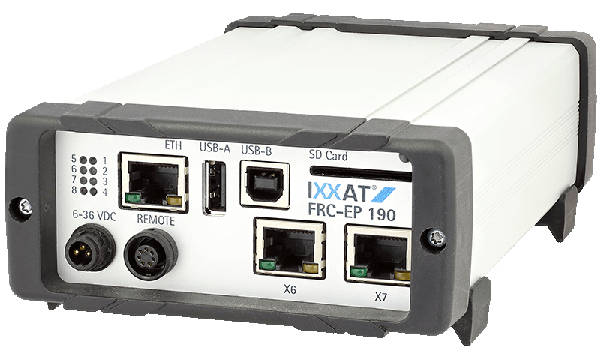 * FRC-EP 190
The embedded platform is part of multiple analysis and testing applications, including IXXAT ACT (Automotive Configuration Tool) tools and customer-specific software solutions specifically designed for automotive and test bench applications. It is
a platform for analysis and measurement with up to four high-speed CAN interfaces, two low-speed CAN interfaces, and two CAN FD channels. It
provides level and error monitoring on up to two CAN interfaces





