 Robots that can see
Svensk Industriautomation (SVIA) is a rapidly growing automation company based in Jönköping, Sweden, that develops robotic systems for customers in the Nordic countries, Germany, the UK, the Netherlands, and the US. These systems are integrated into automated cells, which communicate with other systems within a factory, for example. The most important component of the automated cell is SVIA's proprietary vision system, called Pickvision, which precisely detects how a particular object is positioned on a conveyor belt and thus enables the robot to pick it up. Simply put, SVIA allows robots to see. This revolutionary technology has become very popular in the automation market and has enabled SVIA to double its revenue in recent years.
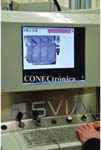
“Our strength lies in simplicity,” says Anders Mandorsson, project manager and designer at SVIA. “It’s very easy to tell the robot what to pick up from the conveyor belt, and then you’re ready to go.” Using Pickvision software, users take a photograph of the object they want to lift from the belt.
The software automatically detects the shape of the object, and each time this shape is shown on the camera, the robot is able to determine how to lift it.
Connecting DeviceNet and PROFIBUS:
As the most advanced automation systems, SVIA's automated cells need to communicate with some kind of wide industrial network, and this type of communication isn't always straightforward.
“A couple of years ago, we built an automated cell for a customer who promised me access to their PROFIBUS system, but after a while, it became clear that our system was going to be just a separate node on their network. That's when we came across HMS's Anybus X-gateways. We tried installing one inside our cabinet, and it was able to handle the conversion between our DeviceNet-based system and the customer's PROFIBUS system very smoothly,” says Anders Mandorsson.
Since then, SVIA has used Anybus X-gateways in many of the automated cells they deliver to customers worldwide. Once again, simplicity is key. “DeviceNet is the standard we use in most of our cabinets, and instead of handling the conversion to other networks ourselves, we simply install an HMS X-gateway. It’s more economical, but above all, it simplifies things for the customer, as they gain clear separation between our system and their own factory network,” says Anders Mandorsson.
How it works:
SVIA automated cells typically come with ABB robots, which operate on a DeviceNet-based network. The robots can easily communicate with other DeviceNet networks, but if they need to connect to a different network, such as a PROFIBUS network (with a Siemens PLC) or an EtherCAT network (with a Beckhoff PLC), a "translator" is required. Anybus X-gateways perform the conversion between the two networks using their own integrated software, which restructures the telegrams from one side and makes them understandable to the other. Configuration takes only minutes using the Anybus Configuration Manager software, meaning no programming is necessary.
Flexibility.
SVIA's automated cells are highly flexible and can be easily adapted to meet the needs of different customer applications such as assembly, packaging, drilling, and turning. Through the Anybus X-gateways, SVIA can also be very flexible in terms of the networks to which it can be connected. "To be honest, we don't think so much about networks anymore," says Anders Mandorsson. "When we create a robotic system, we simply order an X-gateway port that converts it to the customer's industrial network—we plug it in, and it works."
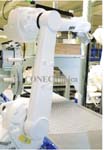
In Pickvision, the operator decides what to take from the conveyor belt. A photograph is taken of each item, and the software identifies the shapes.
When an automated cell is working, a camera on the ceiling monitors the conveyor belt...
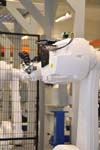
...and allows the robot to know exactly what to pick up and how to do it.
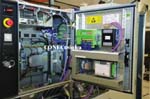
An Anybus X-gateway port performs the conversion between the Robotic Cabinet's DeviceNet system and the end customer's PROFIBUS network.