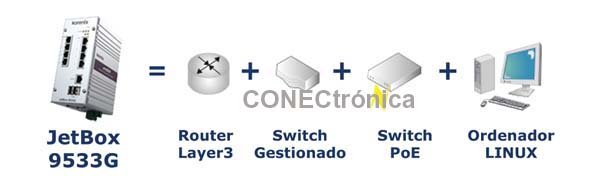
 The computer, in most cases a home computer operating in an environment other than an office, becomes the critical point of the installation. Although it may always operate below its processing capacity, its non-robust design can threaten the reliability of the network.
 On the other hand, adding a PC to the other hardware devices needed for the project (router, switch, and PC) significantly increases power consumption. When the application is in a remote location with limited power available from batteries and solar panels, the computer can be a significant drawback. Furthermore, more devices mean more cable connections, which can also decrease reliability and increase the space required.
New Trends:
More and more applications require a PC, so the industrial communications sector is researching and evolving towards new devices that go beyond the simple switch or configurable router.
New all-in-one devices are becoming increasingly popular, offering full switching/routing capabilities, serial port servers, and digital I/O, all of which are easily programmable by technicians of all types. This allows for the development of custom applications within the switch or router itself, tailored to the specific needs of each project, providing far more options than a configurable menu on a traditional device.
These devices are called Embedded Communications Computers or Embedded Routers, depending on their features. They are compact, efficient, and maintenance-free (with no fan or moving parts) that allow the integration of different devices into a single unit. Optionally, depending on the project, they can also include GPS, Wi-Fi, or 3G.
 The hardware integration they offer leads to other direct benefits, such as software integration, since they are a single, all-in-one device. They also include all the necessary programming tools and drivers to meet any need.
Korenix Technology's JetBox devices:
The JetBox range consists entirely of fanless devices, resulting in a high degree of reliability. Furthermore, the standard models come from the factory with an extended operating temperature range: -25°C to 70°C.
These are embedded Linux computers with Korenix's JetOS Linux operating system, a version of Fedora adapted for JetBox, and available in two versions depending on the model: JETOS95 with a 2.6.21 kernel and JETOS93 with a 2.6.20 kernel for the more basic models. They integrate various Ethernet interfaces, typically a WAN port and a multi-port switch for the LAN interface, as well as several serial ports and digital input/outputs.
Being based on Linux, they are completely open devices that offer a high degree of compatibility and are easy to program by any type of programmer; in addition, to facilitate the work there is a free SDK development environment.
 The devices themselves come integrated with all the communication tools through which it is possible to easily configure layer 2 and layer 3 functionalities at the web interface level or by function call.
Thus, these unique devices perform VPN, Firewall, DMZ, OSPF, RIP, DVMRP, static routing functions: NAT, PAT protocols, as well as layer 2: DHCP, QoS, VLAN, SNMP, ACL, etc.
Thanks to these features and integration, the concept of the small application developed in MSDOS/LINUX that allowed working on a simple computer in a very stable way is recovered, and which had now lost much of its reliability by requiring a computer with fans based on Windows.
The Linux PC can be accessed via the serial console port or via Telnet from the LAN or WAN. It also allows for web-based configuration, like any other manageable switch, through the optional Webmin menu.
Finally, it includes all the necessary software tools for serial ports, digital inputs and outputs, 3G connections, and Wi-Fi. The kernel contains a wide variety of drivers along with the most common Linux utilities for configuring and managing 3G PPP (Point-to-Point) and Wi-Fi connections.
 Models with PoE functionality on their LAN ports are particularly noteworthy, allowing for direct powering of peripherals connected via Ethernet cable. Even more advantageous are models with booster power systems that enable PoE functionality with just a 24VDC power supply. This is ideal for in-vehicle systems.
For industrial automation applications, there are Modbus-compatible models available, allowing for easy integration with SCADA systems without the need for special communication equipment software. The SCADA system itself can communicate directly with the JetBox.
The application fields for these devices can be: industrial automation, energy efficiency, renewable energy plants, power plants and substations, transport systems, tolls, parking lots.
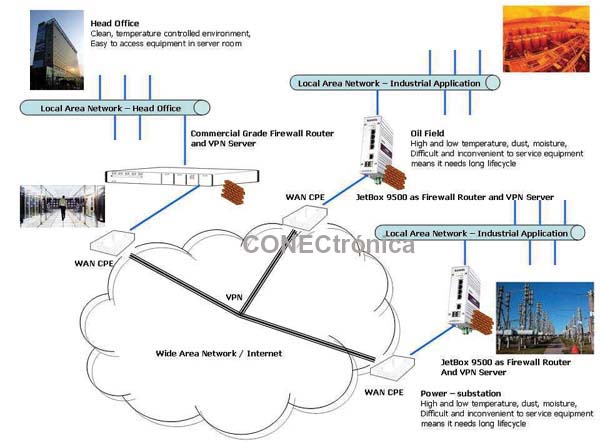
Example 1: VPN Server System for Remote Facility Control
In a facility with multiple remote subnets separated by a WAN/Internet network, the most suitable solution to protect data is to use virtual private networks, the well-known VPN (Virtual Private Networks).
VPNs allow you to create tunnels across WANs, protecting information and making it accessible only to authorized personnel. The Jetbox 9500 can act as a VPN server to terminate these tunnels and decrypt the information, making it transparent to devices on the facility's network. It
also functions as a firewall using the popular Linux utility IPTables, simplifying configuration. Furthermore, it supports Java VM (Virtual Machine), enabling the easy development of Java-based VPN applications.
In addition, the JetBox 9500 allows VPN with Open VPN protocols, IPsec with PSK authentication and RSA “left and right”.
Example 2: Custom Serial-to-Ethernet Converter.
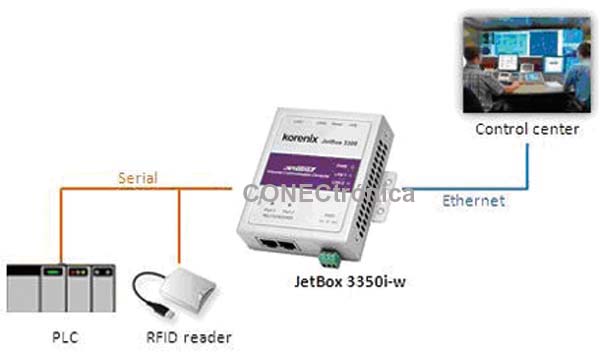
With a basic JetBox model like the JetBox-3300/3350i-w, which features "Serial2Net" (a serial-to-Ethernet converter function), it's possible to route data from any serial device directly to a server, or to allow access from any PC on the network to, for example, a factory PLC. Serial2Net enables the creation of a custom serial-to-Ethernet converter tailored to the specific application requirements.
The Serial2Net application provided by Korenix allows the creation of programs tailored to the application and also has digital outputs, a redundant Ethernet port, and an isolated 2KV serial port, in case it is needed for industrial environments.
Due to their low cost and flexibility, they are used in commercial applications with barcode readers or POS (point of sales) systems.
Example 3: Payment Terminal.
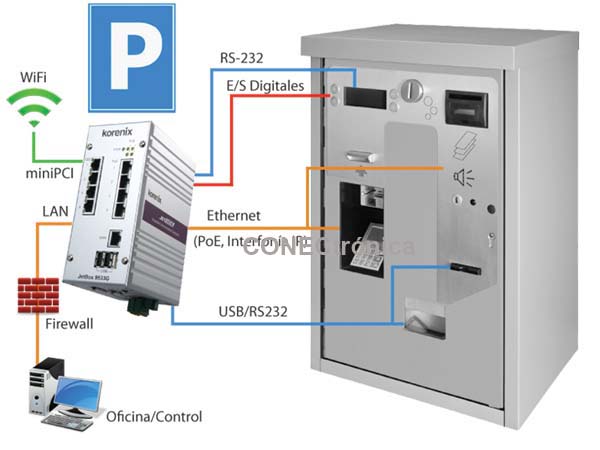
At a parking lot, tollbooth, or other payment point, a JetBox, without fans or moving parts, can replace the traditional computer, Wi-Fi access point, LAN switch, and security firewall. Furthermore, it minimizes maintenance.
JetBox has a control program that manages the various peripherals connected to the switch, including those powered by PoE over the LAN and others connected via USB or serial ports. Simultaneously, it allows you to activate digital outputs and view the status of digital inputs.
JetBox can also manage Wi-Fi and network communications with the control center.
This allows us to perform all control functions on a single, highly reliable device thanks to a high degree of hardware and software integration. Furthermore, it saves space and energy, resulting in significant savings in development and subsequent maintenance costs.
Example 4: DHCP Server for IP Assignment by Port Number.
To facilitate remote system maintenance, a DHCP application is developed within the JetBox itself, capable of always assigning the same IP address to the device connected to a specific LAN port. This allows a replacement device, configured in DHCP (the default factory setting), to be connected directly to its corresponding port, and the JetBox will assign it the same IP address as before. Thanks to this DHCP application within the JetBox, manually configuring the IP address is unnecessary, as is the possibility of DHCP assigning a random IP address that could cause problems for the new replacement device. This allows anyone to replace the device, saving the need for a technician to configure it.
Example 5: IP Video Surveillance System on a Bus
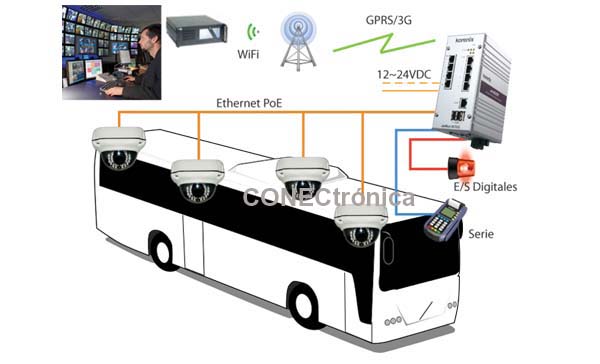
A single JetBox is capable of powering and managing the surveillance system, payment and ticket printing, and the relationship with the control center.
Thanks to the PoE Booster function, the JetBox powers standard 48V PoE cameras from a 12 or 24V input (the vehicle's own).
It communicates with the control center via Wi-Fi or, failing that, via the 3G mobile network using an application that runs on the JetBox itself, which manages the connection change quickly to minimize downtime. In any case, since it has an SD memory card slot, it also allows for local image recording.
Finally, through the serial ports, the JetBox itself can control the bus ticketing system, along with the digital I/O for the indicators and alarm buttons.
Example 6: SCADA System for Electrical Substations.
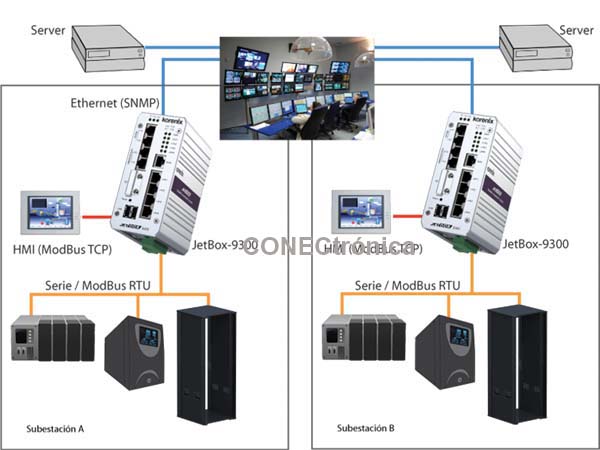
To collect data from more than 150 electrical substations distributed across a large area, a JetBox is used in each substation. This JetBox supports the conversion function between the Modbus and SNMP (Simple Network Management Protocol) protocols. The JetBox acts as a Modbus-to-SNMP gateway, allowing engineers to locally verify and modify the processes of devices operating in Modbus mode. Data is stored on SD cards and then transmitted via Ethernet ports. Furthermore, thanks to its digital inputs and outputs, it allows for the control of process indicators and switches, and the serial ports enable the management of Modbus/RTU devices.
ARTICLE PROVIDED BY QNV