


The Fritz!Box operates using the current Wi-Fi 6 AX2400 class WLAN standard. This provides a significant increase in data transmission speed, especially over short distances, improved parallel switching, reduced latency, and a more stable wireless network overall. It achieves speeds exceeding 570 Mbps on the 2.4 GHz band and over 1800 Mbps on the 5 GHz band.
The device offers all WiFi 6 technologies:
- Beamforming to improve coverage
- MU-MIMO to transmit data to different WiFi recipients simultaneously
- OFDMA
Additionally, you can access the router through the MyFritz service using a web browser or an app to get information or adjust settings. The router's management system is user-friendly and allows for straightforward operation for average users.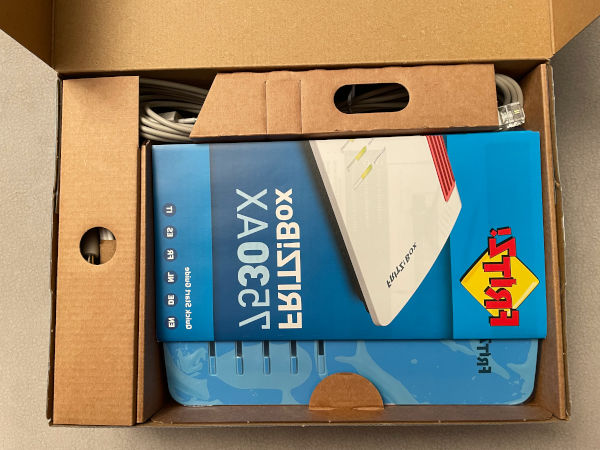
Furthermore, the 7530AX supports IPv6, forms an effective mesh network with other home WLAN devices, and allows for easy integration of new devices with the push of a WPS button. Guests can also connect to the home WLAN using a QR code.
In addition to internet access, the 7530AX also offers telephony. It includes an integrated IP-based system that allows connection to up to six cordless phones. Features such as the answering machine, which automatically forwards voicemail messages to your email address, and the (optional) integration of existing phonebooks from Apple, Google, or Telefónica are attractive additions. A fax function is also included. No separate fax machine is required; incoming messages are automatically forwarded as PDFs via email.
When we open the box containing this FRITZ!Box 7530AX
router, we will find: - FRITZ!Box 7530AX router
- 12V 1.5A power adapter
- 1.5m Cat5e network cable
- 4m xDSL RJ-11 to RJ-45 cable
- Quick installation guide in Spanish
- Router setup card with the SSID and password SPA2
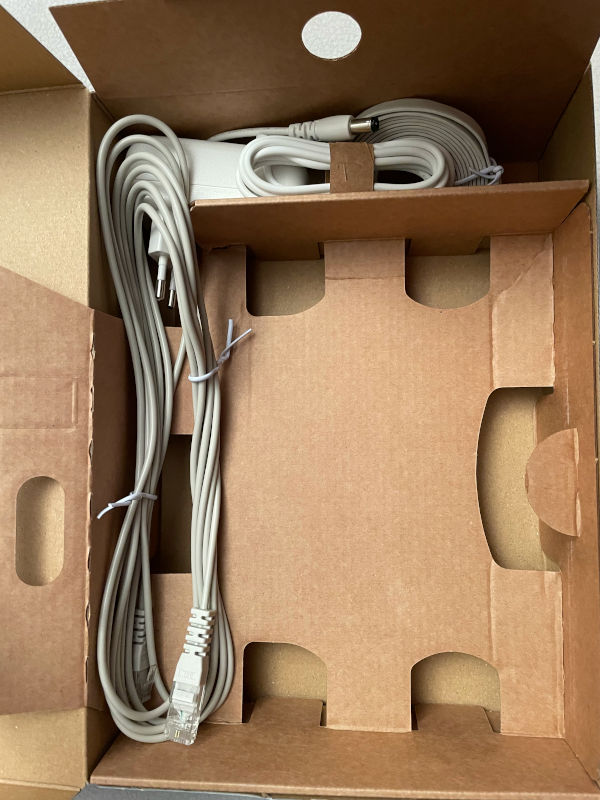 The RJ-11 -> RJ-45 cable allows you to use the integrated xDSL modem (ADSL2+ and VDSL2) and is long enough to connect to any RJ-11 socket in a normal home (note, it is not suitable for fiber optic connection).
There are four Gigabit LAN ports on the router itself, although considerably faster 2.5 Gbps interfaces have been omitted. There's also a USB 2.0 port for external storage. The casing has a modern red and white design and indicates its status via five LEDs on the top.
In the practical test, we measured an average data speed of only 491 Mbps under optimal conditions using a WiFi 6 interface from a leading manufacturer, dropping to 483 Mbps in a typical home environment.
We repeated the test with a WiFi 5 interface from a leading manufacturer, achieving 359 Mbps under optimal conditions.
We also tested a parallel connection of two devices with an average performance of 363 Mbps.
The FRITZ!Box 7590 AX is a Wi-Fi 6 router with 4x4 MU-MIMO. In 11ax Wi-Fi 6 mode, it promises WLAN data rates of up to 1200 Mbps on the 2.4 GHz band and up to 2400 Mbps on the 5 GHz band. In 11ac Wi-Fi 5 mode, the device reaches up to 1733 Mbps on the 5 GHz band, and in 11n Wi-Fi 4 mode, up to 800 Mbps on the 2.4 GHz band.
Furthermore, the new 11ax router is also backward compatible with older devices that transmit using 802.11ay and 11g. The older 802.11b standard from 2000 is no longer supported by AVM. In any case, it's safe to assume that 11b WLAN devices are already largely obsolete. In other words, (almost) no one will need 11b WLAN in 2021.
The WLAN hardware is complemented by intelligent WLAN software. The WLAN can be turned on and off not only via the software, but also using buttons and even connected DECT phones. WPA2 comes pre-configured as the WLAN encryption. The new WPA2/WPA3 transition mode can be enabled via software.






