The Covid-19 vaccine is here, but how do you distribute millions of doses when they need to be stored at -70°C? The refrigeration experts at L&R Kältetechnik in Sundern, Germany, have the answer: in shipping containers fully equipped with refrigeration and power generation technology. And with cables from LAPP.
In November 2020, the German company BioNTech applied for approval of its COVID-19 vaccine in the United States and announced that the first doses would begin to be administered in December. Hopes were somewhat dampened when it became known that the vaccine must be stored at -70°C and only in a standard refrigerator for a short time before administration. BioNTech supplies the vaccine in boxes that act like large insulated containers, maintaining the contents at the correct temperature for several days. But what can logistics companies do if they want to ship the vaccine in containers by air or sea, where transport takes longer? “As soon as the problem became known, we set about finding a mobile, self-contained solution,” says Christoph Wiemer, head of sales for special systems at L&R Kältetechnik. The German company, headquartered in Sundern and with 150 employees, manufactures refrigeration systems, including machine cooling with chilled water and special systems for exceptionally low temperatures for the chemical and pharmaceutical industries.
A container for 3.5 million vaccine doses.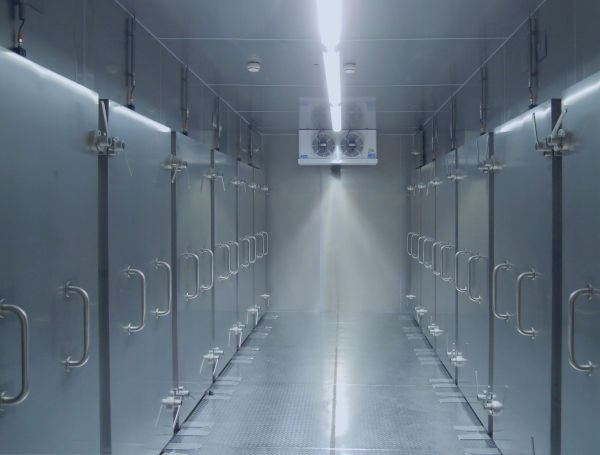
The company has been building stationary refrigeration systems for 25 years. But the vaccine requires a mobile solution. L&R came up with the idea of taking a conventional 20- or 40-foot shipping container and installing a refrigeration chamber, including cooling and even an autonomous emergency power source with a diesel generator or liquid nitrogen, and ensuring that everything has a backup in case of failure. A standard 40-foot container can hold a 40-cubic-meter refrigeration chamber at -80°C and a preliminary chamber at -20°C, which acts as a low-temperature airlock. The storage area is estimated to have a capacity of up to 3.5 million vaccine doses. The first container will be ready in a few weeks and will cost between €150,000 and €300,000, depending on the size and equipment installed. The price is lower than it seems. For such low temperatures, shipping companies typically have to use dozens of laboratory freezer cabinets, which are not only expensive but also require significantly more energy and space. According to Wiemer, the announcement generated considerable interest, particularly in Russia and Japan. “Our management expects to sell up to 70 containers in 2021. We already have many inquiries.”
Hot and Cold:
For 20 years, L&R Kältetechnik has exclusively used LAPP cables. “Service, delivery time, prices: everything fits together perfectly, and we are very satisfied,” says Wiemer. LAPP also delivers on time to construction sites, for example, for mining projects where the ground is frozen, facilitating drilling and eliminating the need to pump out groundwater. Both there and in the vaccine container, the cables have to withstand extreme temperatures, both hot and cold. For example, the refrigerant flows through the evaporator at a temperature of -90°C. Fans ensure that the heat is dissipated. To prevent the electric motors from freezing, the bearings are heated. The two compressors have a power output of 20 kW each, and currents of 40 amps flow through the ÖLFLEX® CLASSIC 110. Directly in the diesel generator, the temperature can rise to over 100°C. In the storage compartment, where temperatures can reach as low as -100 °C in some areas, ÖLFLEX® HEAT cables with PTFE sheathing are installed. L&R Kältetechnik plays it safe, as the ÖLFLEX® HEAT 260 SC is suitable for the most extreme application requirements. It is robust, chemical-resistant, and space-saving for use in machine and equipment construction from -190 °C to +260 °C.
Heating for the Lights and Door Frame:
In addition to the power cables for the refrigeration system, the container also houses signal transmission cables, for example, from the temperature sensor that controls the frequency converter and, consequently, the compressor. Furthermore, the operator can connect a data cable to the control cabinet via an available interface. There are also some cables that are not for cooling, but for heating. When you turn on a light at home, the bulb shouldn't be covered so the heat can dissipate. With this vaccine container, the problem is precisely the opposite. In this case, the LED light strips actually need to be heated because otherwise, they could malfunction. The rubber seal on the door between the lock and the storage chamber can also freeze instantly, trapping anyone inside and quickly putting them at risk of death. To prevent this, there is heating in the door frame and door contacts, and this is monitored when someone enters the chamber. The person present in the low-temperature section of the container must press a button regularly. If there is no signal, the person may have lost consciousness and an alarm may be triggered. Any failure in the electrical system could cost lives, which is why L&R Kältetechnik is playing it safe with LAPP cables. “In our quotations, we not only specify the properties of the cables, but also that they are LAPP ÖLFLEX® cables and what type,” emphasizes Christoph Wiemer. “That really makes a difference for our customers.”
Incidentally, -80° Celsius isn't the coldest system in Sundern. L&R Kältetechnik produces refrigeration chambers that operate down to -110°C, including some for therapeutic applications. "Cold saunas" are becoming increasingly popular for regenerating the body and also for reducing stress and relieving pain. At -110°C, users only need 2-3 minutes per session to achieve these results.