 First, NVP stands for Nominal Velocity of Propagation. It's the speed at which data signals travel through the cable, expressed as a percentage of the speed of light in a vacuum. Therefore, a typical NVP for an unshielded cable might be 69% (sometimes expressed as 0.69).
The speed of light in a vacuum (indicated by the letter c) is a constant and is 299,792,458 ms⁻¹ (meters per second) – as we can see, it's much simpler to state the percentage than the exact value.
What is NVP used for?
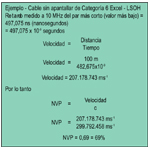
Part of the requirements for cable testing is recording the length of the copper data cable. This can be done manually by reading the cable jacket, relying on accurate markings, and recording the measurement. This is not a simple task once the cable is installed and would require manual entry into the test results. Therefore, if we know the speed at which the signal is transmitted through the cable, the test equipment simply needs to use the formula: Distance = Speed x Time
The test equipment measures the signal delay (time) and uses the speed (NVP xc).
What length is used?
Actually, there are different lengths in a twisted-pair cable.
- Cladding length
- Copper length
The length of the sheath is the physical length, and most cables, like Excel's, have markings indicating the meters to facilitate measurement. The length of the copper is the actual length of the copper conductors. Data cables are composed of twisted-pair cables.
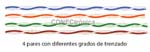
Each of the four pairs has a different twist rate, resulting in a different length.
The pairs have different twist rates to improve performance and reduce crosstalk. These varying lengths account for the differential delay (see below). When cable length is mentioned in relation to the installation or cable design, it refers to the length of the outer jacket.
Why is length important?
Attenuation (insertion loss) is directly proportional to the length of the installed cable. The longer the cable, the greater the attenuation or loss of the signal. Components for infrastructure cabling systems up to and including Class FA are designed to ensure that insertion loss does not exceed certain values when the channel length is a maximum of 100 m. By specifying these limits, applications can be developed knowing they will comply with generic cabling system standards. As mentioned earlier, the twist rate of each pair is different within the cable jacket. The varying lengths of the pairs mean that the delay (the time it takes for the signal to travel along the cable) will be different for each pair. The difference in delay between the shortest and longest pairs is the differential delay. It is important that the differential delay does not exceed certain limits to ensure the proper functioning of applications using multiple pairs.
How is NVP calculated?
Standards use the delay measured at 10 MHz of the shortest pair in 100 m (cable sheath length).
Finding the NVP?
The NVP of data cables is indicated on the specification sheets and is often also stored on the test equipment along with the manufacturer's name (e.g., in Excel). These are nominal values, as the name suggests, and can vary from batch to batch. For greater accuracy, the actual batch of the cable used in a given installation can be checked. The NVP can be measured using test equipment such as the Fluke DTX-1800. The test equipment is connected to a permanent link of a specified length (using the cable sheath length measurement). The test equipment has a function to calculate the specific NVP without performing the previous calculation.
 In summary, NVP, or Nominal Propagation Speed, is the fraction or percentage of the speed of light used to express the equivalent speed at which signals travel through the installed cable. This speed is used to measure the cable length. Knowing the length of the installed cable is important to ensure that it meets specifications and is therefore suitable for the intended applications.
Author
Simon Robinson, Excel Product Manager