


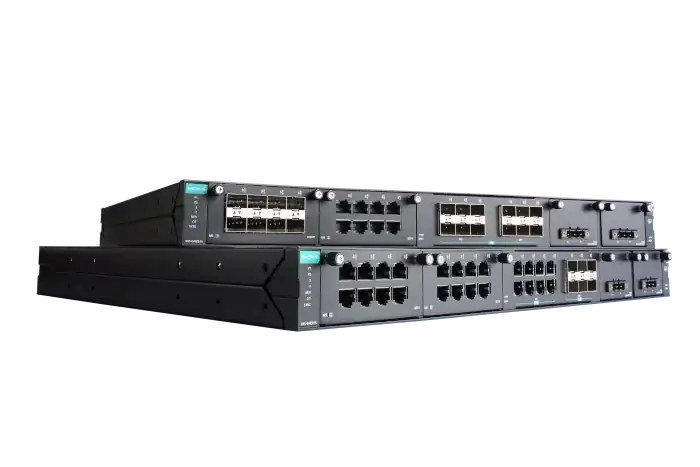
The new range offers connectivity up to 10 GbE, modular architecture, redundant power options, and cybersecurity features designed to protect industrial communications.
The equipment is geared towards infrastructures where operational technology (OT) systems, local servers, and information technology (IT) networks exchange increasing amounts of data. According to Moxa, this increase in traffic can turn traditional 1GbE architectures into a bottleneck, while simultaneously increasing the demands on network availability, security, and maintenance.
Two modular platforms with 10GbE and 2.5GbE ports.
The RKS-G4000-PL series comprises two main platforms with different connectivity configurations. The RKS -G4028-PL model features 12 fixed 10GbE SFP+ ports for high-speed connections. The RKS-G4030-PL , on the other hand, offers six fixed 10GbE SFP+ ports and eight 2.5GbE copper ports. Both models are available in Layer 2 and Layer 3 versions, as well as with and without Power over Ethernet (PoE). This variety allows for selecting the switching, routing, and power capabilities for connected devices according to the needs of each installation.
The modular architecture also supports the addition of LAN modules with up to 16 additional Gigabit ports, expanding the connectivity capabilities of the platforms.
Up to 90W per port IEEE 802.3bt PoE:
The PoE versions of the RKS-G4000-PL series are compatible with the IEEE 802.3bt standard. This technology allows for up to 90W per port, with a total PoE power budget of up to 720W. This power capacity is intended for equipment that requires high power over the Ethernet connection.
Applications mentioned by Moxa include advanced IP cameras and wireless access points.
Integrating power and data transmission into a single cable simplifies certain installations and reduces the need for separate power supplies next to connected devices.
Redundant power supply and hot-swappable modules
The new switches incorporate a modular architecture that facilitates maintenance and adaptation of the infrastructure.
Each platform allows for the installation of two isolated power modules with different input options:
12, 24, or 48 VDC
; 110 or 220 VAC/VDC
; or 48 V EPS.
Using two modules enables redundant power supply configuration to improve service continuity. All modules are hot-swappable, facilitating replacement during maintenance. Furthermore, the power modules can be installed on either side of the unit, providing greater flexibility in mounting and cable management within the rack.
IEC 62443-4-2 SL2 Certification and MACsec Encryption up to 10 Gbps:
Cybersecurity is a key feature of the new RKS-G4000-PL family. According to Moxa, the switches are IEC 62443-4-2 Security Level 2 (SL2) certified, meeting the security requirements for components used in industrial systems. The series incorporates MACsec encryption up to 10 Gbps to protect Ethernet communications.
It also integrates mechanisms such as Secure Boot, TACACS+ authentication, and network access control via IEEE 802.1X.
For secure device management, the switches support protocols such as SNMPv3, HTTPS, and SSH. These capabilities are designed to strengthen the protection of industrial networks and facilitate compliance with cybersecurity regulatory requirements, including those associated with the NIS2 directive.
Independent Data Traffic Management Port
The RKS-G4000-PL series features a dedicated Out-of-Band Management (OOBM) port. This connection provides a separate management path from regular network traffic.
Its purpose is to allow operators to maintain access to management functions during certain incidents that affect core communications. Separating management traffic from data traffic adds a management option for industrial infrastructures that require high levels of availability.
Fanless design and operation from -40 to +75 °C.
The RKS-G4000-PL switches are designed to operate in demanding industrial conditions. The family utilizes a fanless design, eliminating the need for active cooling. The devices support an operating temperature range of -40 to +75 °C. They also incorporate internal system temperature monitoring, designed to help control thermal risks during operation.
These features allow the switches to be used in industrial facilities where environmental conditions and maintenance requirements may be more demanding than in office environments.






