It is essential that both elements be fully compatible so that optical signals can be transmitted between them without loss of quality. The parameters that measure and guarantee this continuity are:
• Insertion Loss, which is the attenuation of the optical signal when passing from one optical medium to another, typically from optical fiber to air. This value must be as low as possible.
• Return Loss, which is the amount of signal reflected back towards the fiber relative to the transmitted signal. Unlike Insertion Loss, Return Loss should be as high as possible.
To maximize signal transmission, patch cords and pigtails must be of the same fiber type (single-mode, multimode), with the same connector type (SC, LC, ST, FC, etc.) and the same polishing type (PC-PC or APC).
The interaction between the two elements forces the optical signal to undergo two medium changes: optical fiber – air – optical fiber. Assuming that the adapter element between both connectors is of quality (Ceramic – Zirconia) and aligns them perfectly, another additional parameter must be considered, which is the concentricity of the splints through which the light (signal) passes.
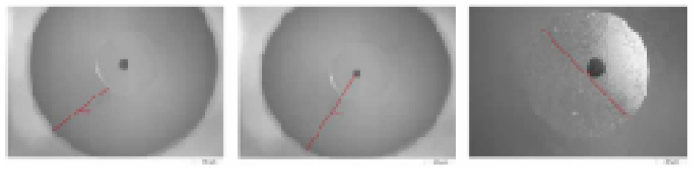
Ferrule concentricity refers to the alignment of the fiber insertion hole with the center of the ferrule. The goal is for the ferrule to be precisely centered on both connectors, ensuring a perfect fit for the signal. For SM fiber, this would be a perfect fit of 9µm, which is practically impossible. This parameter is crucial for connection performance and is defined in IEC standards 61300, 61753, 61754, and 61755, which specify four quality grades (ABCD), with grade A offering the best performance and grade C being the most widely used.

In quality grade C, typical values for single-mode fiber are concentricities of 1.0 µm or less, while for multimode fiber it is 3.0 µm or less.
According to the standard, the insertion and return losses for the different grades are:
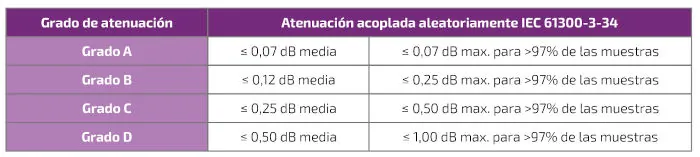
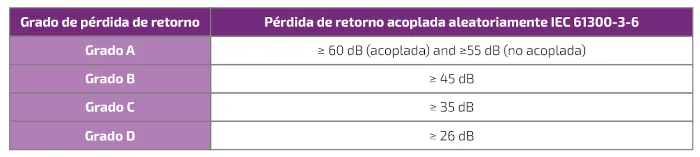
These differences in ferrule concentricity explain why attenuation and return results are never the same when connectors are compared, even if they are manufactured to meet the same grade (A, B, C, or D). Furthermore, these deviations are compounded by the non-concentricity of the two connectors being compared.
Commercial pigtails are grade D or C. Grade C is preferable as it offers a high level of quality sufficient for the vast majority of needs at a very competitive cost.
Grade B is difficult to achieve through standard production methods and is the result of a selection process where less than 15% reach this performance level. Keynet has the capability to manufacture grade B and provide an individual certificate for the measuring equipment if required by the client.
Grade A is extremely difficult to obtain, but it is possible. Its cost increases significantly.