The conventional method of connecting optical fibers requires high-precision polishing to align the fiber ends, making the process quite costly. Fujitsu Laboratories and Furukawa Electric have developed a connector that can accommodate different optical fiber lengths using a spring mechanism that eliminates the need for this polishing process, reducing the cost of connecting optical fibers by more than half.
This new, jointly developed connector achieves performance equal to conventional connectors while simplifying the installation of high-capacity optical interconnects in a server. This technology is expected to increase data transmission speeds between boards, thereby improving overall server performance.
In recent years, the volume of data transmission within servers has grown in line with increased server processing performance. Today, high-speed data rates of 25 Gbps or higher are required for transmissions between CPUs, and between the CPU and memory. Conventional electrical wiring suffers signal degradation due to attenuation at high speeds, making high-speed transmission between server boards difficult, even over short distances. Fiber optics, which suffers little signal degradation, has led to a focus on optical interconnects.
Using optical interconnects for communication between server boards requires numerous multi-fiber connectors, each of which connects and aligns multiple optical fibers to enable parallel signal transfers. The large volume required, however, leads to the problem of high costs in deploying optical interconnects within servers.
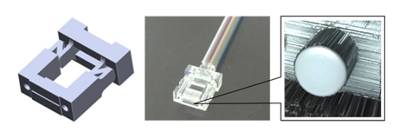 With existing multi-fiber connectors, the fibers must be secured in the connector and then have their ends properly polished so that the tips align flat for low-loss connections. However, this polishing process must be performed for each connector, making it costly. The problem has been the lack of a simple optical connector that offers the benefits of low signal loss without requiring expensive polishing.
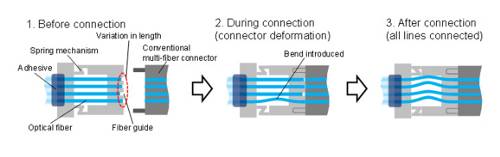 Fujitsu Laboratories' design technology and Furukawa Electric's manufacturing technology have contributed to the development of a multi-fiber optical connector that can be easily used inside servers.
The key technologies of the new connector design are as follows:
• A spring mechanism for optical connectors that deforms slightly when connecting optical fibers (Figures 1, 2). This allows deformation within the optical connector itself to introduce small bends in the optical fibers to accommodate differences in their lengths, ensuring their ends align.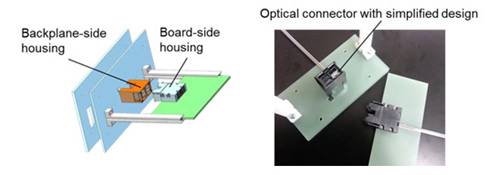 • Laser processing of the optical fiber ends results in surfaces equivalent to those achieved through polishing (Figure 1), allowing the optical fibers to align without gaps.
The combination of these technologies eliminates the need for polishing, and the resulting fiber optic connections have signal loss levels comparable to existing multi-fiber connectors (0.2 dB or less).
Fujitsu Laboratories and Furukawa Electric have jointly developed this optical connector for use on boards, and with an optical connector housing that can accommodate four optical connectors in a compact space (2), this design allows a maximum of 96 optical fibers to be connected (Figure 3).