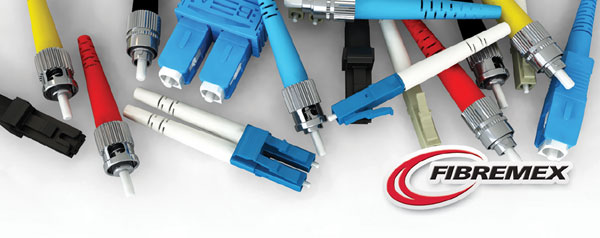
Optical connectors are perhaps one of the most important elements within the range of passive devices required to establish an optical link. Their function, along with the adapter, is to allow the temporary and repetitive alignment and joining of two or more optical fibers under the best possible optical conditions.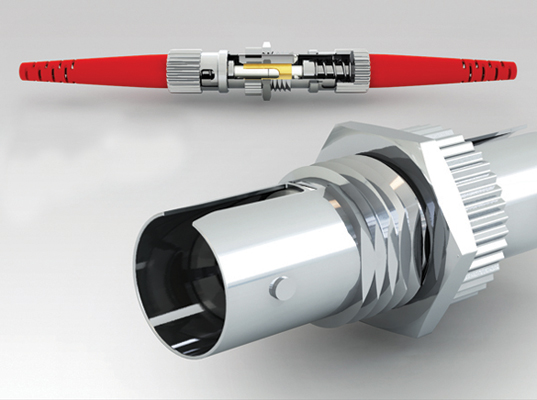 The adapter is a mechanical device that enables the correct alignment of two connectors of the same or different types (Figure 1).
Different fiber optic applications require connectors for single-mode (SM) or multimode (MM) fiber. This leads to improvements in adapters for ferrules of smaller or larger diameters, resulting in specialized connector ranges for each application, even within the same models, and specific mounting technologies for each case.
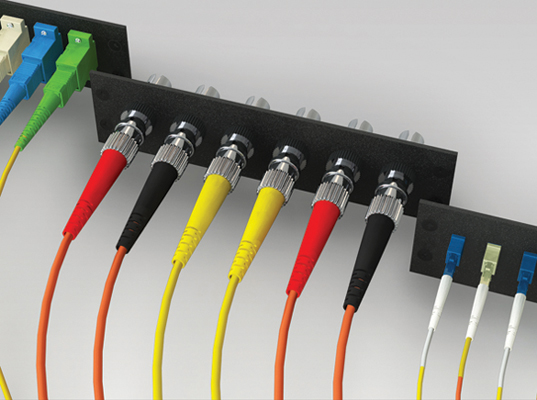
In the design and installation of an information transport system (ITS), fiber optic connectors are fundamental for reliable, standards-compliant performance. These standards define strict optical and mechanical performance specifications that these devices must meet (Figure 2).
The fiber optic connector line offers an unparalleled range of possibilities, allowing you to develop your installations and meet the most demanding optical performance requirements defined by the aforementioned standards and many others.
The first connector models (SMA, Biconical) were replaced by the Standard ST (Straight Tip) for MM and FC (Fiber Connector) models for SM fiber. Early connectors had bodies and ferrules made of various materials (plastics, polymers, etc.), although the best connectors had metal bodies and ceramic ferrules.
Later, to achieve higher fiber density in distribution frames, the SC (Subscriber Connector or Standard Connector) was developed, featuring a plastic body with a push-pull mechanism to protect the ceramic ferrule. The adapter attaches via a clip system, and its square profile allows for easier connection. 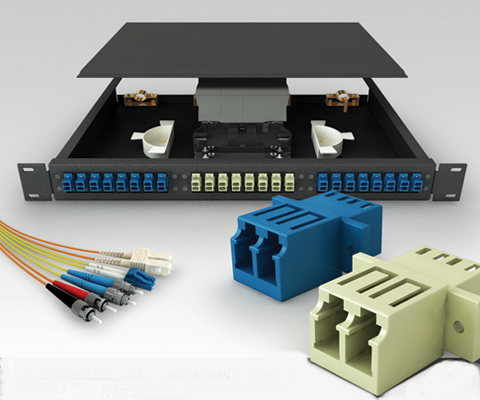 Connectors can be broadly classified into three categories: standard or common connectors, SFF (Small Form Factor) connectors, and multi-fiber connectors. Over time, connectors have evolved in accordance with new technologies and specific applications, including SMA, FDDI, BICONIC, DIN, D4, E2000, ESCON, and VF-45. Standard or common connectors are identified by their 2.5 mm ferrule, which includes ST, SC, and FC connectors. SFF connectors have a 1.25 mm ferrule and include LC and MU connectors. Multi-fiber connectors include MT-RJ, MTP, and MPO.
Using SFF connectors in your fiber network can save space and money. However, choosing the right type can be challenging. Since fiber networks configured with SFF connectors require less cabinet space and are significantly less expensive, SFF connectors also increase port density on electronic devices (such as network interface cards, switches, and hubs), making them less costly and increasing the likelihood of new applications. SFF connectors are also carefully designed for rapid field termination. However, most require special installation toolkits and specially designed transceivers (Figure 3).
It is important to be aware of the variety of connector mounting technologies available, including the traditional epoxy resin method or the use of polyamide-based adhesives. Another important alternative is mechanically mounted (crimpable) connectors.
The variety of connector types will allow you to meet your most important fiber optic system installation needs (Figure 4).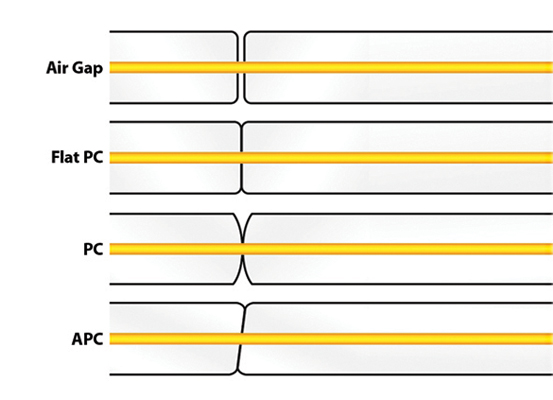 The polyamide-based fiber optic connectors in this line are unique among adhesive connectors. These connectors incorporate a high-performance polyamide-based adhesive within the connector body that is non-aggressive to the fiber and ferrule, significantly simplifying the connector preparation process and contributing to improved optical performance.
Having the adhesive already integrated into the connector substantially reduces preparation time and costs, positively impacting project timelines and overall expenses.
Ferrule Polishing: The finishing of optical connector ferrules is carried out using various polishing technologies, commonly referred to as "termination" (Figure 5). Early connectors did not secure the ferrule, allowing it to rotate within the couplers. They included a gap between their ends (air gap) to prevent marks or damage resulting from this movement. With the advent of ST and FC connectors, the connector body firmly secures the ferrules. The fiber is then connected and finished with a PC (Physical Contact) type finish to minimize attenuation, typically flat polishing for MM and spherical polishing for SM. With the emergence of systems highly sensitive to signal reflection (CATV or high-speed telecom systems), and in order to minimize return loss, termination systems were refined. This led to the development of UPC technology (with return loss >55 dB) and improvements to APC termination systems (>65 dB). APC termination systems incorporate an 8° angle at the spherical end of the ferrule, which diverts all reflections not aligned with the primary mode to the cladding. Connector Types:
ST ST connectors were created in the 1980s by AT&T and derive from "Straight Tip." They feature a bayonet design that allows for easy alignment of the connector to the adapter. Their "Push and Twist" coupling mechanism ensures that the connector does not slip or disconnect. The connector body secures the ferrule, providing better alignment and preventing rotational movement. The ST connector has been the most popular in local area networks (LANs) due to its excellent value. SC connectors have a versatile design that allows for easy alignment of the connector to the adapter. Their "push-pull" coupling mechanism secures it to the adapter easily. The connector body holds the ferrule, providing better alignment and preventing movement. The SC connector is the most popular in both LANs and transport networks: telephone operators, CATV. FC connectors were created in the 1980s by NTT, short for "Fiber Connection." They have a versatile threaded design that allows for a firm connection and alignment of the connector to the adapter. Their threaded coupling mechanism ensures that the connector does not slip or disconnect. The connector body holds the ferrule, providing better alignment and preventing movement. The parts of the connector are: Ferrule (cylinder that surrounds the fiber like a pin), Body (the base of the connector), Crimp eye (which secures the fiber to the connector), Boot (the handle of the connector). LC connectors, developed in 1997 by Lucent Technologies, have an external appearance similar to a small SC connector, about the size of an RJ45. They are available in Simplex or Duplex formats, with SM and MM connectors differentiated externally by a color code. The LC is a high-density SFF connector designed for use in all types of environments: LANs, telephone carriers, and CATV. MU connectors feature a push-pull locking mechanism that locks the connector when pushed in or pulled out. This design prevents rotational misalignment. The connector offers a pre-assembled body and a precision-molded plastic cover, along with a 1.25 mm diameter free-floating ferrule held in place by a pressure spring. The connector components are: Ferrule (the cylinder surrounding the fiber like a pin), Body (the base of the connector), Crimp eye (which secures the fiber to the connector), and Boot (the handle of the connector). The MT-RJ connector features a push-pull mechanism, meaning it is pushed in or pulled out. This design prevents rotational misalignment. MT-RJ connectors use two fibers within a single ferrule, which is manufactured using high-precision molding processes. MTRJ connectors are versatile because a single connector can terminate two fibers simultaneously. The connectors align easily and are secured in the adapter to prevent disconnections. The MTP connector saves space by providing at least twelve possible connections with a single ferrule, replacing up to twelve fiber optic connectors. MTP connectors offer an intuitive push-pull interface and a locking mechanism for easy insertion. They are primarily used for higher throughput processing than standard fiber technology can handle. They provide a secure way to terminate multiple fibers in a compact design.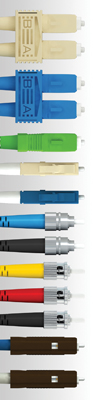
Author: Fibremex