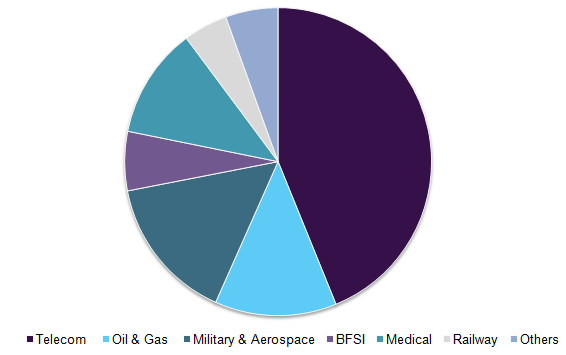
 The industry is projected to show promising growth prospects (during the forecast period), stemming from a combination of factors, including increased government funding for telecommunications infrastructure development, R&D, and other initiatives supported by key market players. Furthermore, growing awareness of the benefits of technology is further driving market growth.
Manufacturers produce fiber optic connectors in bulk for long-distance cabling. They are made of ultra-pure quartz. The high demand from sensing applications and the communication segment for various purposes offers dynamic opportunities for industry growth.
The market is witnessing considerable mergers and acquisitions undertaken by the owners of telecommunications and network service providers in their efforts to achieve enhanced service portfolios and gain access to numerous patents in the client application domain. The growing demand for high-performance, energy-efficient, and cost-effective network infrastructure integration in the IT sector is expected to fuel market demand in the coming years.
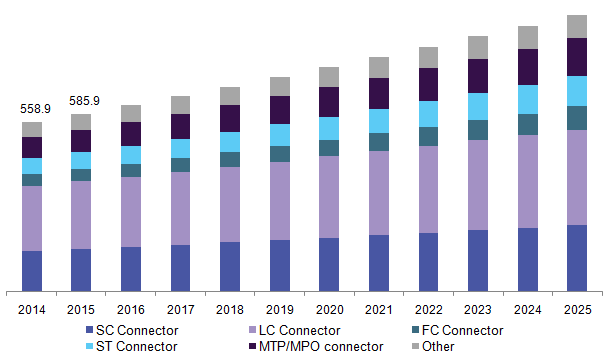 The LC connector segment is projected to be the largest segment, in terms of revenue, and is expected to dominate the technology field, in terms of size, by 2025.
The military, aerospace, and rail application segments are poised to experience significant growth rates due to the increasing adoption of plastic optical fiber (POF) across these sectors. The military utilizes optical connector technology for a wide variety of land, sea, air, and space applications, such as in avionics test equipment modules and ground support systems on fighter jets.
The ST and FC connector segments are expected to experience considerable growth and dominate the market (in terms of growth rates) during the forecast period. However, factors such as high initial investment required to develop and deploy new manufacturing technologies may pose a challenge to market demand during this period.
Mergers and acquisitions, for licensing advanced technology, have evolved into an important part of the modern fiber optics industry (including the cable manufacturing domain). For example, in June 2016, Corning Incorporated (USA) initiated the acquisition of Alliance Fiber Optic Products, Inc. (AFOP) (USA). It planned to incorporate AFOP into its Optical Communications business segment. Alliance Fiber Optic Products, Inc. designed and manufactured high-performance passive optical components.
The telecom applications segment is projected to be the largest segment (in terms of revenue) and will dominate the applications arena, in terms of size, by 2025. The medical applications segment would witness rapid progression in terms of CAGR compared to other application sectors.
The medical and rail applications segments are projected to experience significant growth rates, attributable to their increasing adoption in dynamic healthcare treatment, lighting applications, rail line inspection, and load calculation applications. The technology has established numerous applications across the medical industry, primarily for light guidance and illumination, flexible grouping, and laser delivery systems.
The increasing penetration of telecommunications infrastructure in developing economies, such as China and India, is due to the significant technological growth in the region. Data transmission and communication services represent the main segment of the telecommunications application landscape. Furthermore, the growing demand for cloud-based applications, audio-video services, and video-on-demand services is expected to further stimulate demand for infrastructure.
The technology is undergoing continuous R&D to develop low-cost, high-tech applications for the mass market. It has massive growth potential and can be integrated into application areas such as rail, healthcare, oil and gas, and aerospace and defense.
The high penetration rate of the manufacturing sector and the growing IT and telecommunications sector are strengthening the Asia-Pacific regional market. The Asia-Pacific region is projected to become a leading region (in terms of growth and market size) during the forecast period. This regional market growth can be attributed to the increasing adoption of fiber optic technology across numerous industry verticals, particularly in the telecommunications sector.
Governments of technologically advanced countries, such as the United Kingdom, Germany, Japan, the United States, China, and others, are striving to improve their network security infrastructure (both individually and nationally). Fiber optics serve as a means to meet the increasing bandwidth requirements associated with broadband services, network operators, and broadband connection providers.
The telecommunications sector requires fiber optic components in their dynamic forms, such as distribution cables, trunk cable forms, high-density interconnect cables, and standard patch cables. Stringent regulations and standards imposed by government regulatory authorities and medical associations worldwide further drive the market for optical technology in the medical sector, ultimately leading to remarkable growth in the global fiber optic connector market over the forecast period.
Source: Grand View Research