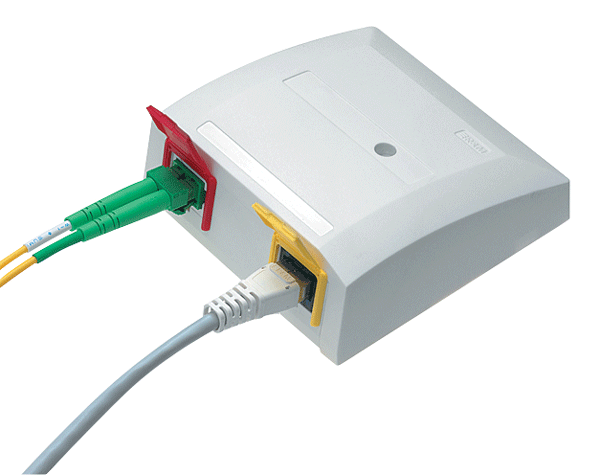
Copper cabling will soon be insufficient to guarantee access to these communication networks. The growing internet data network, along with new online and multimedia services, requires ever-increasing bandwidth and improved transmission technology. To ensure transmission speeds exceeding 50 megabits per second, fiber optic cabling will be necessary throughout the system, including what is known as FTTH, or Fiber to the Home.
Advantages: quality of life, employment, advantages for Europe as a business center
 In the words of Martin Reichle, CEO of R&M: “The arrival of fiber optics to the home is not a pipe dream. It is the logical consequence of the increase in internet applications. FTTH means quality of life. Only a high-quality fiber optic infrastructure can offer the bandwidth, security, and transmission quality necessary to run multiple multimedia computers, video game consoles, internet-enabled HDTVs, and other networking systems in a single home.”.
Throughout this year, various forums, seminars, and conferences on FTTH have been held across Europe. Everywhere, experts in the field acknowledge that copper cabling will soon be obsolete. Heavy Reading, a market research institute in the US, has calculated, for example, that the number of European homes with FTTH will increase fivefold between 2009 and 2013, rising from the current four million to 20 million.
A pilot study presented in February at the European Council Congress on FTTH in Copenhagen, Denmark, also states that FTTH and ultra-broadband infrastructure can benefit education and healthcare systems, teleworking, the construction industry, the service sector, and public administration. The German consultancy firm WIK-Consult, for its part, asserted in a 2008 study commissioned by the European Commission that expanding broadband networks in Europe could create up to two million new jobs by 2015.
The expansion of broadband and the use of online applications must be actively encouraged to achieve sustainable growth, particularly in rural areas. Roland Kohler, Director of the Public Networks Business Unit at R&M, comments: “In the future, a powerful Fiber Optic (FO) network will be the key infrastructure for every business. R&M is convinced that FO connections in homes and offices will be the next mass market after the DSL boom. The better the quality of the infrastructure, the greater the use of online entertainment, information, and business services. This trend can be observed worldwide and confirms that FTTH is the way forward.”
Another study conducted by Ventura, a consulting firm in Switzerland, supports this view: homes with FTTH connections generate three times more data traffic than those with ADSL connections.
Standards: The Swiss approach as an example. R&M believes that Switzerland, along with its neighbors Sweden, the Netherlands, and Italy, has a good starting point. The Swiss four-fiber model for FTTH connections for end users is considered an international benchmark. It was developed in collaboration with an FTTH working group established by the Swiss Federal Office of Communications (OFCOM). This model promotes both cooperation and competition. Network operators can save costs on aspects such as distribution boxes and outlets thanks to standardized cabling and common standards. Users can easily switch providers if multiple cables are in place. This would guarantee open access, i.e., freedom and competition in network access.
No other European country has such an attractive approach for network operators. According to R&M's experience, there are currently no national standards even for the point where the service enters homes. Other obstacles include unresolved regulatory issues at both the European Commission and national levels.
However, authorities in the Netherlands have found a solution to regulate competition in access networks, which has already led to a surge in the growth of fiber optic networks. R&M believes that the Scandinavian countries, the Baltic region, Eastern European states, Austria, France, and Portugal will all experience an increase in FTTH over the next five years. This growth will be particularly strong in areas where local providers and small network operators act quickly and in line with market demands, where local and regional policymakers exert some pressure, and where local demand for bandwidth and internet access is more reliable when requested on a large scale.
Spain
, according to a recent study published by the CMT (Spanish Telecommunications Market Commission), 46% of Spanish households, representing a total of 13.3 million homes and businesses, will have FTTH within 15 years. The rollout, as with xDSL, will initially focus on urban areas where operators have a reasonable guarantee of recouping their investment as quickly as possible. The CMT estimates that these areas will be covered by an average of four or five operators.
Due to its international operations, R&M is familiar with FTTH strategies in foreign markets, from Europe to the Far East. Recently, R&M has acted not only as a consultant but also as a supplier of connections and distribution equipment in a number of large projects. According to Martin Reichle, “R&M knows how to install fiber optic networks efficiently in a wide variety of locations at a reasonable price, whether they be industrial parks, residential buildings, or office buildings.”
The final hurdle: home cabling. R&M emphasizes an important point: “Despite all the hype surrounding FTTH, it’s important to remember that home cabling sometimes falls short of the necessary bandwidth requirements.” To be fully accepted and beneficial, broadband must be available to consumers in their homes without any restrictions, just like water, heating, and electricity. R&M recommends end-to-end solutions to prevent the section between the distribution point and home appliances from becoming a bottleneck. In this regard, Switzerland is considered to have an advantage over other regions. Leading providers offer upgrades to home distribution systems in houses and apartments as part of their services.
According to R&M, the costs are manageable. A home multimedia network can be installed with an investment of just a few hundred euros. Andreas Klauser, R&M's systems manager for residential cabling, explains: “We have defined a design for every type of building situation, especially for older infrastructure. Electricians, planners, and building owners have free access to these designs. Innovative fiber optic cabling systems for older buildings are now available on the market. They are ultra-thin and easy to handle, and can be installed safely, even where space is limited.”
For new and renovated buildings, R&M recommends a structured home cabling system compliant with EN 50173-4. This enables professional broadband and multimedia services, as well as high-performance data transmission for all home applications. This means that the FTTH home access service can be used flexibly in every room. According to Roland Kohler, “The better the quality of the infrastructure, the greater the use of entertainment, information, and business services on the internet. This trend can be observed worldwide and confirms that FTTH is the way forward.” A study conducted by the consulting firm Ventura supports this view: homes with FTTH connections generate three times more data traffic than those with ADSL connections.
Modularity: The Answer to Diversity in Network Design.
But every country, city, and region has different conditions and expansion plans. The task demands experience, innovation, and flexible cabling technology—precisely the strengths that R&M offers. The Swiss company considers itself a leading supplier, capable of supporting all current concepts and protocol systems for broadband and ultra-broadband transmissions. R&M has solutions for the complete installation of fiber optic and hybrid networks, as well as for the gradual migration from copper and coaxial to fiber optics.
What makes this possible is its modular range of copper and fiber optic cabling. It can cover the communication path from switching and data centers, through network nodes and external distributors, to the building and the user connection, including in-home interconnection. Using the modular principle, network operators can plan their FTTH projects according to their own strategies, investment capabilities, and local conditions, thus developing their market flexibility to meet the requirements and the competitive environment.
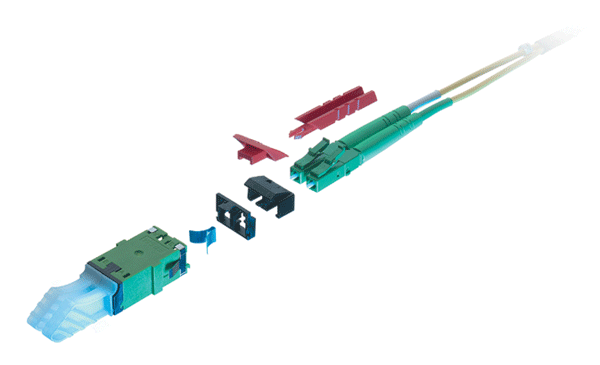
R&M has increased its investment in developing new fiber optic product solutions by ten percent compared to 2008, focusing on streamlining installations and service while making them safer and more reliable. One example is the recent launch of a new generation of LC Duplex connectors for compact fiber optic networks. For the first time, these new connectors incorporate a laser beam protection system and a locking mechanism to prevent unauthorized disconnection. With these innovative safety features, the new R&M LC Duplex can now be used more easily and safely in public areas such as office and residential buildings.