
As information technology has evolved over the past 30 years or so, there has been a growing demand from end users for high-quality, high-speed access to telecommunications services. This demand comes from all sectors of society—from businesses, large and small, to individuals seeking access from their homes. Typically, users simply require broadband (i.e., high-speed) internet access. The terms “broadband” and “high-speed” strictly refer to any access speed faster than that achievable through dial-up access over the telephone network. The precise meaning of these terms is determined by the context in which they are used.
Many governments believe that high-quality, high-speed access to telecommunications services will be crucial for their countries' economic development in the 21st century. This is often compared to the development of highways in the 20th century. Furthermore, the OECD (Organisation for Economic Co-operation and Development) currently publishes statistics and rankings of countries regarding broadband availability and use by end users.1 Therefore, broadband deployment is considered an indicator of a country's economic development and its potential for future growth. All of this simply demonstrates that telecommunications services have become a fundamental aspect of daily life in modern society.
Today, the vast majority of broadband users gain access by sharing the "last mile" of cable from the existing telephone or television network. This results in upload speeds of between 128 Kbps and 1 Mbps, and download speeds of around 6 Mbps (in reality, the nominal download speed available is higher, but access is shared among multiple users). The problem now is that end users are requesting bandwidths that are beginning to exceed the capacity of first-generation bands. There is already talk of wanting bandwidths of up to 100 Mbps.
Such a large capacity relative to current levels will require a radical technological shift, a shift that will become the foundation of future development. Several technical alternatives exist that could offer universal high-speed access, although the main problem is their cost. In the telephone system, the access network accounts for up to 70% of the total network cost. Regarding regular maintenance, the operating and maintenance costs of the access portion of the network could even exceed 70% of the total operating costs.
Any new network access method must also provide existing services. It is clear that the Internet is the technology of the World Wide Web and email, and it seems inevitable that existing services such as telephone and even cable television will quickly migrate to the Internet. However, this has not yet happened, and many more years will pass before the transition is complete.
Several potential architectures are available that would, in some way, meet the needs. Of course, they all have their advantages and entail certain costs.
- An ideal solution would be to connect each end user directly to a switching center (PBX) via a dedicated fiber optic pair. This would satisfy all foreseeable needs and would therefore be a great long-term investment, despite its high initial cost.
- Another solution would be to achieve higher speeds over existing copper telephone lines by shortening the distance between users and the switching center. This would be the so-called FTTx solution ("Fiber to x" - the "x" here indicates that the intermediate connection point could be located in various places, as long as it is no more than about 500 meters from the end user). To achieve this, equipment shelters (cabins) must be installed somewhere between the existing switching centers and the end user. These cabinets could be located on the street, in a suitable building, or on the user's property. This solution involves a significantly lower cost than the full installation of fiber optics, although the available speed would only satisfy immediate internet access needs and the cost of regular maintenance could be quite high.
Radio frequency solutions can offer a solution—and indeed they do. The problem with them is that the available bandwidth is insufficient. The solution would work and be very economical for a small number of users, but it wouldn't be suitable for widespread use in densely populated cities. A cellular architecture, similar to that used for mobile phone networks, could potentially be an appropriate solution. However, achieving this would require a large number of base stations located close to end users. These base stations would need to be connected via fiber optics and would require a powerful power supply and large antennas. In reality, implementing this solution would be complicated for various reasons, including political concerns about radiation risks.
The most economical solution for most situations would be a global optical solution. Each end user would be connected via fiber optics, and these fibers would be interconnected by passive optical splitters located in the street. At the switching center, a single fiber pair would have 32 (or more) users "multi-connected" to it. Due to the need to install new fibers at each end user's location, this solution also entails a high installation cost, although considerably lower than the "ideal" solution hypothesized earlier. Furthermore, its regular maintenance cost is low, and (if needed) it could be replaced by the "ideal" architecture in the future. Currently, several variations of this solution are available, all designated by the generic term PON (Passive Optical Network). The most suitable PON at present is GPON (Gigabit PON). There is little doubt that a PON-based solution is the only architecture available to meet the foreseeable needs of the next 20 years or more at a reasonable cost. However, FTTx also meets current demand and, moreover, "leaves the door open" for evolving to PON in the future.
Regardless of the architecture adopted, fiber optics must be used in the access network. The challenge is deciding which network can be designed to meet current user demand while paving the way (technology-neutral) for future evolution, all at an affordable price.
Current and future-proof applications
All proposed network technologies must focus on the needs of any type of potential user.
Residential Networks: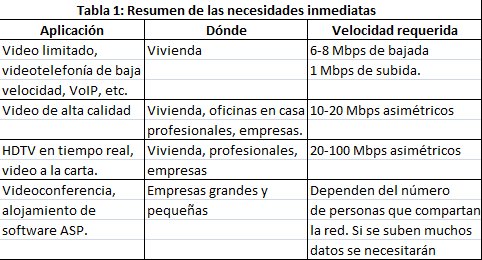 Network connectivity in private homes is perhaps the most prevalent application, given the sheer volume involved. It encompasses a wide range of applications, including alarm control (which involves minimal data transfer), email, internet access (www), telephone, traditional cable television, video on demand, and more. A growing number of these applications are experiencing organic growth. For example, websites now feature a large amount of Flash animations and audio and video content, so a faster connection facilitates browsing and helps people save time, both at work and at home.
Another frequently mentioned bandwidth-intensive application is video on demand. In the past, this was considered (and tested) as a controlled delivery of video (movies of all kinds) via a connection between the service provider and the user. However, it's important to note that with current technology, an alternative architecture could be established that sends the entire movie (perhaps 3 or 4 GB) as a file to a hard drive located in the user's set-top box. This way, the user could watch the movie in the same way they would watch any pre-recorded program. This architecture eliminates the need for the user to synchronize with the network and simplifies the delivery system to the provider. To achieve this with HDTV content, a connection speed of at least 10 Mbps would be needed, although speeds exceeding 100 Mbps would be even more efficient.
It's also possible to envision IPTV as the predominant method of TV broadcasting in our homes. Currently, not many TV programs are broadcast live (practically only sports and news programs); most are pre-recorded. If this situation were to arise, the viewer could consult a menu of the programs available at that moment, download them to a set-top box, and play them from there. Handling the small number of live broadcasts would require a specific mechanism, but some already predict that this will be the future of television.
However, it's not just entertainment that's driving the demand for faster internet connections in our homes; businesses also require them, as the rising social, environmental, and economic costs of transportation are leading more and more people to work from home at least part of the week.
Businesses (large and small)
have traditionally been characterized by a large number of end users, relatively small amounts of transaction data, and the need for very short response times. This has necessitated fast network access. This trend continues to evolve, with more and more applications using graphics as applications like video telephony and videoconferencing mature. A demographic challenge for many businesses is their location in industrial parks, where cable TV operators do not deploy their networks due to high costs and limited demand, depriving many of these companies of broadband access, which is very popular in private homes.
Hospitals, universities, and schools:
These users are similar to those of large companies, except that in recent times they have begun using data visualization applications. Computed tomography scans and "scientific visualization" require the transfer of very large files that must be sent in a relatively short period of time.
In medicine, the most booming applications today are those that allow specialists to make diagnoses or conduct consultations remotely, even when they are hundreds or thousands of kilometers away from the patient. Even something as simple as an X-ray must be transmitted at high resolution because, as these specialists state, they need the greatest possible increase in image quality. The same is true for remote consultations, where doctors explain that videos must be of high quality to be able to observe the patient clearly. Seemingly trivial elements such as a patient's medical history can be of utmost importance in an emergency. When someone goes to the Emergency Room, they are often far from their regular doctor, so having access to their medical history can be the difference between life and death. Therefore, there are good reasons to make medical records (like X-rays, CT scans, etc.) available online so they can be accessed from anywhere in an emergency.
Furthermore, it won't be long before visualization technologies are commonly used in classrooms and even in the games we play at home.
Mobile Infrastructure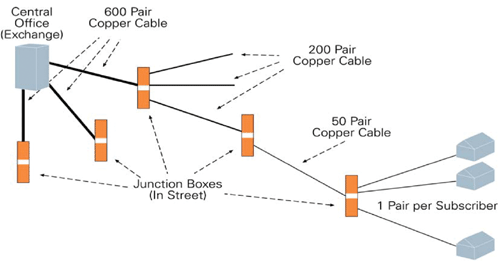 Mobile telephony (and data) networks connect the end user via short-range radio connections (typically less than one kilometer). This means that there are a large number of base stations distributed throughout the coverage area. All of these must be connected to a backbone data and telephony network. In the past, this was achieved using fiber optics, microwave links, and copper cables. As mobile networks continue to develop and expand (especially to provide internet access), mobile base stations will now need high-speed uplink connections. Of course, these could be integrated (or at least relocated) into other network equipment.
Immediate Needs
Table 1 provides an overview of the bandwidth requirements for existing applications.
The Existing Telephone Network.
Early telephone networks used open circuits for connection, a method well-suited to achieving the desired goal. However, even for a small number of users, a large outdoor area was needed to install telephone poles. Furthermore, it has been calculated that providing telephone services to a larger population in Western countries would require more copper than is available in all known copper deposits.
The architecture of the traditional telephone access network (Figure 1) is as follows:
A single pair of relatively thin wires (0.4–0.8 mm) establishes a dedicated, contiguous path from each end user to the switching center, often located within a radius of about 4 km, sometimes up to 6 km via thicker cables.
The cables arriving at and departing from the center contain approximately 600 pairs of copper wires, occasionally more.
The cables are often buried and connected to a "junction box" located in the street. At the box, each pair is isolated and connected to another pair of outgoing wires.
Each pair carries the analog telephone signal and low-voltage direct current (DC) power to the receiving telephone. In most networks, a higher voltage is supplied to the line to make the telephone ring. This often allows users to use the telephone in an emergency even if the main power supply has been cut.
For single-family homes, typically only a single pair is needed to make the connection. Conversely, in buildings with more than one dwelling or unit, multi-pair cables are typically used.
- The network between the central office and the end user is entirely passive. Although the cables carry electrical power, there are no active components in the signal path. This is one of the reasons for the high reliability of telephone networks.
- Switching centers are often quite large buildings with technicians and maintenance personnel on site 24/7.
Broadband access over existing telephone lines (xDSL)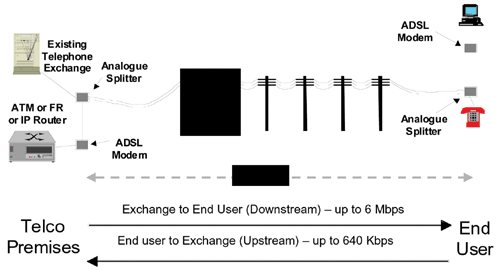 Digital Subscriber Line/Loop (DSL) is the generic service name used to describe the set of technologies that allow the use of existing telephone lines to transfer broadband data (multi-megabits-per-second). In this context, the telephone line used is a telephone twisted pair (TTP) consisting of two copper wires connected (in a point-to-point configuration) between the telephone exchange and the end user. Typically, this end user is a private residence or a small business, but it can be any type of location with an analog telephone line. In many countries, ADSL is the predominant technology for broadband internet access.
There are several DSL protocols. When referring to xDSL, the "x" can be used to describe any component of the generic protocol family. The most widespread DSL is ADSL (Asymmetric Digital Subscriber Line). It's called asymmetric because the speed varies depending on the direction in which the data is sent. Its configuration is shown in the diagram in Figure 2. The most noteworthy aspect is that the TTP (Terminal Pointer) connecting the user to the central office is the ONLY thing shared by the telephone network and the broadband data connection.
This is a very important characteristic. "Extension" telephone circuits (or "local loops") were designed in the 20th century to provide connections for analog telephones. All the characteristics of these circuits (maximum length, physical topology, cable thickness, insulating material, etc.) were determined by economic considerations in relation to telephone communication at the time. As a medium for high-speed, broadband digital signals, this system is far from ideal.
Each protocol has specific characteristics. Some of these are summarized below:
Asymmetric Digital Subscriber Line (ADSL)
ADSL was originally designed to provide broadband internet access in homes. The maximum data transmission speed specified in the standard is 6 Mbps download and 640 Kbps upload. However, the standard allows equipment manufacturers some flexibility to offer higher speeds. Nevertheless, the maximum potential speed achievable is often reduced by distance or line quality. The greater the distance, the lower the maximum data transmission speed. The actual speed available to a user can also decrease depending on the service plan. For example, a service provider might offer 1.5 Mbps, 3 Mbps, and 6 Mbps services at different prices.
ADSL-Lite:
One problem with ADSL is that analog telephone and broadband data remain on the same connection. In buildings with multiple telephone outlets, this means a (passive) splitter is needed at the telephone line to separate voice and data, requiring new data cabling. The drawback is that installing this splitter and the new cabling requires a technician, resulting in a considerable additional cost.
The ADSL-Lite protocol was designed to allow direct installation of simple, provided filters on the user's equipment (e.g., telephone and modem). In some cases, these filters aren't even necessary. This eliminates the need for a technician (and therefore reduces costs), ALTHOUGH the data transmission speed is also significantly reduced. The maximum defined speed is 1.5 Mbps download and 512 Kbps upload.
Cable Television Networks (HFC)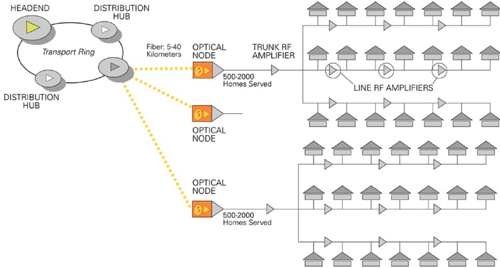 Figure 3 shows the standard network architecture required to deliver cable television. This is called an HFC network (hybrid fiber-coaxial cable network):
- Fibers run from the central office to a cabinet located on the street. The connection between the cabinet and the central office is made with a single pair of single-mode optical fiber.
- The radio frequency (RF) signal is carried through the fiber as if it were an analog signal. This reduces the amount of equipment needed at the fiber node, although it requires a rather specialized optical transceiver (with linear response).
- At the fiber node, the signal is recovered from the fiber, amplified, and sent over a coaxial cable.
- At the user's location, the cable is tapped, and part of the signal is directed to the end user through a short run of dedicated coaxial cable.
- The distance between the fiber node and the central office can be up to 50-70 km, and therefore only one or two central offices are needed, even in a large city.
- Fiber nodes contain certain active electronic components, meaning they carry electrical power. Thus, when a problem is suspected, technicians must inspect the node to determine the issue.
One aspect unrelated to technology, but fundamental to the characteristics of cable TV networks, is that their primary objective is to provide entertainment, so most users will only invest a limited amount of money in them. In many countries, this has led to low-cost installations and a correspondingly low-quality service, which is usually reflected in long repair times after an outage. "After all, it's just entertainment."
It should be noted that the current structure is not very different from that of VDSL or PON networks, which will be discussed later. The only difference is the connection of the "last 500 meters" to the user.
Broadband Connections via HFC Networks:
The coaxial cable used to connect users to HFC networks is a very suitable communication method. It is capable of handling a very wide signal bandwidth. Currently, cable operators routinely offer broadband (Internet) and traditional telephone services over existing cables.
Broadband services are achieved by allocating unused frequency bands within the cable. The main technical challenge to overcome in providing access is that these cables are "buses." This means that many users share a single channel, and an access arbitration protocol must be in place for the upstream connection. Although the advertised speed is typically 30 Mbps, this is the total shared speed available to an entire group of users. To simplify matters and be fair, upload speeds for users are generally limited to 128 Kbps. Of course, each cable can have multiple shared channels, with a group of users associated with each one, because if they become overloaded, there's a relatively easy way for the network operator to "cut a segment of the cable in two" to provide two fiber upload connections instead of one. The system works very well with a small number of users, but the service can suffer significant quality issues in case of overload.
Radio Frequency Connections:
Broadband internet access can also be achieved using radio technology; in fact, this is already the case in many places. The problem with radio technology is that the available radio frequency spectrum is quite small, so large-scale radio use would quickly saturate the available bandwidth. However, it is possible to build a cellular network (similar to a mobile phone network). Using minimal power over short distances, the same frequencies could be used repeatedly. Such a structure would require an architecture similar to FTTx and would also use fiber optic cables to connect a large number of base stations to create a vast network. Nevertheless, radio propagation presents challenges in urban areas with tall buildings, mountainous regions, and so on. In practice, antenna placement is often difficult.
Current Network Environment
The first widely available communications network in history was the telephone network. Even today, it can be seen as the largest and most complex machine ever created by humankind. In contrast, cable TV networks were initially developed by small communities that wanted to improve their TV reception and therefore installed shared antennas. In the US, these networks are still called CATV (Community Antenna TV).
When computer networks arrived, the first users were large companies willing to pay for special, customized services. Universal access was slow and used existing telephone lines. To achieve higher speeds (broadband), new networks were built by installing equipment in most exchanges. Access was achieved by sharing the "last mile" of cable from the exchange for the new data service and for the existing cable or telephone service.
The main problem now is that users want even faster speeds, so shared access with existing services is no longer suitable. However, the cost of installing new cabling (of any type) at user locations is high, and replacing all existing cables would be very complicated. External works (tearing up streets, etc.) are extremely expensive. Radio-based technologies could be viable, but limitations in available bandwidth seem to make their widespread adoption in urban areas impossible.
In the long term (20 years), in principle, the only alternative will be to completely replace the existing copper cabling with fiber optics. However, it is possible to upgrade existing installations using technologies such as FTTc (Fiber to the Cabinet). This is very important because it will meet current demand at a significantly lower cost than the ideal solution, while all the new cabling can be reused in the future when an upgrade to a "final" solution becomes necessary.
It is important to remember that any proposed solution must be usable indefinitely and upgradeable if needed. Furthermore, the proposed solutions should be installed progressively and in parallel with other services (such as power supply cables).
Physical Environment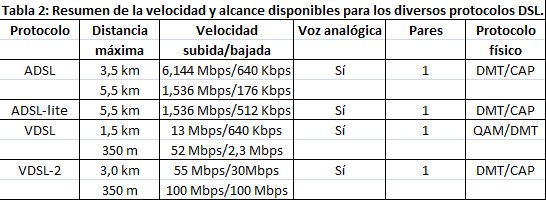 When considering network needs, many people think only of single-family homes built on individual plots. But in most countries, this type of residence is more the exception than the rule.
- Many people currently live in apartment blocks or multi-family buildings.
- In America and Europe, there are large semi-rural areas outside of cities where homes are separated from each other by hundreds or even thousands of meters.
- Potentially, the cost to service a large apartment block is lower since expenses are shared. However, large blocks are often located on streets where the cost of installing access cables is very high. Furthermore, in many countries, the installation of service provider equipment in customer homes is affected by legal issues.
- Small businesses have similar characteristics to residential properties.
- Many large companies located outside major metropolitan areas also require services.
Legal, Political, and Business Environment:
In most countries, legal restrictions influence network characteristics. For example, in the U.S., various laws define and limit the role of cable companies and telephone operators. In other countries, the government has established laws aimed at promoting competition among providers. These rules and laws assume that currently available technology will be used in the future and, to a large extent, also determine the possible options for network development.
Very High Speed FTTx-DSL (VDSL):
Existing ADSL networks work very well, but many users feel that significantly higher speeds are necessary. As mentioned earlier, the maximum speed achievable over an ADSL link depends heavily on its length (a characteristic of copper cable environments). So why not shorten the link length? The idea is to have a cabinet with active equipment located somewhere along the existing cable path. The copper (multipair) uplink cable is replaced with a fiber optic pair, while the copper cable connection to the user remains intact. The DSL equipment is housed in the cabinet. This architecture is often called FTTx, where the "x" can stand for any letter of the alphabet (cabinet, curb, sidewalk, node, etc.).
VDSL operates over relatively short distances, between 350 meters and 1.5 km, with speeds of up to 52 Mbps download and 2.3 Mbps upload. VDSL-2, the current leading technology, offers even higher speeds and slightly greater distances, and, importantly, is compatible with users' existing ADSL equipment.
It's important to remember that the speeds and distances mentioned above depend heavily on the characteristics of the existing cable. In some situations, the distances may be slightly greater than those indicated, while in others they may be considerably shorter. Furthermore, it's crucial to remember that the transmission characteristics of one pair in a multi-pair cable can differ from those of an adjacent pair.
 The main advantage of FTTx technology is that, although it requires fiber from the central office to the distribution frame, it saves the costs of installing new cable at the customer's location.
However, it's not entirely ideal because:
- It requires the installation of electrically powered equipment cabinets on every corner. Since telephone access is needed, these cabinets must have a highly reliable power supply.
- The cost is likely to be high because serving any of the 50 largest cities in the world requires between 2,000 and 5,000 cabinets. However, while this infrastructure is not future-proof, if it is installed with a smart plan for future migration to a fiber-only infrastructure, unnecessary expenses can be minimized.
- The presence of active equipment installed in the streets means high ongoing maintenance costs.
- In many cases, existing copper cable may be adequate to carry the proposed speeds, but in others, it will not. There are significant doubts about whether the system will function correctly when a large number of users are using VDSL. Currently, technicians select the highest quality pairs of cables for ADSL or VDSL, and the lower quality pairs are reserved for traditional telephone users. If everyone used xDSL, it is believed that many (or most) of the existing cables would not be usable.
Fiber to the Home (FTTH) or PON location
If you need to provide service to a large apartment building with around 100 units, why not run fiber to the building and install a VDSL node there? This would eliminate the need to re-install cables inside the building, which can be very costly. Of course, the building owners must cooperate and reserve a secure room for the equipment installation.
Often referred to as FTTH or FTTB, this solution is identical to the FTTC solution, except for the location of the access point. However, since the final links to the user are short and typically consist of individual cables, the quality will be very good and the service excellent. The cost, perhaps too high for single-family homes, can be quite attractive when serving a large number of apartments.
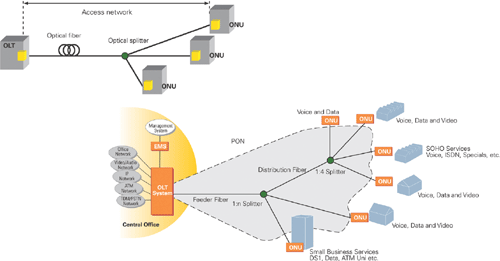
Passive Optical Networks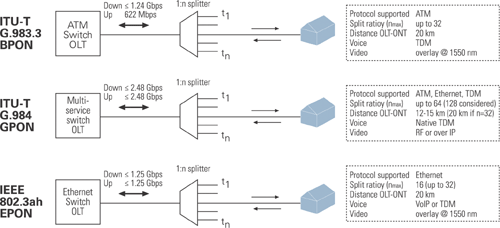 As mentioned earlier, a point-to-point fiber connection from each user to the central office would be the ideal technical solution from most perspectives, except for cost. Such a solution would offer each user a capacity of many gigabits of data per second. This would satisfy any foreseeable need. A solution that offers more than adequate capacity and can be achieved at a lower price is the Passive Optical Network (PON).
The idea behind a PON is to build an optical network infrastructure that uses passive optical splitters to connect many users to a single fiber upon arrival at the central office.
The diagram in Figure 4 above shows the basic PON configuration. Splitters divide the signal and send a portion of it to each user. However, it's important to remember that light is not electricity. Splitters are very different from a voltage regulator. However, they can generally be considered similar since they significantly reduce the optical signal (in both directions). If the configuration above were electronic instead of optical, it could support hundreds or even thousands of users. Because it's optical, the current limit
is 32, although 64 (GPON) is possible under certain circumstances.
The most important characteristics of this architecture are the following:
- Since no external cabinets are needed, network configuration and operation are simpler. Splitters could be installed similarly to how patch panels are currently installed.
- There is no need to modify the Optical Network Units/Terminations (ONUs/ONTs) to upgrade network access capabilities to accommodate future broadband and multimedia service developments.
- Maintenance is simple because the system has no active electronic components in the field. Once the fiber is installed, it will continue to function unless and until an external factor affects it.
- Depending on the specific PON system, the end user can be up to 20 km from the Optical Line Termination (OLT). Currently, a large city can have up to 500 exchanges. With a PON system, far fewer would be needed, between 12 and 20. This could mean significant savings in operating costs.
PON Operating Protocols:
All current PON systems utilize shared fiber in some form. From the switching center's perspective, many end users are connected to the same fiber. This offers a significant cost advantage, as far fewer line terminations are required at the central office. However, this situation demands discipline in using and managing the links. While it would be possible to use multiple wavelengths of light (Wavelength Division Multiplexing) to "channel" the fiber, doing so electronically is considerably less expensive. For example, since all users transmit upstream data over the same channel, a control protocol is needed to ensure that only one user transmits data at a time. Furthermore, a protocol for troubleshooting and equipment maintenance is also required.
Practical Networks: Summary and Conclusion.
In June 2007, 50% of households in Western Europe and the US had access to broadband Internet. In the US, most users accessed the Internet via cable modems connected to cable TV networks. In most European countries, DSL is the most widespread access method, with over 75% of users connected in each country.
In the US, there are approximately 1.5 million subscribers using FTTx pilot networks (including PON) of one type or another. In Japan and South Korea, around 40% of users connect primarily to PON networks. In the People's Republic of China, approximately 15 million FTTx subscribers have been registered. Clearly, the use of FTTx and PON technologies is increasing enormously worldwide.
The growing demand for telecommunications services has reached its peak, as it can no longer be met by simply increasing upgrades to telephone or cable television networks. A complete replacement of the telephone network with a new technology would require a massive investment that is not in line with the rates users are willing or able to pay.
Network operators and governments must identify immediate levels of actual demand and anticipate demand in the near future, as well as consider the potential situation 20 years from now. They would need to identify the technologies required in the long term and improve network development and modifications, taking into account the architecture required in the future.
Patrick Gähwiler, Reichle & De-Massari AG (R&M)


