 In the 1990s, DWDM revolutionized the telecommunications sector thanks to the dramatic increase in network capacity. However, the main problem with these systems is their fixed bandwidth; that is, connectivity is predefined at the time of installation, and any subsequent changes are complicated and costly. On the other hand, services like IPTV or video on demand require bandwidth that is unpredictable and needs to be configured according to user demand. Clearly, the solution is not simply adding extra capacity, but rather operators must be able to reconfigure their DWDM networks quickly and transparently to provide greater bandwidth in areas where it is needed on a case-by-case basis. Therefore, a transition from a static system to a dynamic and reconfigurable architecture is needed, and this is where ROADM (reconfigurable optical add/drop multiplexer) technology comes into play.
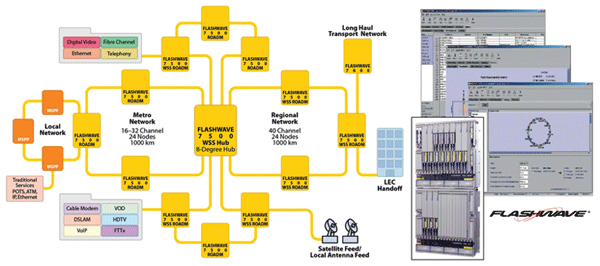
  ROADMs allow for flexible and efficient bandwidth management in DWDM networks, supplying and switching different DWDM channels according to traffic needs (Figure 1). Some network operators have already deployed ROADMs in their long-haul networks, and more recently, they are doing so in metropolitan areas. These deployments have been significant in North America and Japan, where fiber-over-fiber video service distribution is more developed, although in Europe they are still relatively uncommon.
Only recently has demand for ROADMs emerged in the European market. The ROADM market is quite 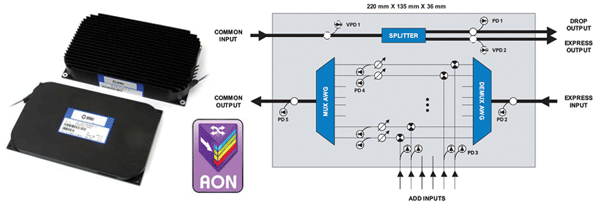 diverse, with multiple manufacturers and different technologies depending on the application and network type. In this article, we will delve deeper into this market, examining some of the various products offered by manufacturers.
Technologies and Applications.
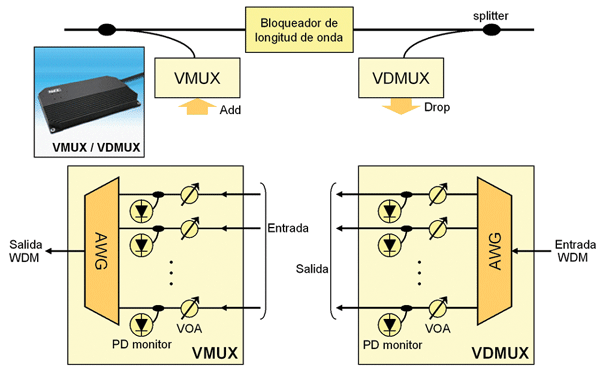
Broadly speaking, the ROADM market can be divided into two main application areas. On the one hand, there are backbone ROADMs, used in the core network, which are characterized by a high price and performance exceeding typical requirements. On the other hand, some manufacturers focus on designing ROADMs for metropolitan applications, which are experiencing growing interest. Clearly, ROADMs designed for metropolitan environments must be more compact and less expensive than those optimized for long-distance systems. Therefore, the technology used in each type of application or network environment will differ.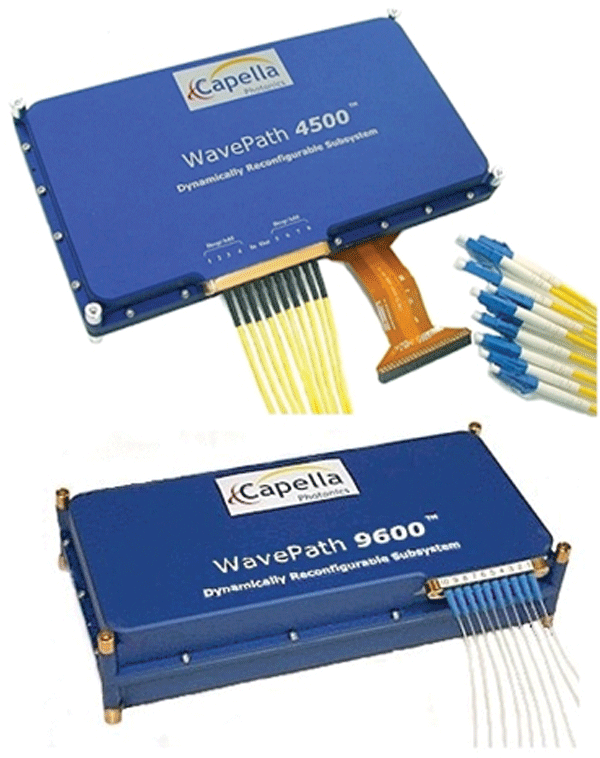 Among the various existing technologies, it is worth starting with wavelength blockers. Together with the use of variable optical attenuators (VOAs) and integrated DWDM multiplexers/demultiplexers, DWDM signals can be separated into two different paths (drop and through) in order to add new channels. Figure 2 schematically illustrates its application in a ROADM. While not as flexible as some newer designs, wavelength blockers represent an attractive option for long-distance networks due to their lower cost. Most wavelength blockers use liquid crystal switches. This technology was previously explained in detail (Conectrónica no. 59, pp. 10-16, July 2002). Examples include products from JDSU, Xtellus, and Avanex. This technology offers good performance at a lower cost than spatial optics-based designs. By controlling channel polarization, channels can be partially attenuated or completely blocked. Furthermore, a large number of channels (128/64) can be managed with narrow spacing (50/100 GHz) and high speeds (10 and 40 Gbit/s).
 However, for metropolitan applications, liquid crystal-based devices are still too expensive. Consider a simple application like an add/drop multiplexer in a ring network. In this specific case, JDSU and NeoPhotonics propose a 2D ROADM based on planar optical circuits (PLCs), which would include switches, gratings, and other components easily integrated onto a silicon chip. Current PLC-based ROADMs have low insertion loss and large bandwidths, enabling operation at 40 Gbit/s with 100 GHz channel spacing. They typically use AWGs for filtering (mux/demux), microsecond switches, wavelength monitors, and VOAs for dynamic channel equalization. An example of this type of device is shown in Figure 3.
However, despite the integration advantages of PLC technology, it is limited in terms of reconfigurability and scalability, which become more apparent as the bit rate increases and the channel spacing decreases. While surveys predict that in the next two years, 70% of ROADM developments will require only 2D functionalities, the future will be very different. Liquid crystal-based technology essentially allows for two operating states, which depend on the signal polarization. Therefore, it is easy to build a 1x2 switch, but two stages are needed to achieve a 1x4 scheme and three stages for 1x8. This adds complexity to the system (reduced scalability) and introduces significant power penalties. A different approach is therefore needed.
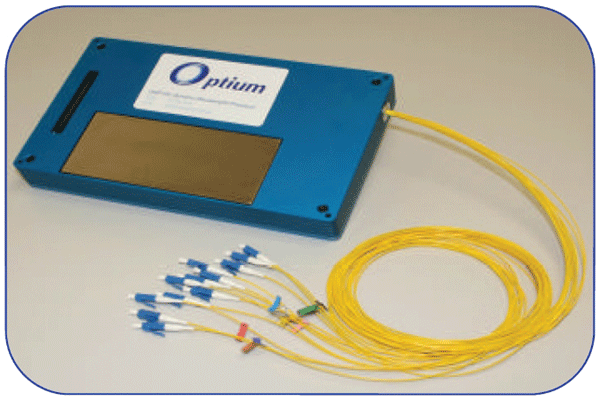
To achieve full scalability, some manufacturers are employing MEMS (micro-electro-mechanical systems) technology, which enables the development of wavelength-selective switches (WSS). These devices allow the selection of one or more wavelengths of the DWDM signal, which are then redirected to one or more output ports. This multidimensional solution allows for the simultaneous management of both add/drop channels of the ROADM in a flexible and efficient manner. For example, Capella produces 10-port WSS devices in 1x9 and 9x1 configurations, with versions offering 45 channels at 100 GHz or 96 channels at 50 GHz for metropolitan and backbone applications, respectively (Figure 4). Other companies that also develop MEMS-based devices include Xtellus, DiCon, and JDSU.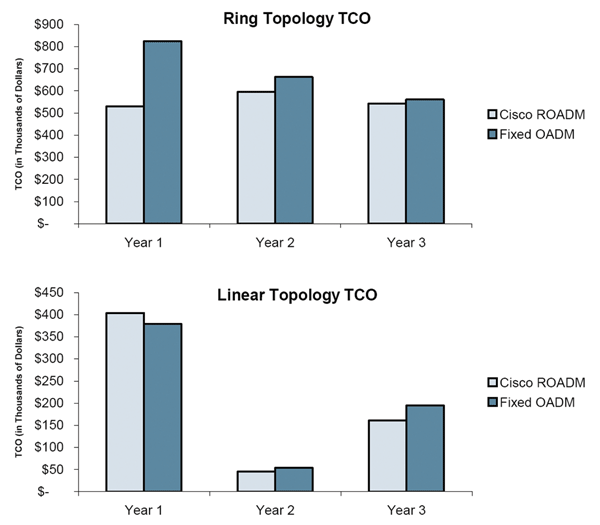 Finally, we would like to highlight that Optium has developed a WSS based on liquid-crystal-on-silicon (LCoS) technology, which is also used in consumer LCD displays. LCoS consists of a liquid crystal layer controlled by an active-matrix CMOS backplane. Unlike MEMS, it has no moving parts, making it insensitive to vibrations. It also has a large number of pixels per channel, enabling advanced features such as dispersion compensation and, more generally, performance optimization via software. Figure 5 shows an example of this type of device.
Business Case:
Just over a year ago, Network Strategy Partners, LLC conducted a comparative economic analysis of using ROADM solutions versus fixed OADMs. For this analysis, they used the Cisco ONS 15454 ROADM system as a case study. The findings indicated that ROADMs provided savings (CAPEX and OPEX) compared to traditional solutions, especially in mesh networks with uncertain traffic demand, rapid growth, and high capacity. Some of these results are shown in Figure 6, confirming that installing ROADMs in networks provides a positive ROI and greater scalability and flexibility in network management.
Francisco Ramos Pascual. PhD in Telecommunications Engineering.
Full Professor at the Polytechnic University of Valencia.