

It seems clear that in the medium term everything will be IP-based: voice, data, video, and even mobile communications, completing the so-called "IP Quadruple Play." When, and how suddenly, this will happen can be debated, but the impact that the need for much greater bandwidth will have on current and future networks is clear.
IP to the home, and in the home, will have an immediate effect on a new range of services and applications:
- Voice over IP (VoIP).
- IPTV.
- Music distribution.
- Hard drive video recorders.
- Video on Demand.
- High Definition TV (HDTV).
- Interactive television.
- Interactive services marketed by the operator.
- Interactive security services.
Of these services, video is the one that requires the most bandwidth and significantly has the greatest impact on how the customer perceives the quality of the service offered.
IPTV
So, what is IPTV? For many, the acronym means hundreds of on-demand video channels delivered anytime, anywhere. IPTV (Internet Protocol Television) describes a system in which a digital television service is delivered using the Internet protocol over an access infrastructure, which can be as simple as a single broadband connection. For residential subscribers, this service is often provided alongside a Video on Demand service, and sometimes combined with Broadband Data Access and Voice over IP services, providing what is known as "Triple Play." These services theoretically offer users complete control over their multimedia experience. For many operators, however, it represents a new revenue stream through the delivery of advanced multimedia services over a broadband network.
IPTV is being facilitated at the same time as the transition from traditional analog television to digital television and all its associated services, which are also now entirely digital. Advances in video compression techniques are making it easier to deliver standard and high-definition video (video and audio). The growth in bandwidth, along with improvements in compression techniques, allows for the delivery of increasingly more content to a growing base of xDSL and PON subscribers.
In such a competitive operator environment, what is the best way to deliver IPTV? There is no single answer. Today, the most common mechanisms are ADSL2+, VDSL2, passive optical fiber (PON) networks, HFC networks (hybrid cable operators' networks), and even a combination of these. Each has its advantages and disadvantages.
This study investigates the key elements of IPTV service deployed on a passive PON network, focusing on the following four fundamental aspects:
Technology: What technology is needed, and is it currently and in the medium term available?
Capacity: What are the differences between the various types of PON networks? Can they meet the necessary service requirements?
Cost: What are the cost differences between the various PON options?
Business: What price should the service be offered at? What is the impact on revenue? What is the relationship to cost?
Technology:
We will begin with a bit of history about IPTV and describe some of the standards that dictate how combined video and audio are delivered, all over IP. We won't discuss another IP possibility, DBS (Digital
Broadcast Satellite Television), as much. DBS is a term generally used to refer to satellite television distribution for residential customers. It covers both analog and digital television, as well as radio reception, and also includes additional services that these platforms can offer, such as limited video-on-demand and interactive services. A DBS service generally refers to a commercial service or a group of free channels available from an orbital position and focused on a specific country.
Typical xDSL Deployment and MPEG Standards (Moving Picture Experts Group):
 With current video compression techniques, neither symmetric SHDSL nor asymmetric ADSL systems can provide the bandwidth required for IPTV. ADSL2+ at 26 Mbps and VDSL at 50 Mbps offer higher bandwidth, but at the cost of a shorter physical range. Subscribers need to be closer to the central office, or the speeds achievable decrease significantly with distance. Many operators find the possibility of offering IPTV over xDSL attractive since they already have existing copper networks deployed, making service deployment very easy. However, one of the main problems is the delivery of traditional television channels and new high-definition channels over MPEG2. With MPEG2, high-definition channels require approximately 20 Mbps per channel, compared to 2.5 to 3.5 Mbps for standard-definition television channels.
MPEG4 is the next stage in compression techniques, similar to MPEG2, which primarily compresses digital audio and video (AV) data. Introduced in late 1998, MPEG4 designates a group of video and audio coding standards.
Services delivered using the MPEG4 standard include web video (streaming), CD distribution, videophone, and television broadcasting. MPEG4 utilizes tools from MPEG1 and MPEG2 and adds new capabilities such as the Virtual Reality Modeling Language (VRML), which supports 3D rendering. Other MPEG4 features include object-oriented programming (including audio, video, and VRML objects), support for externally specified copyright management, and various types of interactivity such as video on demand. Most of MPEG4's features and capabilities are available to the developer, who decides whether or not to implement them. This means that complete implementations of everything the standard can offer are unlikely. This is countered by concepts included in the standard such as "profiles" and "levels" that allow you to specify a particular set of capabilities or functionalities and use it in specific applications.
The new standard,
already ratified as part of the MPEG-4 standard (MPEG4 Part 10) and the latest 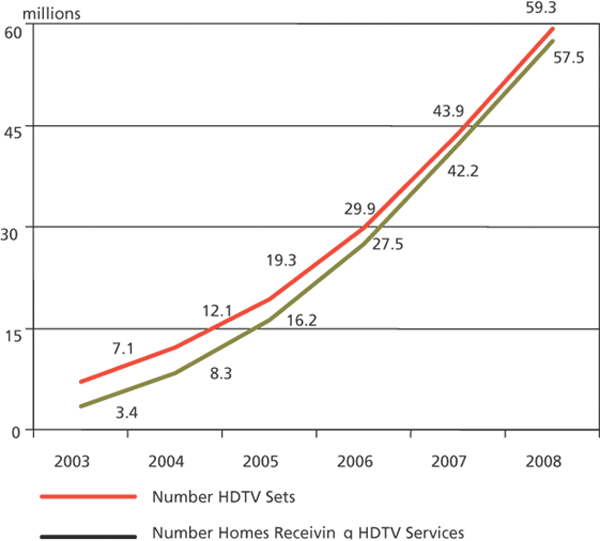 ITU videoconferencing standard, the H.264 standard is mandatory for the specifications of HD-DVD and Blu-ray (the two high-definition DVD formats) and is also ratified in the latest versions of the DVB (Digital Video Broadcasters) and 3GPP (3rd Generation Partnership Project) standards. Numerous broadcast, cable, videoconferencing, and electronics manufacturers consider the H.264 standard as their codec choice for their new products and services. This adoption of an open standard by such a diverse range of companies makes it possible for any company in the world to create devices—mobile phones, set-top boxes, DVD players, etc.—that will offer the new HDTV specifications.
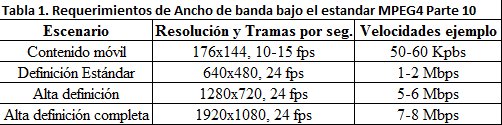
One area where MPEG4 Part 10 has been established as necessary is in video and audio compression, making it easier to transmit the signal across different types of networks and broadcast mechanisms (Table 1).
Requirements for Multiple Video Channels Simultaneously:
After investigating the drivers of the need for multiple video channels per subscriber, the results show that this need is not linked to the number of televisions per household. Currently, 98.2% of households in the United States have at least one television, and 74.3% of those have two or more televisions. (Source: Nielsen Media Research).
Another statistic shows that four out of every five televisions sold today are high-definition televisions (HDTVs). (Source: Harvard Research). Table 2 shows the growth of high-definition televisions per million households (Source: The Yankee Group).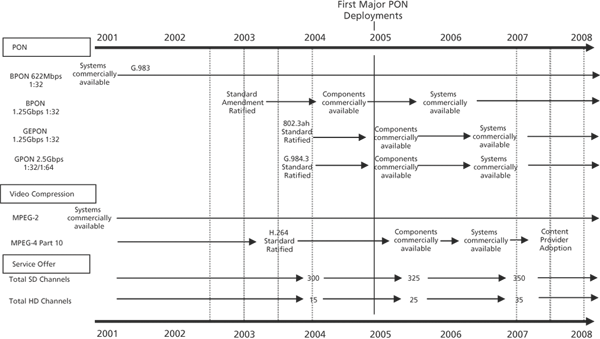 An additional driver pushing for digital video standards is the planned analog switch-off in 2010. Studying the trends of television distributors, the idea would be not only to distribute digital video, but high-definition digital video.
PON Bandwidths and Comparison with MPEG
This section focuses on the IPTV support that various PON topologies can provide, including BPON (Broadband PON) with speeds of 622/1.2 Gbps, GEPON (Gigabit Ethernet PON) with downstream speeds of 1.2 Gbps, and GPON (Gigabit PON) with speeds of 2.4 Gbps.
Based on the timeline shown in Table 3, deployment strategies should leverage technologies such as MPEG2 and BPON, while ensuring an evolutionary path to technologies such as GEPON and GPON, as well as MPEG4.
Capabilities
PON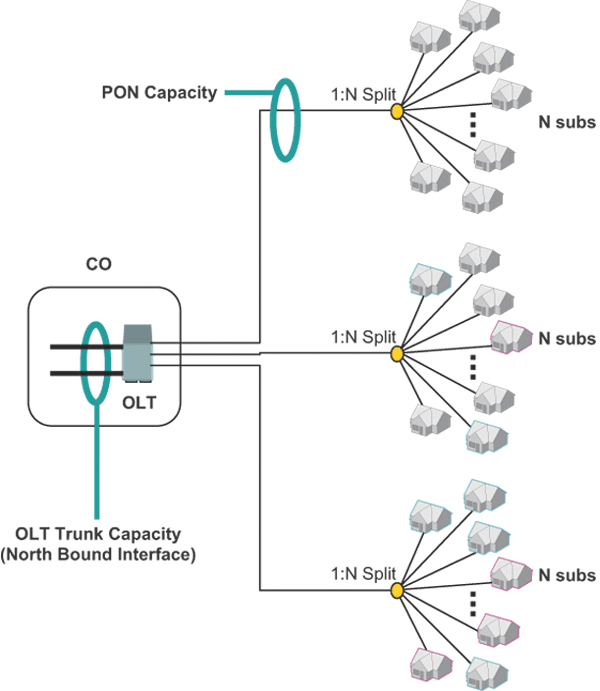 The objective of studying different PON topologies is to determine if a particular PON implementation can support bandwidth requirements. This is important not only at the subscriber end but also at the central office, where multicasting techniques must be applied.
The PON network capacity must guarantee maximum utilization without video blocking. The PON architecture must be designed to handle typical traffic and also ensure service provision during peak network demand. The PON network capacity determines the maximum number of video channels per subscriber. However, multicasting capability will be critical for handling the video services that will be demanded over the PON network.
As shown in Figure 2, sending simultaneous channels to different subscribers, as well as the regular use of the Video On Demand service, will affect the bandwidth required on the link between the OLT and the end subscriber. Depending on the type of Video On Demand service used, multicast or unicast techniques can be employed.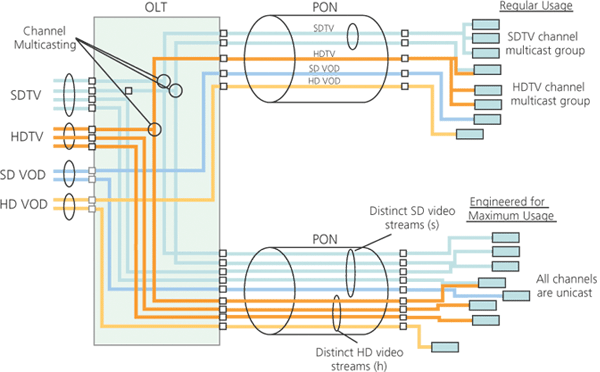 Multicast is the ability to send identical data from a network node to a variable number of end users. In contrast to unicast and broadcast, multicast involves transmitting information to different users using a single transmission channel. A typical IP multicast transmission is further complicated by the fact that users can join or leave the transmission group at any time. Unicast is the transmission of a single Protocol Data Unit (PDU) from a source to a single destination. In the case of video unicast, it is simply the individual transmission of a channel to an end user. A point-to-point unicast transmission requires sending an individual copy of the message to each end user.
Using multicast techniques, a PON network can better distribute bandwidth and allocate it more efficiently. Conversely, with a completely unicast transmission for all users, the link between the OLT and the backbone network requires significantly higher bandwidth.
Designing for Specific Service Speeds: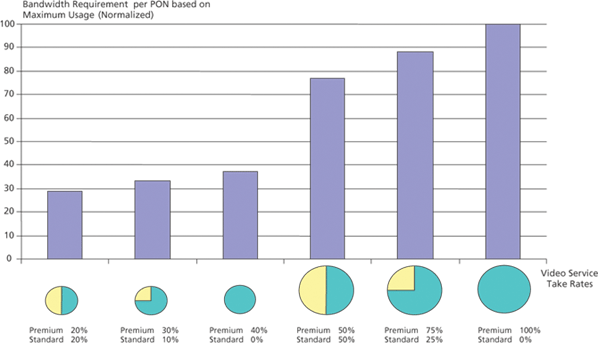 The bandwidth used by the PON network will depend heavily on the type of service the end customer uses. Not all PON networks will be at 100% capacity with 100% video service usage. As shown in Figure 3, there will be significant differences in bandwidth requirements depending on the service used by the end customer.
In Figure 3, to calculate the total bandwidth used, two different service packages are offered: Premium Service, which includes 3 standard video channels and 2 high-definition channels; and Standard Service, which offers 2 standard video channels and 1 high-definition video channel. The video channels are encoded using MPEG2, with the high-definition video channels encoded at 19.2 Mbps and the standard video channels encoded at 3.5 Mbps.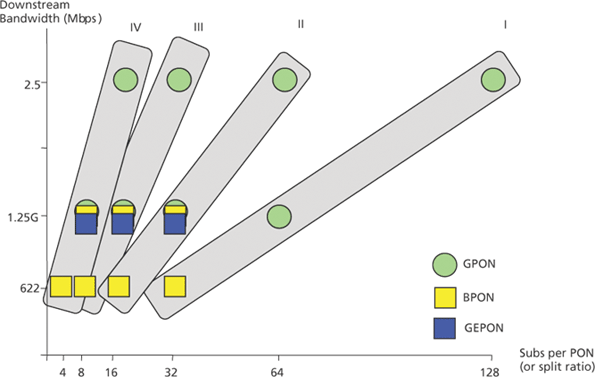 Figure 4 shows four PON deployment groups (I, II, III, and IV) that deliver the same bandwidth per end user. At the bottom, you can see the subscriber split ratio per OLT port.
Effective PON capacity measures the number of distinct video channels that can be delivered per end user. It measures the actual network capacity by combining the impact of video compression and deployment groups.
Cost
Components of a PON Network:
The cost of PON network components and interfaces will undoubtedly change over time. Currently, a typical BPON network deployment costs 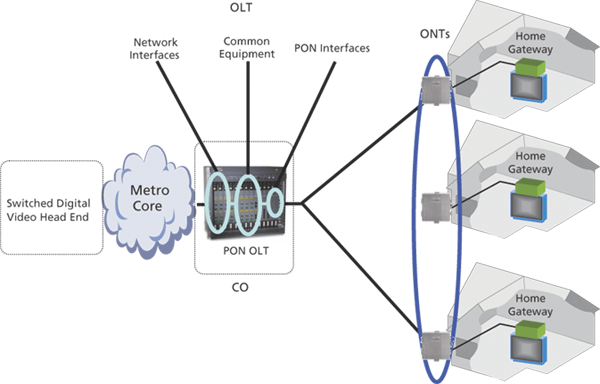 significantly less than a GEPON or GPON deployment simply due to the maturity of the technology and the availability of chipsets. However, when comparing cost to technology, BPON may have more difficulty adequately handling the requirements and support of Video over IP. Looking at the total cost of a PON deployment, the cost of the central office equipment, including installation, accounts for no more than 8% of the total. Meanwhile, the outside plant hardware and its installation represent 40% of the total cost. The final part of the network, which includes subscriber equipment (CPE, Customer Premise Equipment) and the installation of the service drop and equipment, accounts for up to 50% of the total cost.
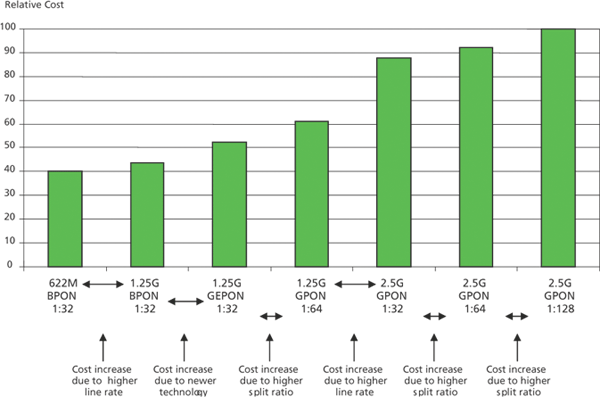 The costs of PON headend equipment are essentially threefold: the cost of the interface with the video servers, the OLT terminal equipment, and the interface with the access network. Research shows a clear relationship between the access network interface and the overall solution cost. A larger split ratio, a higher bandwidth source, and newer technology all lead to higher interface costs.
As previously described, BPON has seen a rapid decrease in cost due to technological maturity and high volumes. GPON, however, is expected to experience a much more pronounced and rapid cost reduction. This will be due to the support for 64 subscribers per trunk and the inclusion of technologies such as MPEG4.
PON Revenue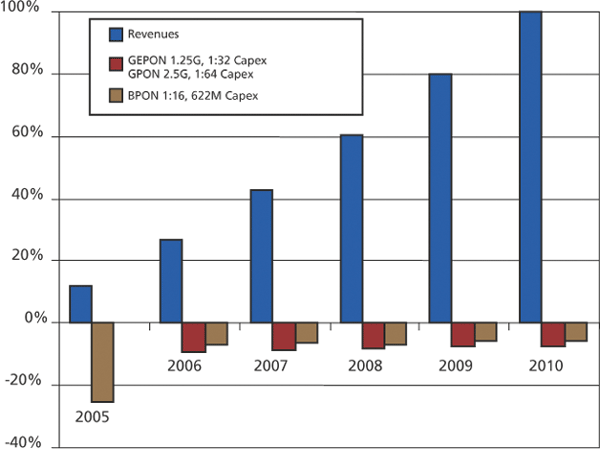 When comparing different PON deployments and architectures for profitability analysis, it is important to consider the following aspects:
1) It's a deployment in a new area, where I'll be the sole provider and therefore can expect 100% penetration.
2) I'm remodeling my existing network, so I already have voice and data customers, and the only additional revenue I can expect is from video.
3) I'm rebuilding my network to prevent competitors from entering this area.
Triple-play services represent a very important source of revenue, so delaying construction could result in a significant opportunity cost.
Figure 7 shows how in 2005, CAPEX spent on PON architectures exceeded revenue (Source: Verizon Published Financial Results). 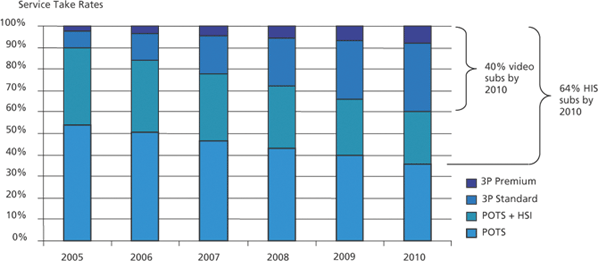 When studying penetration rates for new PON services, it is assumed that 40% of new subscribers will subscribe to video services, and 64% to high-speed internet, all before 2010. A 40% increase in new triple-play service translates to a 60% increase in revenue, or $1.8 million per residential unit for every 2,000 households passed. (Source: Yankee Group Forecasts for 2006–2010).
Summary:
With current compression techniques, neither VDSL nor ADSL2+ technologies provide the bandwidth required for transporting multiple IPTV channels. Using MPEG2 compression, a high-definition channel requires 19.2 Mbps, while a standard television channel requires 3.5 Mbps. Even changing a channel with a remote control at home incurs latency with DSL, since the transmitted channel must be changed. This results in a delay even with VDSL.
As an alternative to xDSL, PON networks offer much higher bandwidth and greater distances. Multiple customers can be served with a single fiber using optical splitters, and with great flexibility for network reconfiguration. Depending on the PON network version deployed, downstream speeds can range from 622 Mbps to 2.488 Gbps over a single fiber, with split ratios from 1:16 to 1:128. A GPON network delivering 2.488 Gbps with a 1:32 split ratio can offer 77.75 Mbps per customer, making a potential video service offering very attractive. However, even with GPON bandwidth, delivering HDTV channels is complicated unless MPEG4 is used for distribution.
Conclusions
- Traditional telephone operators need to change their service mix and focus much more on video, especially given the competition from cable operators.
- Video on Demand (VoD) and high definition (HDTV) are gaining momentum every day, and their bandwidth requirements make building a robust fiber optic infrastructure essential.
- The number of televisions per household will no longer be the determining factor in the bandwidth required per user; instead, it will be the number of channels per household and the requirements for high definition.
- ADSL2+ and VDSL have served as a lever for quickly reaching the market with new services, but the need to compete in video with an offering equivalent to that of cable operators means that copper-based technology will have little competitiveness in the medium term.
- PON architectures offer sufficient bandwidth to compete today with video, whether or not using MPEG4.
- The types of PON bandwidth offered are determined by the line speed of the cards, the split ratio, and the video compression used, and not solely by choosing BPON, GEPON, or GPON.
- Video represents a very significant percentage of the potential revenue from triple and quadruple play services.
- There may be a substantial opportunity cost due to inaction or delays in implementing new triple play services over PON architectures.
José Luis González. Technical Director ADC Krone Iberia


