

But do we really need higher-performance lines for subscribers? Recent market research, communications experts, and the industry's initial experiences with Next Generation Access (NGA) projects provide the answer: fast connection technologies and access networks are essential for the efficient use of the growing number of bandwidth-intensive, data-driven applications in the future.
Some services today have already reached their operational limits with the latest versions of DSL. Against this backdrop, operators and providers must look beyond copper-based subscription lines and take the necessary steps to prepare their access networks for the bandwidth demands and new market scenarios anticipated in an IP-based world.
International expert organizations and institutions largely agree that the future belongs to fiber optic access networks (FTTx). For example, in its comparison of different access technologies, the Organisation for Economic Co-operation and Development (OECD) concluded that FTTh networks offer the best performance per end user in terms of bandwidth and sustainability, and are therefore likely to prevail in the future among all the alternatives considered [OECD Report 2008b - April 2008].

Strategy and Efficiency:
This technology is less favorable in economic terms. Relatively high investment costs are cited as a drawback, as are other critical factors such as operator models and profitability, separate billing, and unresolved regulatory issues.
However, a wait-and-see approach seems ill-advised given today's fiercely competitive environment. Instead, network operators should develop a medium-term strategy focused on FTTx. Only a handful of operators or alternative carriers are technologically and economically positioned to convert their access networks to fiber optic technology in a single step. In most cases, FTTx can only be achieved through intermediate solutions and migration phases, all of which place greater demands and responsibilities on planners and electricians.
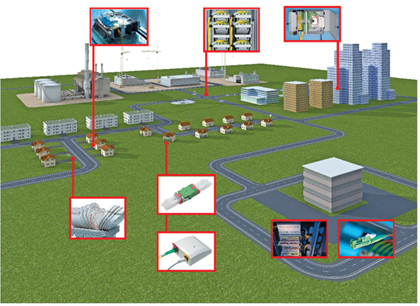
Passive infrastructure solutions capable of supporting both legacy networks and fiber optic technology become even more important. They provide the required flexibility and investment security. FTTx is the acronym commonly used in the industry for various versions of fiber optic access networks. The fiber optic cable's termination point determines the meaning of the "x": FTTC (Fiber to the Curb, e.g., to the next external distributor), FTTB (Fiber to the Building), and FTTH (Fiber to the Subscriber).
Although these acronyms have become quite common, it's important to keep in mind their meanings and the different strategies they imply. Otherwise, it would be too easy to get a distorted picture of the topology, the distribution to the end user, and the cost-benefit ratios. Caution should be exercised when publications discuss concepts like fiber optic networks or bandwidth without providing specific details about the access technology.
The VDSL2 packages offered by Deutsche Telekom and Swisscom are prominent examples of FTTC. Partially replacing copper segments with fiber optics in combination with the latest DSL technology is an obvious growth strategy for traditional and dominant operators in each country, e.g., established operators with a virtually perfect telephone line system (developed organically over time). VDSL2 is simply an intermediate technological step in the world of broadband with Future Generation Access fiber optic networks. FTTx can offer customers transmission speeds of 100 Mbps (or even Gigabit speeds for enterprise customers) depending on the selected extension version. These speeds cover foreseeable bandwidth needs in the medium term, even assuming intensive use of IPTV and HDTV. Several urban network operators are now developing solutions like these, or in some locations, they are already operational.
Speeds of 100 Mbps are already achievable if the fiber only goes as far as the building (FTTB) and data traffic is routed from there over the building's existing cabling, e.g., from a LAN to the workplace or home. FTTB reduces investment costs by approximately 20 percent compared to an FTTH extension. Furthermore, an FTTB network can be migrated relatively easily to an FTTH network in a later expansion phase.
Quality and Availability:
The high expectations people have for NGA networks are also impacting passive network infrastructure technology. Enormous amounts of data must be transmitted quickly and reliably. The characteristics of average connection and distribution systems are no longer sufficient to meet bandwidth demands. Even greater quality and availability are required than before. It's a matter of meeting agreed service levels, achieving customer satisfaction, and securing revenue streams. In the development of these networks, the interaction between active and passive layers must be examined even more closely in the future. Only fully developed, comprehensive solutions for PON and P2P access networks can achieve this.
An evolving market:
Fiber optic connections (still) play a subordinate role in most European countries compared to other economic regions. Japan is the global leader with over 10 million FTTH connections. Every month, nearly 300,000 new customers opt for FTTH, and another 60,000 switch from ADSL to FTTH. In South Korea, FTTB/LAN connections account for more than 35 percent of the total, and in Hong Kong, they represent approximately 28 percent.
With 3 million connected households and growth rates exceeding 100 percent, the US is also ahead of Europe in the global FTTH rankings. In an interview with the website Portel.de, Professor (FH) Hartwig Tauber, Director General of the Council of Europe for FTTH, explains that the picture is also gradually improving in Europe.
“In the initial stages of fiber optic expansion in 2004, its progress in Europe was slow,” he says, “and we forecast approximately 3 million FTTH connections by 2010. But the reality is that we currently have approximately 1.8 million connections in Europe, and we expect to see that figure rise to 5.5 million in 2010 and approximately 15 million in 2012.”
In terms of service level, for example, the number of connections per 100 households, Sweden and Denmark will lead the list of the top 10 countries in Europe with FTTH in 2012, with 36.9 percent and 29.2 percent respectively.
According to the FTTH Council’s findings, broadband speeds in Europe are increasing at an annual rate of more than 50 percent. Broadband usage is growing by around 20 percent per year, while households with an FTTH broadband connection generate three times more traffic than households with ADSL.
This is compelling evidence for the thesis that end users almost immediately take advantage of higher bandwidth access as soon as it becomes available (given the attractive pricing structure). Speaking of the economic importance of fiber optic expansion, Professor Tauber notes that Greece, Portugal, and Finland have now followed the lead of Sweden, Norway, Denmark, and the Netherlands and are launching significant FTTH programs on their own. In some cases, these are even state-run programs aimed at providing genuine broadband access to the general population.
FTTH is also making steady progress in France and Slovenia, where national telecommunications companies have begun nationwide rollouts. Professor Tauber comments: “With a growing number of companies selecting their business locations based on available ICT infrastructure, a lack of FTTH services in a country or region could soon become a significant economic disadvantage.”
Harmonization in Europe:
Besides funding, the lack of regulation in this area across the European Union poses the biggest obstacle to the expansion of fiber optic access networks. In September 2008, the European Commission launched a public consultation on the regulatory principles to be applied by EU Member States to Future Generation Access networks. Europe is seeking to harmonize certain categories, specifically regulated services, access conditions, fees, and risk indices. The aim is to ensure standardized treatment for network operators across the European Union and thus generate the legal certainty so crucial for investment. It is generally expected that the European Union's recommendation will signal future cooperation between telecommunications companies and alternative network operators. It will facilitate open access.
Overcoming Challenges:
There are a multitude of topologies and approaches for deployment and expansion, including hybrid solutions. This fact alone gives us an idea of the many ways in which FTTX enriches the lives of network planners. In many fiber optic projects, network operators have chosen manufacturers of high-quality, reliable solutions, such as R&M, as their cabling partner for passive infrastructure. They seek to benefit from R&M's ability to create customized solutions and its many years of international experience.
Planning and building FTTx access networks is a complex undertaking. Every network is different. Every operator has its own strategy; every city, its own unique local situation. But in all projects, a key priority is minimizing personnel costs and installation time. The answer: the challenges of FTTx can be met by using a fully modular cabling system combined with technical support and customer-specific solutions.
Author: David López, Carrier Director for R&M Spain and Portugal


