
 FTTH adoption is growing rapidly across the EU+8, despite the current economic climate: FTTH/B deployment progressed at an annual rate of 41% in 2011, with over 5.1 million FTTH/B subscribers and nearly 28 million homes wired by the end of 2011.
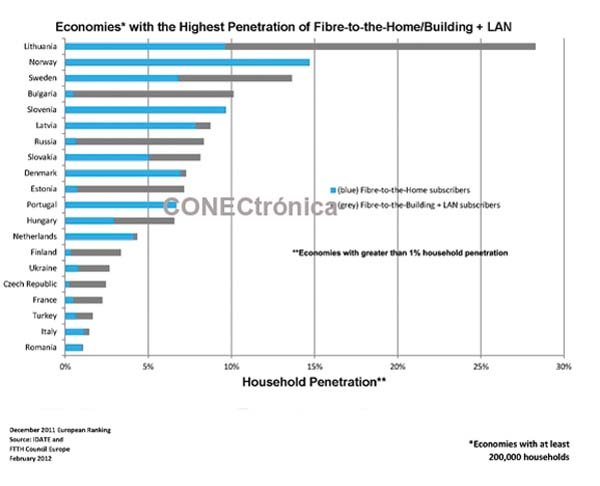
In the ranking** of leading FTTH economies with over 1% household penetration, the top three remain unchanged from the previous edition, with Lithuania (28.3% penetration), Norway (14.7%), and Sweden (13.6%) still in the lead. Countries that have significantly improved their positions include Norway, now number two, confirming the continued dynamism of the Scandinavian countries; Latvia; and Turkey, now ahead of Italy. Hungary has fallen two places, now behind Estonia and Portugal. See the chart in Figure 1.
Household penetration in Lithuania has increased by a total of 3% since the previous edition; in Norway, the increase was 2%, and in Sweden, only 0.4%. Compared to the previous market landscape, the average increase across the top 10 countries was 1.23%.
Although Spain is not included in the FTTH ranking**, it is likely to be included in the foreseeable future, as it has witnessed the greatest growth during 2011, with 184%.
The UN Broadband Commission for Digital Development has declared that every country should have a national broadband plan by 2015, arguing that the Internet should be seen as a human need and a right, and that broadband contributes to economic growth and job creation.
The European Commission proposes spending €9.2 billion between 2014 and 2020 on high-speed broadband and related services, with €7 billion available for infrastructure investment.
The restructuring of major FTTH economies remains an ongoing process, and time is now of the essence to ensure a sustainable future for the European economy.
* EU+8 = The 27 countries of the European Union + Andorra, Croatia, Iceland, Israel, Norway, Serbia, Switzerland, and Turkey.
** The FTTH ranking covers all countries with at least 200,000 households where FTTH/B penetration has reached 1% of the total number of households.


