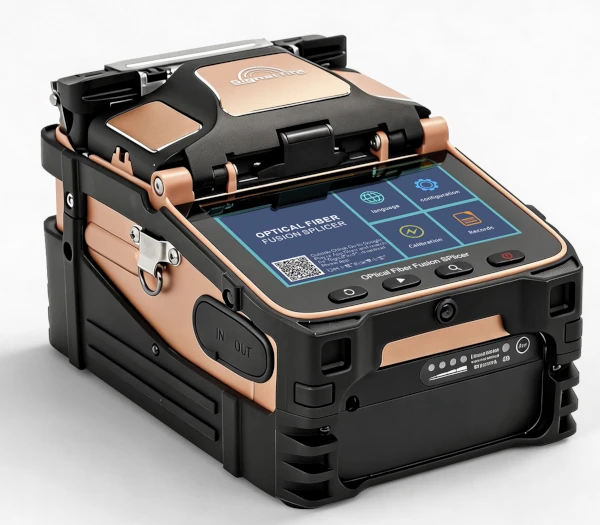
One of the most outstanding features of the Signal Fire AI-12 is its six-motor core alignment system, designed to achieve alignment accuracy down to 0.05 μm. The device also offers up to 320x image magnification, allowing installers to easily visualize the fiber and monitor the process before splicing.
The splicer incorporates automatic fiber type identification and is compatible with various configurations, including single-mode and multimode fiber, bare fiber, pigtails, drop cables, and multi-fiber cables.
Fast splicing and greater autonomy in the field.
The AI-12 was developed specifically with the needs of field technicians in mind. The manufacturer specifies splicing times of approximately 6 seconds and heating times of 15 seconds, aiming to reduce the time required to complete installations with a high number of fibers.
The device features a 5-inch color touchscreen and offers 14 language options, a feature designed to facilitate its use in international projects.
For work away from a power source, Signal Fire has integrated a 7,800 mAh lithium battery. According to the manufacturer's specifications, a full charge allows for up to 260 splicing and heating cycles.
The battery is removable and features USB-C connectivity with bidirectional charging up to 45W, so it can also be used to power other devices, such as a mobile phone, during fieldwork.
Integrated VFL and Optical Power Meter
Another feature of the AI-12 is the integration of additional diagnostic functions. The splicer incorporates a visual fault locator (VFL) and an optical power meter (OPM), eliminating the need to carry separate instruments in certain operations.
The OPM allows working with different wavelengths commonly used in optical networks, while the VFL has continuous and intermittent operating modes.
The machine also incorporates a 3-in-1 fiber holder and a heating system compatible with SoC (Splice-on Connector) fibers, in addition to conventional fibers.
Bluetooth Management and Mobile App:
Signal Fire has also added Bluetooth connectivity to link the AI-12 with its mobile app. From the app, users can view logs and the number of splices performed, export information, modify certain operating parameters, and update the device's software.
The platform also allows for the management of one or more devices, a particularly useful feature for installation companies that work with fleets of splicers or offer equipment on a rental basis.
Configuration options include parameters such as warm-up time, machine language, specific menu options, and limits related to the time or number of operations performed by the device.
Designed for backbone networks and demanding environments,
Signal Fire positions the AI-12 for backbone network projects up to approximately 100 km, as well as for multi-fiber optical cables, server rooms, railway infrastructure, wind energy installations, operator networks, security projects, and research and teaching applications.
The manufacturer also highlights the equipment's design for working in demanding environmental conditions and notes its use in high-altitude installations and in diverse international environments.
With the AI-12, Signal Fire aims to combine high-precision core alignment, fast splicing, autonomy, and integrated measurement tools into a single device, thus reducing the number of instruments technicians need to carry during fiber optic installation and maintenance work.