
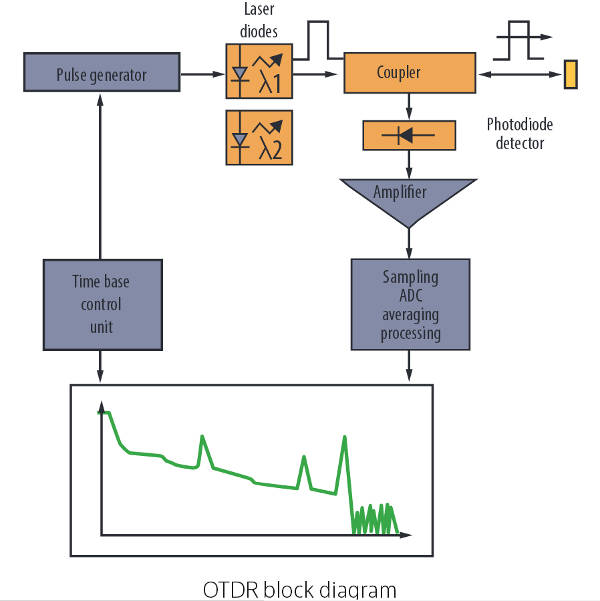
This instrument only needs access to one end of the fiber optic link to function as a radar system. Furthermore, it can obtain a graphical representation of the entire fiber optic link, also known as a trace.
By "introducing" light pulses into one end of the fiber and analyzing the backscattered and reflected signals, an OTDR measures both optical distance (to elements such as splices, connectors, splitters, or multiplexers; to faults; or to the fiber end) and signal loss, optical return loss (ORL), and connector reflectance.
For these reasons, an OTDR becomes an essential tool for maintaining fiber optic infrastructure and troubleshooting.
Given the wide range of models available, the COFITEL Group recommends reading this article from its partner Viavi before purchasing any such instrument.
This article helps to understand the main specifications of OTDRs and, therefore, facilitates the process of acquiring the most suitable model for each project.
For example, it lists the questions to ask yourself before buying an OTDR: what type of network will it be used in (LAN, metro, long haul, etc.); what type of fiber will it test (single-mode or multi-mode); what is the maximum distance to be tested; and what type of measurement will be performed (construction acceptance, troubleshooting, or in-service).
Most importantly, it includes a list of factors to consider in the selection process.
These are:
• Size and weight: Keep in mind that you may have to climb a tower and work inside buildings.
• Screen size: 5” should be the minimum requirement for an OTDR display. Models with smaller screens cost less, but make trace analysis more difficult.
• Battery life: This instrument should have enough battery life for a full workday, so the minimum would be 8 hours.
• Trace or results storage: Here, the minimum would be 128 MB of internal memory with external storage options, such as a USB device.
• Bluetooth and/or Wi-Fi: Wireless connectivity facilitates exporting results to tablets, laptops, and PCs.
• Modularity/upgradeability: A modular/upgradeable platform adapts to evolving testing needs. This may increase the initial cost of the OTDR, but it is more economical in the long run.
• Availability of post-processing software: Although it is possible to edit the fibers on the test instrument, it seems more convenient to analyze and document them using post-processing software.
Therefore, the COFITEL Group recommends that customers consider all these factors before purchasing an OTDR and seek advice from reputable companies.
The COFITEL Group sells professional OTDRs and a complete range of cables, accessories, tools, and equipment for cabling communications networks, both copper and fiber optic.


