
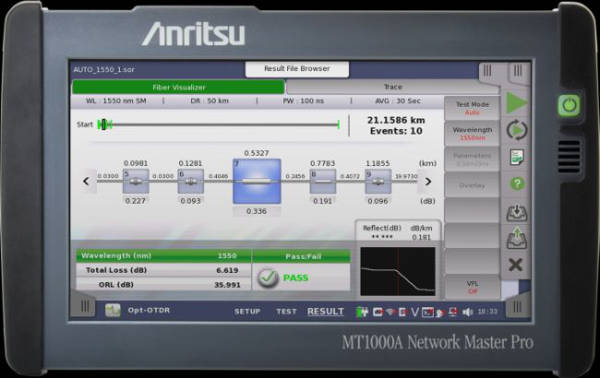
The new module supports high dynamic range across all wavelengths, including 1625 nm, enabling the MT1000A to perform "extra sensitive" tests to ensure the operation of today's broadband networks.
With the new MU100022A-022 "Tri-wavelength" OTDR module installed, the Network Master Pro MT1000A can achieve a dynamic range of 46 dB at 1310 nm and 1550 nm, and 44 dB at 1625 nm. Supporting the dynamic range at 1625 nm wavelength allows the MT1000A to achieve high-precision macrobend detection in all single-mode fiber applications.
This new OTDR module also features Anritsu's Fiber Visualizer, a fault-finding function that simplifies the entire testing process. Fiber Visualizer automatically selects test parameters to ensure correct configuration and provides a simple, graphical summary of the fiber under test in seconds. Fiber Visualizer also features individualized PASS/FAULT analysis to further simplify fiber optic testing.
Ideal for the installation and maintenance of fiber networks, all Network Master Pro MT1000A OTDR modules benefit from new specialized features to make field testing more efficient. An OTDR build mode provides an automated method for testing numerous fibers at multiple wavelengths during cable installation. A simple setup screen initiates a test wizard, ensuring that all fibers are tested and the results are stored using compatible file naming conventions. Additionally, a bidirectional measurement function has been added for accurate and straightforward analysis of loss events.
The Network Master Pro MT1000A is a compact, battery-powered, and easy-to-use device that offers a variety of testing capabilities. The MT1000A simplifies the complex task of data collection and interpretation with an intuitive graphical user interface and clear summaries, enabling users of any skill level to operate the instrument to its full potential. The multi-function MT1000A analyzer is field-upgradeable and configurable with a variety of OTDR modules and test functions, including RFC2544/6349, Y.1564, OTN, and CPRI/OBSAI, to meet the current needs of core, metro, and mobile backhaul networks, while also providing the flexibility to expand support for future technologies.


