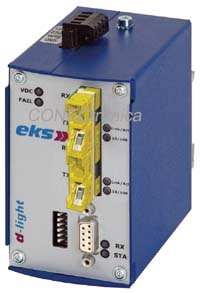
 The visible part of FiberView is like a traffic light with a clear interpretation.
It consists of three LED indicators: Red (Fail - Malfunction - Error); Yellow (Limit - at the Limit, Warning: Close to Malfunction); and Green (Link/Act - Good signal level).
In every type of data transmission there is a sender, a receiver and a medium between the two that carries the data transmission signal.
The medium that carries the signal consists of a material of a certain quality, with varying degrees of attenuation due to length (the defined distance between the transmitter and receiver), and connectors that also cause attenuation.
Attenuation can vary and depends on parameters such as changes in ambient temperature, the actual bend radius of the optical fiber, and the quality of the connectors used.
The system is compatible with the following networks:
• Profibus (Profibus-DP, FDL, FMS, Master, and Slave).
• CANbus (CanOpen, DeviceNet, protocols over CAN).
• Modbus-RTU (RS485 Multi-Drop or RS232/422).
• Modbus-Plus.
• RS232, RS422, RS485, TTY-20mA Loop.
• Modbus TCP (and Ethernet in general).
Network topologies are classified into the following basic types: Bus (linear); Ring; Redundant Ring; Star; Tree; and Mesh.
 Bus Topology. The bus topology is the simplest and most economical. It consists of a cable, usually twisted pair, that runs from device to device, connecting them like beads on a string. RS485 buses are of this type. It is sometimes called "multi-drop."
Ring Topology. In a ring network, each device has exactly two neighbors in the direction of communication. All messages travel around the ring in the same direction (either "to the right" or "to the left"). A failure in any cable or device breaks the ring and ends communication throughout the network.
Note: The ring can be very elongated, so elongated that it approximates a bus.
Redundant Ring. If a cable or device fails in the ring, the ring reverts to a bus topology. When the devices detect the failure, they switch to operating as in a bus topology. This feature is the advantage of the Redundant Ring Topology, which is much more robust than a bus topology. Once the fault is repaired, it reverts to functioning as a redundant ring.
The Eks Engel Data-Light product line generates a malfunction alarm on the ring. This malfunction alarm is used to alert maintenance personnel to the error. The redundant ring functions perfectly with the loss of one segment, but not with two. The probability of simultaneously losing two segments on the ring is much smaller than the probability of losing one.
Star Topology. A star network has a central connection point called a "hub," which can be a hub, switch, or router. Compared to a bus topology, a star network generally requires more cabling, but a failure in any one cable in a star network will only affect the connected device and not the entire network.
Tree Topology. The tree topology is used to integrate multiple star topologies via the bus topology. In its simplest form, only hub devices connect directly to the tree bus, and each hub acts as the "root" of a new tree of devices. This technique allows for easy network expansion in the future and reduces traffic on the overall network.
Mesh Topology. Mesh topology uses the concept of paths to communicate from device to device. Unlike each of the previous topologies, messages sent in a mesh network can take any of several possible paths from source to destination.