


The Telecommunications Industry Association (TIA) initiated a working group in October 2014 to develop a guide for a 50/125 μm wideband multimode fiber (WBMMF) standard to support short wavelength division multiplexing (SWDM) transmission. The TIA-492AAAE standard was published in June 2016. The IEC WBMMF standard is expected to be finalized by early 2017.
The optical and mechanical characteristics of OM5 meet the specifications of OM4 50/125 μm and include the additional specifications of effective modal bandwidth and attenuation at 953 μm. WB MMF is designed for operation using vertical cavity surface emission (VCSEL) laser transceivers in the 846–953 nm wavelength range.
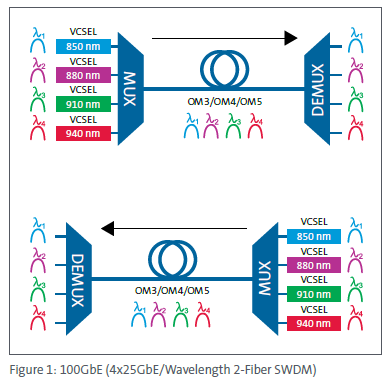 What is SWDM?
SWDM is a wavelength division multiplexing (WDM) technology that uses four wavelengths in the 850–940 nm range. SWDM transceivers are designed to use two-fiber connectivity in a single transceiver with OM3/OM4. SWDM VCSEL transceivers are expected to be commercially available throughout 2017. Figure 1.
SWDM transceivers are compatible with OM3/OM4/OM5 optical connectivity solutions.
The maximum expected operational distances of 40/100GbE are shown in the table below.

What are the specified effective modal bandwidth (EMB) values for OM5?
EMB ≥ 4700 MHz・km at 850 nm
EMB ≥ 2470 MHz・km at 953 nm
While EMB is specified at 850 nm for OM3/OM4 at 2000/4700 MHz/km, respectively, the EMB values for OM5 are specified at 850 and 953 nm.
Why is the EMB of OM5 lower at 953 nm compared to 850 nm?
Optimal system performance is achieved by combining low chromatic dispersion and high EMB. For a typical optical fiber, the ideal zero-dispersion wavelength occurs at 1310 nm. Since 953 nm is closer to 1310 nm than 850 nm, the chromatic dispersion is lower, and consequently, the EMB requirement is lower to achieve the same system performance, as shown below.
It should be noted that there are no transmission standards that specify OM5 or SWDM. Typical transmission standards include only one multimode fiber variant, which is selected based on economic, commercial, and technical criteria. Parallel transmission is the default multimode fiber variant for data rates ≥ 40G. The TIA has specified lime green as the official cable jacket color for OM5.
Does this new technology require a new polarity method for duplex fiber connectivity?
No. Traditional Corning universal polarity connectivity solutions can be used. End users are expected to deploy solutions with Base-8 or Base-12 MTPR backbone cables and MTP-to-LC modules or harnesses to break down into 2-fiber LC interconnects.
Will 850 nm and 953 nm field channel loss measurements be required?
No. Compatible 850 nm field channel loss measurements can be used to demonstrate 953 nm channel loss compliance. (For more information on this topic, seehttp://www.flukenetworks.com/blog/cabling-chronicles/wide-band-multimode-fiber-update. – Fluke Networks)
Can BiDi transceivers be used with OM5?
Yes. Corning Optical Communications' EDGE and EDGE8 solutions with OM4 and OM5 have the same 40G BiDi 200m range capability.
Article extracted from this link






