


In this context, the characteristics, advantages, and benefits of these networks are presented, along with their historical evolution through their recognition by structured cabling standards, such as ANSI/TIA (American National Standards Institute/Telecommunications Industry Association), and manuals, such as the TDMM (Telecommunications Distribution Methods Manual) from BICSI (Building Industry Consulting Service International). Finally, the important points to consider for the implementation of these networks are discussed, and some questions that sometimes challenge ICT (Information and Communication Technology) professionals are answered, particularly those focused on infrastructure and who are not yet familiar with PON operation in LANs (Local Area Networks). Likewise, some pertinent issues that typically arise when comparing POL with a traditional network in terms of infrastructure, compatibility, and performance are addressed.
The technological evolution of the last forty years is astonishing. New technologies emerged and others were consolidated, some even created between the 1970s and 1980s. The 1990s were a pivotal decade in the field of networks, whether telecommunications or LANs. The beginning of the decade was marked by the launch of the first structured cabling standard, ANSI/TIA-568, created to standardize and organize the physical infrastructure of networks. At the same time, the Ethernet protocol began to gain traction, promoted by an ever-increasing range of manufacturers, due to its open and easy-to-implement nature. Soon, all computers began to be sold with one or more network interfaces operating on this standard.
While Ethernet was growing and consolidating, technologies with great potential, such as ATM (Asynchronous Transfer Mode), were beginning to lose market share. In the early 1990s, ATM was used for transmissions with speeds exceeding those of Ethernet and offered a highly effective approach to network traffic management and forwarding, with notable and innovative features such as lower transfer latency, greater transmission reliability, and high bandwidth efficiency, as channel allocation was on-demand according to the traffic of each connection. It also utilized TDMA (Time Division Multiple Access), which eliminated the need for fixed time slot allocation to subchannels. ATM's adoption initially occurred in the SDH (Synchronous Digital Hierarchy) networks of telecommunications operators, as its use in local area networks (LANs) ultimately did not reach the level of widespread adoption that had been anticipated. Another factor contributing to the decline of ATM in LANs was the emergence of Ethernet, which, in addition to the factors already mentioned, rapidly gained market share, speed, and a much more attractive implementation cost.
With the expansion of fiber optic use during the 1990s, the telecommunications industry began exploring last-mile customer service alternatives, focusing on reaching the homes of fiber optic subscribers. One of the alternatives considered to achieve this was the use of Ethernet. Due to its characteristics, providing this service would require a point-to-point infrastructure that, by default, uses two single-mode fibers: one for transmission and one for signal reception. Initially, this aspect would make the use of Ethernet unfeasible in that scenario due to the operating cost (OPEX – Operational Expenditure), either because of the distance (no more than 10 km, in terms of application costs) or to maintain a remote shelter that would have to support a significant amount of equipment in terms of power and cooling, since each customer would need, in addition to the fiber pair, a dedicated switch port at that location.
Even during the 1990s, an idea that had emerged in the 1980s, and which had been relegated for various reasons, resurfaced: PON technology. This technology gained momentum and took shape due to the maturation of optical communications, the increased speed, and the decreasing cost of the technologies involved. Regarding physical implementation, the use of PON networks would simplify network infrastructure and the need for remote telecommunications shelters, including all their equipment, as these would be replaced by small passive elements called optical splitters, which can be easily installed in splice or termination boxes. In addition to covering greater distances with the passive network, a pair of fibers would no longer be necessary since, in this new approach, signal transmission and reception would be carried out with a single single-mode fiber using wavelength division multiplexing (WDM).
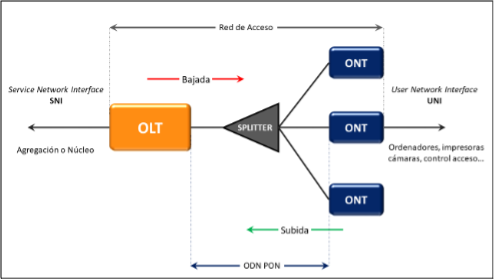
A network implemented with PON technology essentially consists of active equipment, generally installed at the network edges, and passive elements, including optical cables, splitters, ODFs, patch cords, and other components used to implement the optical connection infrastructure. In the active portion, the equipment that interacts with the services, typically connected to the aggregation or core layer of the network, is called an OLT (Optical Line Terminal), and the equipment that interacts with the user is called an ONT (Optical Network Terminal). The entire passive portion of the network, between the OLT and the ONTs, is called the ODN (Optical Distribution Network), a point-to-multipoint fiber infrastructure built in a tree topology due to the presence of optical splitters. For example, in an FTTH (Fiber-to-the-Home) network, the OLT is the headend installed on the operator's side, while the ONTs are installed inside the homes served, and the ODN is the entire optical infrastructure that enables the connection between the headend and the ONTs in the homes. The traffic generated in the layer above the OLT and sent through the access network to the devices connected to the ONTs is called downstream. On the other hand, the traffic generated by users below the ONTs and sent to the OLT is called upstream. Figure 1 presents this scenario described for PON technology
. To meet the transmission characteristics of PON networks, the initial development was based on ATM, originally called A-PON. As the name suggests, its implementation brought with it the various positive characteristics of this protocol. Implementations using ATM PON were known as B-PON (Broadband PON), which was standardized and published by the ITU-T as the G.983 series of recommendations in 1998. Initially, this standard defined transmission speeds (bit rates) of 155 Mb/s for both uplink and downlink, but later adopted rates of 1244 Mb/s for downlink and 622 Mb/s for uplink.
In the years following its release, this standard matured, adding the ability to carry telephony services such as POTS (Plain Old Telephone Service) and VoIP (Voice over Internet Protocol), as well as improved uplink transmission capacity through the use of DBA (Dynamic Band Allocation), which was defined and standardized.
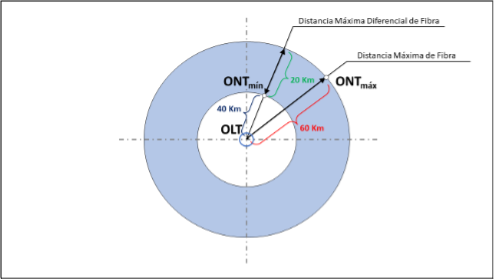
In 2003, the ITU-T launched the G.984 series of recommendations, known as GPON (Gigabit-PON), which defined and implemented a new protocol developed based on the strengths and characteristics of B-PON, initially offering ATM as an optional protocol. Among its various advantages are the possibility of coexistence with the next generations of ITU-T PON technologies and a consolidated level of convergence; that is, GPON was designed to deliver/carry any necessary telecommunications service. It was standardized to operate at speeds of 2488 Mbps downstream and 1244 Mbps upstream, with capacity shared among the ONTs. GPON meets the needs and characteristics of a gigabit network, initially supporting up to 64 ONTs (1:64 split ratio) per OLT port at distances of up to 20 km. The maximum supported distance is 60 km, and the maximum number of ONTs is 128 (1:128 split ratio). This depends on the optical network's power budget and the power capacity of the OLT transceiver, which is determined by its class. For example, a Class B+ transceiver has a maximum range of 20 km and can handle up to 64 ONTs, while a Class C+ transceiver has a maximum range of 60 km and can handle up to 128 ONTs. Regarding distances, it's important to consider two related characteristics: the maximum fiber distance and the maximum differential fiber distance. The maximum fiber distance is the maximum range between the OLT and an ONT. The maximum differential fiber distance is the difference in range between two individual ONTs on the same PON port of the OLT. In the case of GPON, this distance has a conventional range of 20 km, due to its PMD (Physical-Media Dependent) and TC (Transmission Convergence Layer) requirements. Thus, if one ONT is connected at a maximum fiber distance of 60 km, all other ONTs on the same PON port of the OLT must be connected within a 20 km range relative to it. In this scenario, for the correct operation of all ONTs, the minimum fiber distance used must be 40 km from the OLT. Figure 2 shows the relationship between the maximum fiber distance and the maximum differential fiber distance in this example.
 GPON was deployed on a substantial scale in the years following its launch, especially between 2008 and 2009, and continued to expand in subsequent years. Since GPON is designed to coexist only with the next generation of PON networks, coexistence with B-PON networks is not possible due to the use of the same wavelengths for transmission and reception, operating in the 1490nm window for downlink traffic and 1310nm for uplink traffic, respectively.
The evolution of PON networks progressed in the following decade, with the release of the G.987 series of recommendations in 2010, known as XG-PON (10-Gigabit-capable Passive Optical Networks), where X represents the Roman numeral 10. Previously known as XG-PON1, this term was discontinued and replaced by NG-PON1. This standard features asymmetric transmission and reception speeds, with 9953 Mb/s for downstream traffic and 2488 Mb/s for upstream traffic. It operates on a different wavelength range than GPON, using wavelengths of 1575nm–1580nm for downstream traffic and 1260nm–1280nm for upstream traffic. As defined for GPON, the maximum fiber distance supported by NG-PON1 is 60 km. However, the maximum differential distance defined for its reach is now 40 km, a feature also defined for GPON, but years after its release, through recommendation G.984.7. The split ratio supported by XG-PON is 1:256, meaning it can support up to 256 ONTs per PON port on the OLT.
In 2013, the ITU-T G.989 series of recommendations, known as NG-PON2 (40-Gigabit-capable Passive Optical Networks), was launched. These recommendations outline the characteristics for the development of Generation 2 PON technology, based on Time and Wavelength Division Multiplexing (TWDM) and an optional Point-to-Point Wavelength Division Multiplexing (PtP WDM) connection system. TWDM is a PON solution that uses a multi-wavelength channel architecture, where each wavelength is shared among several ONTs. PtP WDM is a PON solution that provides one wavelength per ONT for both downlink and uplink, which can be overlapped with TWDM and has bidirectional data transmission capabilities between OLTs and ONTs. NG-PON2 has a nominal aggregate capacity of 40 Gbit/s downstream and 10 Gbit/s upstream. The wavelengths were based on a wavelength plan for TWDM and PtP WDM to allow coexistence with previous standards in a potential migration. For TWDM, the 1596nm–1603nm range was reserved for downstream transmissions, and a set of upstream range options were selected, classified as Wideband (1524nm–1544nm), Reducedband (1528nm–1540nm), and Narrowband (1532nm–1540nm). For PtP WDM, the 1524nm–1625nm range, known as spread spectrum, was defined. This spectrum can be used as long as it does not interfere with TWDM or legacy systems, respecting isolation requirements. Another band can be used when PtP WDM is used in conjunction with TWDM, which is known as shared spectrum, and uses wavelengths from 1603 nm to 1625 nm. The maximum supported fiber distance and maximum differential fiber distance are the same as those defined for NG-PON1; however, the minimum split ratio must be 1:256.
In 2016, ITU-T Recommendation G.9807.1 was released, defining XGS-PON (10-Gigabit-capable Symmetric Passive Optical Network), a technology that uses symmetrical rates, with speeds of 9953 Mb/s for both downstream and upstream. It can use the same wavelengths as an existing XG-PON system or GPON wavelengths, thus supporting migration and coexistence with these technologies, as well as with NG-PON2. A key feature of XGS-PON was the extensive reuse of previous ITU-T PON recommendations; that is, this standard incorporates the physical transmission specifications (PMD) derived from XG-PON, and the logical specifications based on the TC layer of both NG-PON2 and XG-PON. Interestingly, all transmission rates for PON technologies are based on the rates of the SDH standard.
A key milestone in the evolution of PON technologies, primarily due to their maturity, robustness, and operational characteristics, was the significant interest generated for indoor applications. The concept of POL networks, the name given to the implementation of PON technology in local area networks, emerged in North America around 2010. In 2012, APOLAN (Association of Passive Optical LANs) was created, an organization that brings together manufacturers, distributors, integrators, and consulting firms, focusing on market education and promoting the adoption of passive optical technology in local area networks (LANs). In 2014, BICSI published the 13th edition of the TDMM manual, which provided recommendations for the use of PON networks within buildings, where structured cabling standards and concepts are applied. Until that point, this trend had been discussed by various regulatory committees, finally being officially recognized in the fourth revision of the ANSI/TIA-568.0-D generic structured cabling standard and the fourth revision of the ANSI/TIA-568.1-D structured cabling standard for commercial buildings, both released in 2015. This revision highlights: harmonization with the international structured cabling standard ISO 11801 and the recognition of PON technologies in Annex C of ANSI/TIA-568.0-D, which specifies the maximum supported distances and minimum and maximum attenuations of a single-mode fiber optic channel used for PON applications, as well as other characteristics related to the centralized optical cabling used in these applications. At the time of writing, the current ANSI/TIA standards are in their fifth revision (revision E), and the TDMM manual is in its 14th edition.
Cabling standards were created for a physical network implementation in a hierarchical star topology due to its acceptance, flexibility, and ease of management. With the use of PON technology in LANs, its original tree topology is perfectly adaptable to the topology proposed by the standards. This is achieved through the use of different structured cabling components, ensuring compatibility with current implementations and future expansions, making PON networks a disruptive technology for use in this type of environment. Among the main advantages of using PON technology in local area networks are reduced equipment costs and electricity costs for both the equipment and cooling systems, reduced space occupied by cabling and equipment, reduced plastic consumption, reduced overall installation and deployment time, and the promotion of a future-proof infrastructure.
The term "future-proof" is used because it essentially characterizes the optical infrastructure of the structured cabling, which must be certified and may have a 25-year warranty provided by the manufacturer. Thus, if the customer is interested in a technology upgrade, for example, replacing GPON with XGS-PON, they only need to replace the active network equipment (OLTs and ONTs), without having to touch the existing optical infrastructure. Furthermore, in addition to being a sustainable solution, POLs contribute to a reduction in total implementation costs (CAPEX) and, primarily, a significant reduction in operating costs (OPEX), which positively impacts the total cost of ownership (TCO) throughout the network's lifecycle.
In LANs or even campus area networks (CANs), distances are shorter compared to networks provided by operators or internet service providers and, therefore, are not a concern in POL design. On the other hand, to enhance the efficiency offered by PON technology and address the complexity of the various services in a LAN/CAN, the chosen equipment must be capable of providing greater capacity in terms of memory management, processing, and frame/packet forwarding. Furthermore, it must be transparent to current and future applications and offer features that can be adapted to the complexity of the project, whether in terms of redundancy (PON ports, Ethernet uplink ports, power), security, centralized management, or synergy and adaptability with the existing network architecture. For example, the connection between the OLT and the core can be established using IPv4 or IPv6 routing, depending on the scenario.
Despite all the advantages that a POL offers, there are still some concerns regarding the operation of this network compared to a traditional network in terms of infrastructure, compatibility, and performance.
Regarding infrastructure, how can cabling performance be guaranteed? A suitable infrastructure is ensured through the use of high-quality, tested materials and skilled labor. When all components of the optical structured cabling infrastructure are from the same manufacturer and installed by an integrator accredited by that manufacturer, the implementation must adhere to high-level, standards-based, and certified quality control, and the manufacturer can provide a 25-year warranty. And what about service compatibility, typically Ethernet-based, in a POL? In this context, PON technologies are implemented only in the access network, between the OLT and the ONTs. As explained in Figure 1, the connection from the OLT to the service network, known as the SNI (Service Network Interface), and from the devices to the ONT interfaces, known as the UNI (User Network Interface), is primarily via Ethernet. Thus, various devices, such as computers, telephones, printers, cameras, and access control devices, among others, can be connected and operated normally on the POL, in the same way they are used on a traditional Ethernet-only network. The access network (PON) operates transparently in the communication between these devices, handling the transport of the Ethernet protocol between ONTs and OLTs. This transport occurs by encapsulating Ethernet frames in GEM (G-PON Encapsulation Method) or XGEM (XG(S)-PON Encapsulation Method) frames, which are visible only between the OLT and the ONTs.
And what about performance and transmission speeds? In a traditional network, devices connect individually, via structured cabling, to switches located in technical rooms on each floor of a commercial building, for example. Given the network usage characteristics of these devices, most of the available bandwidth is idle, since traffic is not deterministic, varying according to the time of day and the application profile used by the user. In other words, bandwidth consumption can be characterized by usage spikes that occur randomly and not constantly. Precisely to address this network idleness, PON technologies have been increasingly used and are expanding in the various markets where they are implemented. This intelligence is based on an intrinsic Quality of Service (QoS) feature used by the OLT for traffic management in a PON network. The OLT uses Dynamic Bandwidth Assignment (DBA) to allocate bandwidth in real time among the various ONTs connected to the same PON port, based on the traffic load of each ONT. Upstream traffic from each ONT is transmitted in bursts at predetermined time intervals (TDMA), which must be authorized by the OLT. This authorization is orchestrated by the OLT using Bandwidth Maps (BWmaps), which are broadcast to the ONTs and used to control the timing and total size of their bursts. Bandwidth map synchronization and addressing determine which ONT transmits a burst, when it transmits it, and how long it lasts. In this way, the available bandwidth is managed efficiently and intelligently by the OLT, maintaining the expected performance for a gigabit or 10 Gigabit network.
In addition to these characteristics, another point to consider is the number of ONTs connected to a single PON port. For each case, the user and application traffic profile should be analyzed to find a balance between implementation costs and potential bottlenecks that could affect network performance due to errors made during the design phase. In this regard, the split ratio, which physically determines the maximum number of ONTs per port, should be considered. Generally speaking, a split ratio of 1:32 or 2:32 (when PON port redundancy is present) can be used for a GPON application in the context of passive optical structured cabling in commercial buildings. For critical applications that demand excessive bandwidth consumption over a prolonged period, a smaller split ratio should be adopted. However, it is always recommended to conduct a Proof of Concept (PoC) test. Another important point is to pay attention to the minimum attenuation levels specified by the standards for each PON technology. If the split ratio is too low, it may necessitate the use of attenuators on the OLT's PON ports.
Furukawa Solutions offers a complete solution for indoor passive optical networks (POLs) called Laserway. This solution includes optical structured cabling components, active equipment (OLTs and ONTs), software to facilitate the provisioning and management of the entire PON network, and support. This support can be pre-sales, through specialized consulting, application engineering, and high-level design (HLD) developed by the project engineering team, or post-sales, through technical support and deployment engineering. This support can assist with network commissioning and address any issues that may arise during the contracted period, with 24/7 remote operation available in multiple languages (Spanish, English, and Portuguese).
With the Laserway solution, it's possible to deploy a scalable optical structured cabling infrastructure, certified with a 25-year warranty, making it ready for future expansions and the use of new PON technologies. Expansions can be carried out in an organized manner, as the infrastructure is implemented based on structured cabling standards that allow for scalability. For new PON technologies, the same cabling infrastructure can be used, simply by replacing the active equipment (OLTs and ONTs) located at the network edges. Since coexistence between GPON and new ITU-T PON technologies is supported, on-demand technological upgrades can be performed through a migration process. Since the active equipment (OLTs and ONTs) is part of the Laserway solution, full support and network guarantees are provided by a single manufacturer, Furukawa Electric, which guarantees the customer greater peace of mind when implementing a POL, as well as the security of being able to count on professionals with consolidated experience who can offer support in all phases of the project.
Due to the benefits offered by PON technologies and the standardization provided by regulations, their future potential is evident, precisely because of their market acceptance and expansion in recent years. Understanding the historical evolution of a technology is important to grasp how its implementations, improvements, and updates to its defining characteristics occurred. In the specific case of PON technologies based on ITU-T recommendations, knowing that their consolidation was primarily due to the reuse of well-established standards, along with the evolution of their most striking features and advantages that make them stand out in terms of efficiency and performance, ensures a quality and resilient implementation. When applied to structured cabling infrastructure in LANs, PON technologies contribute to high-performance connections and a sustainable infrastructure. Long live PON technologies and POL networks!.
Author: Samuel Graeff, Senior Applications Analyst for Europe at Furukawa Electric Group.
Bibliographical references
HOOD, Dave, TROJER, Elmar. Gigabit-capable passive optical networks. New Jersey: Wiley, 2012.
[ITU-T G.983.1] Recommendation ITU-T G.983.1 (1998), Broadband optical access systems based on Passive Optical Networks (PON).
[ITU-T G.984.2] Recommendation ITU-T G.984.2 (2003), Gigabit-capable Passive Optical Networks (GPON): Physical Media Dependent (PMD) layer specification.
[ITU-T G.984.5] Recommendation ITU-T G.984.5 (2007), Gigabit-capable Passive Optical Networks (GPON): Enhancement band.
[ITU-T G.984.6] Recommendation ITU-T G.984.6 (2008), Gigabit-capable passive optical networks (GPON): Reach extension.
[ITU-T G.984.7] Recommendation ITU-T G.984.7 (2010), Gigabit-capable passive optical networks (GPON): Long reach.
[ITU-T G.987.1] Recommendation ITU-T G.987.1 (2016), 10-Gigabit-capable passive optical networks (XG-PON): General requirements.
[ITU-T G.987.2] Recommendation ITU-T G.987.2 (2016), 10-Gigabit-capable passive optical networks (XG-PON): Physical media dependent (PMD) layer specification.
[ITU-T G.989.1] Recommendation ITU-T G.989.1 (2013), 40-Gigabit-capable passive optical networks (NG-PON2): General requirements.
[ITU-T G.989.2] Recommendation ITU-T G.989.2 (2019), 40-Gigabit-capable passive optical networks 2 (NG PON2): Physical media dependent (PMD) layer specification.
[ITU-T G.9807.1] Recommendation ITU-T G.9807.1 (2016), 10-Gigabit-capable symmetric passive optical network (XGS-PON)
ANSI/TIA-568.0-D, Generic Telecommunications Cabling for Customer Premises, 2015
ANSI/TIA-568.0-E, Generic Telecommunications Cabling for Customer Premises, 2020
ANSI/TIA-568.1-D, Commercial Building Telecommunications Infrastructure Standard, 2015
ANSI/TIA-568.1-E, Commercial Building Telecommunications Infrastructure Standard, 2020
BICSI/TDMM-13, Telecommunications Distributed Methods Manual 13th Edition.






