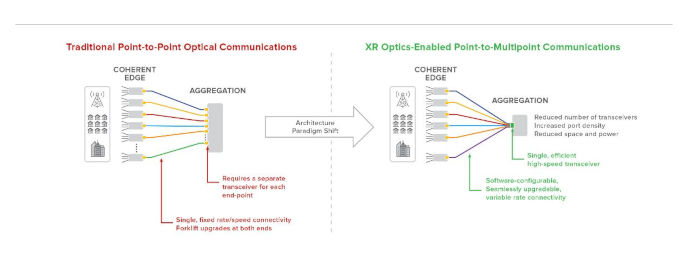
Powered by independently routable Nyquist subcarriers and coherent optical aggregation capabilities, the XR optical interface will enable network operators to design more efficient, flexible, and cost-effective transport networks optimized for the applications that drive network growth.
Historically, connections in optical transport networks have been implemented using point-to-point technology, which requires identical-speed matched transceivers at each end of the fiber link. These point-to-point solutions are extremely inefficient at handling hub-and-spoke traffic flows, which dominate traffic patterns in aggregation networks. The result is increased capital expenditures (CAPEX) and operating expenses (OPEX), driven by an extremely large number of transceivers, increased space and power requirements, and the removal and replacement of unnecessary physical access points as traffic demands grow. Furthermore, as networks scale, additional digital aggregation devices are required at intermediate locations to support upscaling to higher speeds. Operating costs and complexity are compounded as operators prepare for the significant increase in traffic demand from 5G, deep fiber, and new cloud-based business services and applications.
With coherent subcarrier aggregation (CSA) capabilities, XR optical technology allows a single high-speed transceiver to simultaneously send and receive independent data streams to and from numerous low-speed transceivers. By leveraging these capabilities, network operators can significantly reduce the number of transceivers in the network, eliminate the need for costly intermediate aggregation devices, and more efficiently optimize transport infrastructure for hub-and-spoke end-user traffic flows. The XR optical interface has been designed to integrate into a variety of form factors, including industry-standard sockets, ranging from low-speed interfaces with a single subcarrier to high-speed (400G+) interfaces with multiple subcarriers.