 Network capacity planning is an ongoing process that involves continuously evaluating network utilization, traffic volumes, and types to identify deficiencies, such as performance bottlenecks, that can impact end-user work. By failing to invest in capacity planning measures, organizations risk decreased employee productivity due to degraded network performance, unmet service-level agreements, and ultimately, a poor end-user experience.
 Capacity planning is essential for service availability. VIAVI's State of the Network 2021 study indicates that bandwidth demand continues to grow, having practically doubled compared to last year.
This could be due to unforeseen upgrade resources or traffic increases that have caused new bottlenecks. In fact, the report also reveals that over 80% will invest in 400 Gb networks by 2023.
The need for adequate visibility into bandwidth allocation is critical to ensuring that IT has a proper business justification for new upgrades or the deployment of higher-speed networks.
Let's examine a real-life example.
A tech-savvy end user at a financial institution contacts help desk to complain about insufficient bandwidth.
Does IT need to allocate more bandwidth to ensure this end user can perform their work? How can they verify and resolve this issue and ensure it doesn't recur?
One way to accurately diagnose the problem is with a network monitoring tool that visualizes bandwidth availability and easily identifies bottlenecks. Capacity planning graphs in Observer help with proactive planning and responding to capacity-related issues like the one in this example.
In this case, the financial institution's IT department can easily obtain utilization reports, organized by device or workstation related to the end user, and use them to determine whether the problem is isolated or widespread.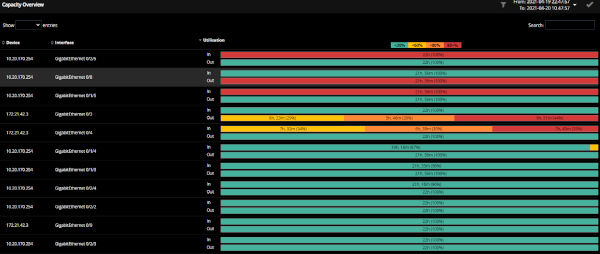 Capacity reports in Observer use sophisticated burst analysis, logging the time each link spends at utilization in each range, from >80% to 60-80%, 30-60%, and so on.
Identifying problems early on:
But how does the network team know that the link related to that end user is being used for critical business purposes and not just recreational traffic that creates bandwidth pressure?
With Observer, IT teams can leverage NetFlow data at that location to determine which applications are at the source of most of the capacity usage and whether it is indeed critical business traffic that requires a higher bandwidth load. It could be, for example, that the bandwidth issue is due to excessive traffic from Twitter, Facebook, or video.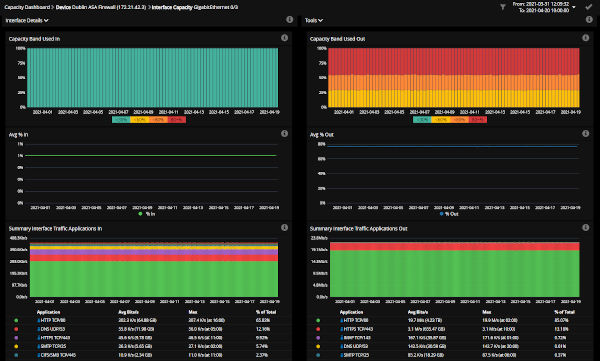 We've seen how Observer can be used to identify a capacity-related problem, but how can the organization be proactive in capacity planning to minimize or prevent this from happening again?
Using the color guide, the network engineer can quickly identify problems in Observer's capacity planning reports.
Intuitively, red indicates how many interfaces are in a congested state, for how long, and in urgent need of an upgrade. If the organization wants to get ahead of the problem, color is again its guide.
Orange alerts you to links approaching maximum utilization, between 60% and 80%. It then becomes important to monitor these links for continuous utilization improvement. The goal should be to avoid a red alert state, as this is when users and productivity suffer. With this color-coded approach, it's faster and easier to know what and where to monitor proactively and determine which locations need specific spending in the next budget period.
Proactive network capacity planning is important because it allows organizations to meet user demands within a constantly changing network infrastructure, ensuring smooth service delivery. Having a solution that enables continuous, visual assessment of utilization, volume distribution, and traffic types can shorten troubleshooting time, reduce the impact on users, and support more efficient spending.
Observer is an accurate and easy-to-use solution that meets all these requirements with actionable data. Whether the bandwidth problem was proactively identified through capacity planning dashboards or you're reacting to user complaints, these intuitive, visual workflows can act as a business case to approve additional bandwidth spending, return that location to a non-congested state, and keep end users productive.
For more information on key IT challenges, including capacity planning, read Top IT Challenges: Enterprise Network and Security Management. This article on network capacity was written by Aidan Lynch of VIAVI Solutions and translated by COFITEL, an authorized distributor of the company.