JA Purity IV
  • Start
  • Present
    • Agreements
    • Briefs
    • Companies
    • Appointments
    • News
    • Regulations
    • New Offices
    • Projects
    • Seminars
    • Technology
  • Novelty
    • Structured cabling
    • Cables
    • Connectors
      • Circular connectors
      • Power connectors
      • Industrial connectors
      • PCB Connectors
      • RF Connectors
    • Cable-Connector Assemblies
    • Ethernet
    • Industrial Ethernet
    • Industrial Tools
    • Tools
    • Interconnection
    • Microconnection
    • Industrial networks
    • Routers
    • Switches
  • Optical fiber
    • Couplers and Splitters
    • Fiber optic cables
    • Distribution boxes
    • Fiber optic connectors
    • Media converters
    • Fiber optic course
      • Measurement and certification techniques
    • Laser diode
    • FTTH and FTTx networks
    • Fiber Optic Tools
    • Instruments for Fiber Optics
      • Optical Network Certifiers
      • Optical Loss Testers
      • Fiber Optic Cutters
      • Optical Signal Detectors
      • Fiber Optic Fusion Splicers
      • Optical Network Fault Locators
      • Optical Power Meters
      • OTDR
    • whiplashes
    • Optical Networks
    • Fiber optic switch
    • Optical transceivers
    • Optical fiber formation channel
      • Fiber Optic Fusion Training Videos
      • Fiber Optic Connector Training Videos
      • Fiber Optic Testing and Measurement Training Videos
  • Envelopes
    • Rack Cabinets
    • Frames and Chassis
    • Mounting boxes
    • Technical Furniture
    • Parts
    • Racks
    • Air conditioning systems
  • Technology
    • Storage
    • Security Software
    • Product Catalogs
    • Data Centers
    • Components
    • Photonics
    • Computing
    • Instrumentation
    • Investigation
    • Various products
    • Security
    • Video - IP
  • Wireless
    • Smart City
    • Antennas and links
    • RF Components
    • RF Connection
    • EMC/EMI
    • RF test and measurement equipment
      • Analyzers
      • Amplifiers
      • Testers
      • Generators
      • For LTE - WiMAX
      • Field Meters
      • Multimeters
      • Oscilloscopes
      • Other RF Equipment
      • Measurement Software
    • GSM/GPRS/UMTS/GPS
    • M2M
    • Other Products
    • Wireless Networks
    • RFID
  • Contact
  • Language
  1. It's here:  
  2. Start
  3. Optical fiber
  4. Optical Networks
  5. What is Open RAN?

What is Open RAN?

Gloria Touchard Corporate Technical Director NokiaThe introduction of Open RAN is the final piece of the disaggregation puzzle that enables mobile network operators to use equipment from multiple vendors while still ensuring interoperability.
 
How networks work
To understand Open RAN, it is helpful to first acquire a general level of understanding of how networks work and how they have evolved through several generations.
The mobile, or cellular/wireless, network comprises two domains: the Radio Access Network (RAN) and the Core Network. 
The RAN is the final link between the network and the phone. It's the visible component and includes the antennas we see on towers, buildings, or stadiums, as well as the base stations. When we make a call or connect to a remote server, for example, to watch a YouTube video, the antenna transmits and receives signals to and from our phones or other handheld devices. The signal is then digitized at the RAN base station and connected to the network.
The core network has many functions. It provides access controls to ensure users are authenticated for the services they are using, routes calls to the public fixed telephone network, allows operators to charge for calls and data usage, and connects users to the rest of the world via the internet. It also controls the network by enabling handovers as a user moves from the coverage provided by one RAN tower to the next.
 
Evolution of networks
Cellular networks have evolved rapidly since they were first digitized to create 2G, and each new generation has witnessed a qualitative change in technical complexity.
While it has always been possible for operators to have one vendor for their core network and a different vendor for the RAN, interoperability between equipment from different RAN vendors was prioritized over general functional capabilities. As a result, with current solutions, it is difficult to mix vendors for the radio and baseband units, and in most cases, they are supplied by the same vendor.
Open RAN intends to change this situation and enable operators to mix and match components.
 
Opening of the RAN
As equipment manufacturers improved their capabilities, the industry consolidated around those offering the strongest solutions, often with proprietary features. But now, operators want a more diverse vendor ecosystem and are redefining their network architecture requirements, especially for the RAN. 
In an Open RAN environment, the RAN is broken down into three main blocks:
• the Radio Unit (RU)
• the Distributed Unit (DU)
• the Centralized Unit (CU)
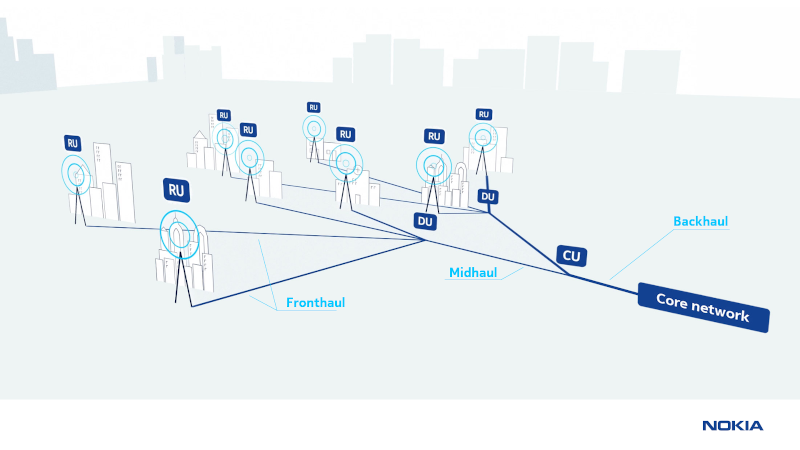
The RU is where radio frequency signals are transmitted, received, amplified, and digitized. The RU is located near or integrated with the antenna. The DU and CU are the parts of the base station where computing takes place, and they send the digitized radio signal to the network. The DU is physically located in or near the RU, while the CU may be located closer to the network core.
The key concept of Open RAN is the "opening" of protocols and interfaces between the various components (radios, hardware, and software) of the RAN. The O-RAN Alliance has defined 11 different interfaces within the RAN, including those responsible for:
• 'Fronthaul' between the Radio Unit and the Distributed Unit
• 'Midhaul' between the Distributed Unit and the Centralized Unit
• 'Backhaul' that connects the RAN to the network core
 
open-RAN-architecture-simplified-1920x1080-wAnother feature of Open RAN is the RAN Intelligent Controller (RIC) which adds programmability to the RAN.
Advantages of Open RAN
An open environment expands the ecosystem, and with more providers offering the various blocks, there is more innovation and more options for operators. They can also add new services. For example, Artificial Intelligence can be introduced through the RIC to optimize the network near a football stadium on match day.
 
vRAN (Virtualized Radio Access Network) and Cloud RAN
While RAN virtualization is not the same as Open RAN, it can be implemented alongside it and makes the RAN much more flexible. What was previously done with hardware can now be done with software, lowering barriers to market. The DU and CU are, in effect, computers running software. Instead of using custom hardware, they can now be virtualized and run on any cloud server, as long as it's close to the base station to reduce latency. Nokia calls this Cloud RAN, and its software is the same as that running on the custom hardware to ensure feature parity and facilitate version maintenance. 
 
Nokia and Open RAN
Nokia is a strong supporter of Open RAN and was the largest telecommunications equipment provider to join the O-RAN ALLIANCE and the Open RAN Policy Coalition.
 
Nokia believes that openness is the only way forward. Open communities are what facilitate innovation and co-creation. Open source allows us to share and reuse innovation and focus our efforts on what matters most. We need open interfaces and collaboration to simplify network operation, enable analytics, and allow us to introduce new services more quickly.
Resources:
Nokia's RAN products include:
• AirFrame open-edge server
• 'Fronthaul' AirFrame Portal
• AirScale active antennas
• AirScale Base Station
• AirScale Indoor Radio System
 
Key terms
• Radio Access Network (RAN) The final link between the network and the telephone. It contains the Radio Unit (RU), the Distributed Unit (DU), and the Centralized Unit (CU).
• Central network or network core. Controls the network.
• Open RAN is a disaggregated RAN functionality built using open interface specifications between its components. It can be implemented on hardware from any vendor and with software-defined technology using open interfaces and standards developed by the community. These open interfaces include Fronthaul and Midhaul, which connect the different parts of the RAN, and Backhaul, which connects the RAN to the network core.
 
• O-RAN. O-RAN refers to the O-RAN Alliance or its designated specifications. The O-RAN Alliance is a set of specifications that defines next-generation RAN infrastructures, empowered by principles of intelligence and openness. It is a global community of approximately 200 mobile operators, vendors, and research and academic institutions operating in the Radio Access Network (RAN) sector. Its mission is to reshape the sector by providing smarter, virtualized network elements, white-label hardware, and open, standardized interfaces. The term O-RAN refers to the interfaces and architectural elements as defined by the O-RAN Alliance specifications.
• The Open RAN Policy Coalition represents a group of companies formed to promote policies that advance the adoption of open and interoperable solutions in the Radio Access Network (RAN).
• The RAN Intelligence Controller (RIC) is a new network element that enables the introduction of new services into the Radio Network, such as software that optimizes network performance. The RIC works by exposing an API (Application Programming Interface) that allows different programs to communicate with each other.
• Cloud RAN, or vRAN, refers to a RAN implementation in a more open and flexible architecture that virtualizes network functions on software platforms based on general-purpose processors. vRAN, using open interfaces, is a component of Open RAN.
 
Technology explanation, by Nokia
This new series of benchmark reports is designed to educate journalists and other commentators on the technology that connects the world. Only Nokia offers a comprehensive portfolio of network equipment, software, services, and licensing options worldwide. Driven by our commitment to innovation, powered by the award-winning Nokia Bell Labs, we are leaders in the development and deployment of 5G networks. 
 
Author: Gloria Touchard, Corporate Technical Director of Nokia
Previous Article: Proactive Network Capacity Planning for Optimal Service Utilization Next Article : Viavi's 800G FLEX XPM Module

Unlabeled

  • Connectivity with plastic fiber and 60 GHz Wi-Fi

    Telefónica has presented a pioneering innovation project in Spain based on plastic optical fiber (POF), a home connectivity solution that is easy to install and guarantees speeds of up to 1Gbps for customers.

  • Infinera and Telstra validate the Advanced Coherent Toolkit on the 9,000 km Endeavour transoceanic cable in the Pacific

    Infinera, a leading global provider of smart transport and telecom networks, and technology company Telstra, today announced the successful validation of Infinera's Advanced Coherent Toolkit (ACT) for super-channels.

  • Why do PON technologies guarantee advantages and high performance in POL networks?

    The aim of this article is to present the evolution of PON (Passive Optical Network) technologies based on ITU-T (International Telecommunications Union) recommendations, from their origin, highlighting their physical characteristics, distances, transmission rates, length of...

  • What is OM5?

    OM5, formerly known as wideband multimode fiber or WBMMF, has been a trending topic as the standards that have now been finalized were openly debated.
    More simply put, it is a version of OM4 fiber with additional bandwidth characteristics...

  • 100 Gigabit Ethernet

    Currently, there is a great deal of activity related to the development and standardization of future 100 Gigabit Ethernet products and devices. In this article, we will discuss some of these initiatives.

  • Proper placement of telecommunications conduits for future infrastructure expansion

    In times of truly rapid technological development, especially with the ever-increasing role of fiber optic internet, the correct and efficient design of telecommunications infrastructure becomes a crucial aspect of the overall infrastructure. It forms the basis for future...

Cofitel group

Newsletter

Subscribe to our newsletter:

Latest News

ACUTELAN files complaint against DIGI with the CNMC for predatory pricing

Thursday, April 23, 2026

On April 22, 2026, the ACUTELAN association submitted a formal application to the CNMC to...

Demonstration of free-space optical communication with PCSEL: a breakthrough from Vector Photonics

Friday, April 10, 2026

Vector Photonics, the Scottish start-up that is leading the way in the use of surface emission lasers with crystal...

AI for Good Global Summit 2026: Innovation and Leadership in Artificial Intelligence in Geneva

Wednesday, March 25, 2026

As governments accelerate their strategies on artificial intelligence, sovereign AI, and...

Iceland's Parliament modernizes its security with Genetec Security Center and IoT sensors

Wednesday, March 25, 2026

The Parliament of Iceland, Alpingi, one of the oldest democratic institutions in the world,...

Commvault strengthens data and AI security in Commvault Cloud with new governance and classification capabilities

Tuesday, March 24, 2026

Commvault has announced an expansion of its data security and AI capabilities within...

Social networks

Facebook Twitter Instagram LinkedIn YouTube

cover 267

Subscribe to CONECtrónica magazine

You can subscribe to the Conectrónica magazine in 2 formats.

Digital Format: 5 downloadable PDF editions at an annual cost of 60 Euros (VAT included)

Paper Format: 5 editions to be received by mail at an annual cost of 180 Euros (VAT included).

Contact our subscriptions department at subscriptions@conectronica.com

Payment via Bizum or bank transfer

Technical Courses and Seminars

D-Link launches the 29th season of free webinars on networks, 5G and cloud

D-Link has announced that the 29th season of its D-Link Webinars begins tomorrow. These sessions...

Taoglas launches The Antenna Podcast, a new technical space about antenna design and innovation

Antennas remain one of the most critical and, at the same time, most misunderstood elements in...

ISE 2026 Barcelona: Summits, Megatrends and the most ambitious content program in the AV sector

Returning to Barcelona in February 2026, Integrated Systems Europe (ISE) presents its program of...

E-book: the future of satellite communications

Mouser Electronics, Inc., in collaboration with Qorvo and other technology innovators...

European project “Engineers of the Future” with free online training for young people and teachers on cybersecurity, green energy and automation

The GAIA Cluster has participated in the European project "Engineers of the Future", co-financed by...

Optical Networks

Evolution of optical networks: ROADM, OpenROADM and OpenZR+ in the 400G and 800G era

The rapid increase in data traffic is driving the construction of new infrastructure worldwide...

Legrand launches Chroma Link, the fiber optic solution for high-density AI networks

Legrand has announced the launch of Chroma Link™, a fiber optic cabling solution with...

Hollow Core Fiber (HCF) Deployment and Testing

Hollow Core Fibers (HCF) represent a significant evolution...

Network infrastructure in the age of AI: why fiber optics is key beyond bandwidth

New requirements for network infrastructures: why, in the age of AI, fiber optics...

Nokia drives optical networks for the AI ​​era with new coherent solutions and multi-fiber amplifiers

Nokia has announced a suite of new optical network innovations designed to address...

Fiber optic network testing in hyperscale data centers: keys to ensuring performance and reliability

Hyperscale data centers represent the backbone of the digital infrastructure...

High-Speed ​​Network Demands: Architectures, Challenges and Technological Evolution in the Era of Exponential Traffic

The rapid growth of IP traffic, driven by applications such as 4K/8K video, computing...

Connectors. FTTH Magazine. Industrial Electronics. Fiber Optic Courses, Online Seminars, Technology News and Trade Shows, Industrial Fiber Optic Cables and Connectors, Company News, Oscilloscopes and Tools, Data Centers.

Conectrónica Magazine © of Telecommunications for Professionals. All rights reserved GM2 Technical Publications, SL.

Tel.: +34 91 706 56 69

Symphonic Poem, 27. Esc B. Floor 1 Pta 5

28054 (Madrid - SPAIN)

e-mail: gm2@gm2publicacionestecnicas.com or consultations@conectronica.com

Other GM2 publications include Convertronic Magazine and Gasogeno98 Channel

Privacy Policy

Legal Notice