
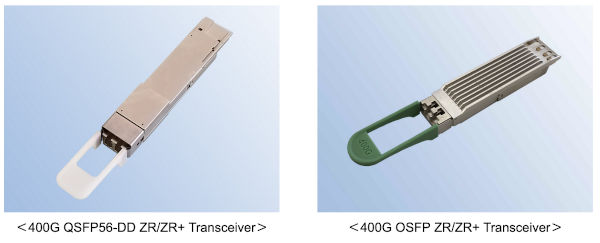
In recent years, internet content providers and cloud operators have built hyperscale data centers by seamlessly interconnecting multiple data centers across large metropolitan areas. This has led to a growing demand for coherent pluggable WDM transceivers, which are widely used today in data center interconnection (DCI) platforms and installed directly in routers and switches. These transceivers are capable of transmitting WDM in QSFP56-DD and OSFP form factors that are as compact as the popular 100GE QSFP28 transceiver. To meet these demands, the OIF, a standards organization, has specified the OIF 400ZR Implementation Agreement (*1), which only supports DCI edge applications up to 120 km.
The 400G ZR transceiver ensures interoperability with transceivers from other manufacturers through the use of CFEC, which complies with the OIF 400ZR Implementation Agreement. Error-free transmission of data traffic has been demonstrated using the FOC 400G ZR transceiver on data center-optimized equipment such as Arista's 7060/7280R3 400GE switches, and multi-vendor 400G ZR interoperability testing is currently underway.
Open ZR
The OpenZR+ MSA (*2), a combination of 400ZR and OpenROADM (*3) elements, is now underway to support hyperscale DCI links exceeding 120 km while maintaining the same QSFP56-DD/OSFP form factors as the 400ZR.
The OpenROADM MSA is advancing with standardization focused on carrier applications and specifications for flexible, coherent, pluggable transceivers that support additional specifications not found in the 400ZR, such as high optical output power, multi-tariff, multiplexing functionality, and additional protocols like OTN.
The OpenZR+ MSA aims to extend transmission distances by leveraging the enhanced Open Forward Error Correction (OFEC) performance of the OpenROADM standard, supporting multi-tariff Ethernet, and enabling users to select the optimal transmission distance and capacity for their needs by supporting adjustable 100G, 200G, 300G, and 400G line-side transport links. Furthermore, the OpenROADM MSA is advancing standardization focused on carrier applications and specifications for flexible, coherent, pluggable transceivers that support additional features not found in 400ZR, such as high optical output power, multi-tariff functionality, multiplexing capabilities, and additional protocols like OTN.
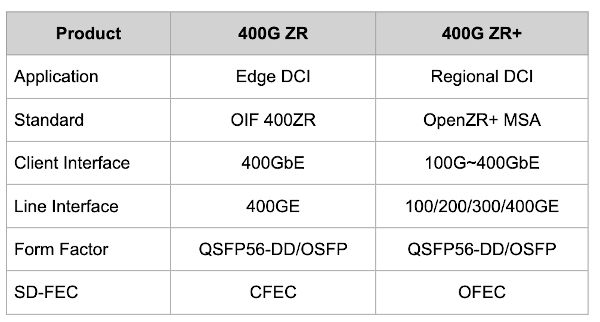 The 400G ZR+ transceiver is available in the same compact QSFP56-DD and OSFP form factors as the 400ZR. Furthermore, the use of OFEC, which offers higher performance than the CFEC used in the 400ZR, enables greater transmission range and ensures the desired interoperability. NTT Electronics and Acacia Communications have successfully completed module-level interoperability testing between DSPs in 400ZR and OpenZR+ operating modes, using modules supplied by FOC and Acacia.(*4)
The line interface is configurable from 100GE to 400GE, enabling a wide range of transmission distances. The client interface supports 100GE to 400GE for 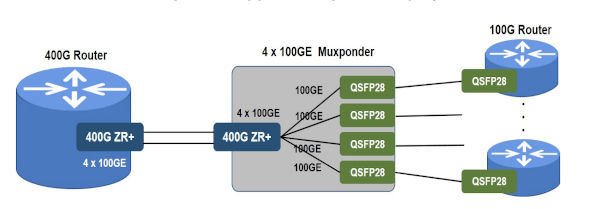 efficient multiplexing, as shown below in a 4x100G to 400G multiplexer application.
FOC's 400G pluggable coherent transceivers utilize a next-generation coherent platform based on a 7nm CMOS coherent DSP (Digital Signal Processor), integrated silicon photonics optical devices, and high-density packaging technology. This enables a compact size, low power consumption, and low cost per bit rate.
(*1)https://www.oiforum.com/wp-content/uploads/OIF-400ZR-01.0_reduced2.pdf
(*2)http://openzrplus.org/
(*3)http://openroadm.org/
(*4)https://www.ntt-electronics.com/en/news/2020/10/successful-interoperability-testing-of-400ZR-OpenZR.html



